Chapter 5 of 6 · 1902 - 1920s
Ashbee and the Guild of Handicraft
An idealist brings a hundred and fifty craftspeople out of the East End of London to make beautiful things in a Cotswold valley - and the workshop never quite stops.
HS-0005
In 1902 Chipping Campden became, for a few extraordinary years, the centre of the English Arts and Crafts movement. C. R. Ashbee - architect, designer, and a follower of John Ruskin and William Morris - moved his Guild of Handicraft out of the East End of London and into the town, bringing some hundred and fifty craftsmen and their families with him. They set up in the old Silk Mill on Sheep Street: silversmiths, jewellers, cabinet-makers, blacksmiths and printers, making by hand in the country what the age was learning to make by machine in the city.
It was a utopian experiment - good work and good lives, beauty made by hand and within reach - and as a business it failed. The Guild struggled and was wound up in 1908. But it left behind the thing a factory cannot: people who knew how to make. Many of the craftsmen stayed on in Campden, and their skills stayed with them.
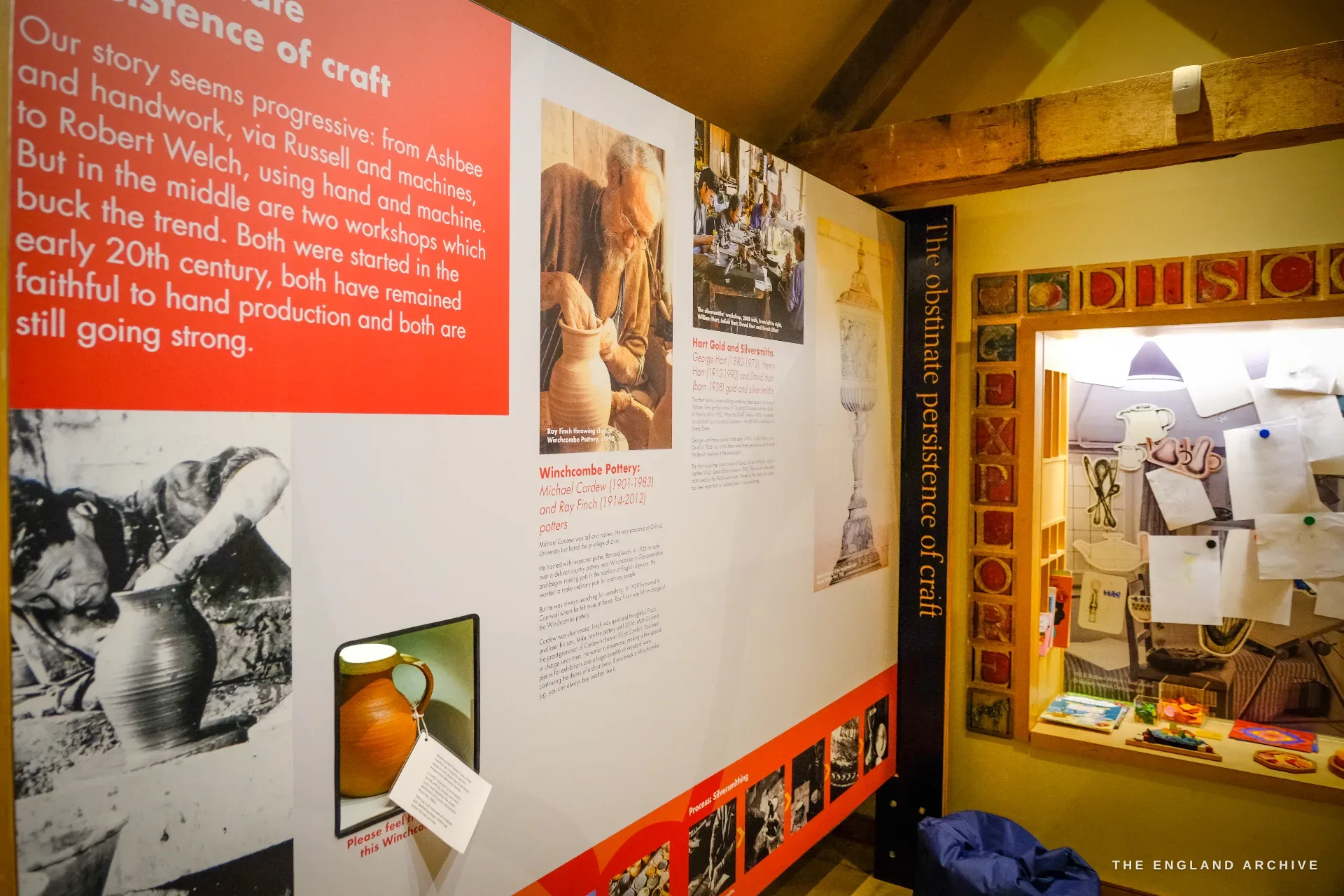
One of them was the silversmith George Hart, who simply kept working. More than a century later, Hart Silversmiths is still at the bench in the same Silk Mill - four generations on, with David Hart and his son William still making by hand. It is the last continuously working workshop of Ashbee's Guild, and one of the reasons this archive began documenting the town. The designer-silversmith Robert Welch later took a studio in the same Mill, carrying the line on into modern design.

The Guild made Campden famous a second time. Where its first fame had come from wool, this came from craft - from the fact that here, unusually, things were still being made by hand. That reputation, and the makers who keep it going, are why the town has a craft museum, a working silversmithing tradition, and a place at the centre of this archive.
Key dates
- 1902Ashbee moves the Guild of Handicraft to the Old Silk Mill
- 1908The Guild is wound up; the craftsmen stay
- from 1908George Hart carries the craft on - Hart Silversmiths today
Compiled with the Chipping Campden History Society and from the published record. Corrections welcome - this is a living reference.