Method
How the archive is actually made - the editorial decisions, the camera choices, the pace, the voice, the working contracts with subjects. Revised as the practice grows.
This page is not a manifesto. It is a working record of how The England Archive is actually being made today - the choices the photographer is making at the level of camera, frame, sequence, sentence, and contract with the subject. The practice will change. The page changes with it. Each section below is a discrete editorial decision; each one is open to revision when next year’s experience says it should be.
Below the practice itself, the page closes with a short list of what is currently changing and what the photographer has not yet learned how to do. That list will be different in six months, which is the point.
The question the archive is trying to answer
Every editorial decision below flows from a single question: who, today, is keeping England alive? Not what does England look like - that question has been answered, repeatedly, by photographers far more accomplished than I am. Not what was England - that is the work of historians and museum curators, and they hold it well. The archive’s question is who is doing the work of carrying it forward, right now, on a Tuesday in March, and what does that work actually consist of when nobody is watching.
Three consequences follow from holding that question seriously.
The subject of the photograph is the person, not the place. The thatcher, not the thatch. The hedgelayer, not the hedge. The post mill, when it is photographed, is photographed because Richard Seago built it, not because it is a beautiful object in the landscape. The hedge would already exist without me; the hedgelayer might not exist for very much longer.
The work has a window. The people whose knowledge lives in their hands are leaving. Several Red List crafts have fewer than ten practitioners. The archive is not optimised for completeness in some abstract future; it is optimised for what can be documented while the person who carries it is still alive to document.
The pictures alone are not enough. A photograph of a thatcher is not the same as a record of what the thatcher knows. The archive’s pages carry photographs and prose together because the prose is where the knowledge lives that the photograph cannot reach.
The question is the compass. When a decision feels uncertain, the test I run is the same one every time: does this serve the answer to that question, or does it serve something else - my own taste, my own visibility, the medium’s vanity? If the latter, the decision is wrong, even when the result looks good.
The lineage
Documentary photography is a tradition before it is a technique. Every working photographer is in conversation, knowingly or not, with the photographers who came before. The archive is explicit about which conversation it is in.
Sir Benjamin Stone, the National Photographic Record (1897–1910) is the project’s nearest ancestor. Stone founded the NPR with the same conviction the archive starts from: that the customs and traditions of England were disappearing and would be lost without systematic documentation. Stone’s work survives in the Birmingham Library; his pictures are typological, frontal, and dispassionate. The archive borrows the conviction and the systematic register; it does not borrow the frontal aesthetic, which has been better answered by photographers since.
Walker Evans, Let Us Now Praise Famous Men (1941) is the precedent for putting people at the centre of a documentary record about a place. Evans’s photographs of the Burroughs, Tingle, and Fields families would be diminished if they did not exist alongside Agee’s prose; the prose would be diminished if the photographs were not there. The archive treats every page the same way: the photograph and the writing are the two halves of the entry, not redundant overlays of one another.
Bernd and Hilla Becher, the typological work (1959–2007) demonstrated something the archive borrows wholesale: that systematic, repeated documentation across many examples of the same subject category produces a record that no single virtuoso photograph can. The hedgelayers are the hedgelayers because there are several of them, photographed in the same register, on the same kind of day, with the same patience. The archive’s six subject categories are typological in this Becher sense.
Simon Roberts, We English (2009) and Merrie Albion (2017) is the most recent direct precedent for a long-form survey of contemporary English life conducted with the rigour the subject deserves. Roberts is an active advisor to the project. The archive does not duplicate his question (his is mostly what is English now); it asks the next one (who is keeping it alive). The two questions are companions, not competitors.
Homer Sykes, Once a Year (1977) and fifty years of customs documentation is the photographer who has spent the longest sustained career on the subject closest to one of the archive’s six categories: the Carriers. Sykes is a mentor to the project; the archive’s Carriers register is built on top of fifty years of his eyes already having looked. The Spring Equinox at Tower Hill is on the archive in part because Sykes pointed at it.
Other influences shape the archive in narrower places. Don McCullin’s late landscape work in Somerset informs the archive’s late-afternoon light. John Davies’s elevated black-and-white English landscapes shape the area-hub frames. Fay Godwin’s land-and-people register sits behind the Long Melford walk. The archive is not a remix of any one of these. It is what falls out of taking all of them seriously at once and running them through the question above.
Monochrome by default, colour earned
The archive’s photographic grammar is black and white. A frame runs in colour only when its meaning cannot survive in monochrome. This is an editorial rule, not a reader preference. There is no toggle.
The reasoning is short. A documentary photographer’s voice is partly what they choose. Committing to B&W as the archive’s grammar - with colour reserved for the small set of frames whose subject is their colour - is the artistic act. Nobody else has that specific rule. A reader-facing toggle would abdicate the decision and muddy the visual identity of the archive.
The frames that earn colour are narrowly defined. Painted signs - pub signs, hand-lettered shop fronts, ghost signs whose surviving paint is the subject. Stained glass - the meaning of the photograph is coloured light. Painted objects whose colour is their identity - a cigar-store figure, ceremonial regalia where colour signals the order, a period poster, heraldic paintwork on a wagon. Seasonal or ecological frames where colour is the point - a single autumn frame in an autumn walk, a wildflower meadow at peak; rarely, with discipline.
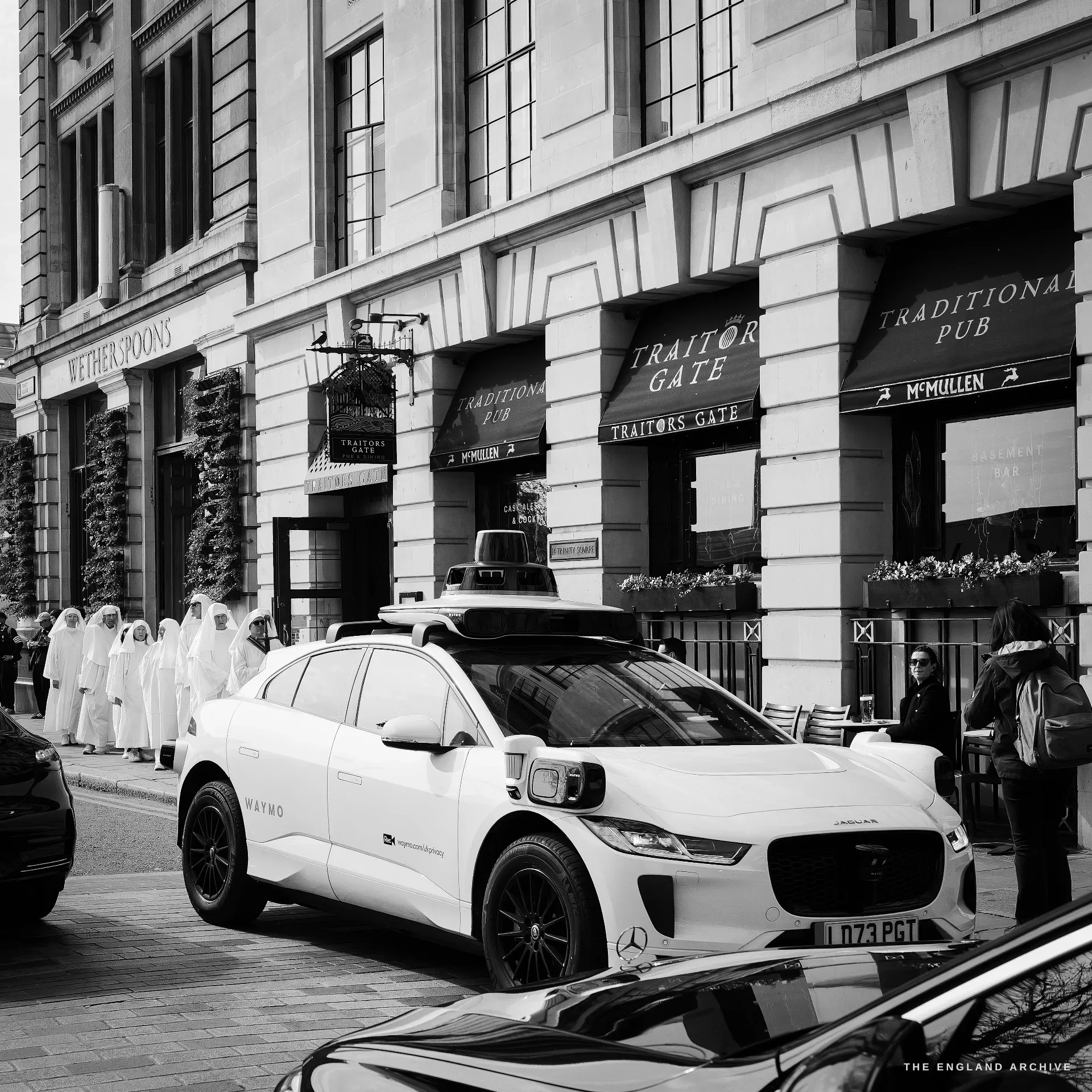
Everything else runs monochrome. Every portrait. Every landscape. Every interior. Every architectural detail. The Druid Order’s spring equinox at Tower Hill is fifty-five frames of white robes through the City of London; nothing in that set demanded colour, and the published location ships zero colour. Long Melford runs about thirteen percent colour because it is a wool village with painted shop fronts and Norman stained glass. The Yorkshire Dales walk will likely run zero.
The Bronica SQ-A frames, when they appear, run on Ilford HP5+. The Leica Q3 and Fujifilm X-S20 frames are converted to monochrome at the editorial pass; the colour file is preserved off-repo as cold storage so the conversion can be revisited if the rule’s application ever needs to change. The point is that the rule is held, not that the archive cannot reconsider its applications.
One frame is not enough; one visit is not enough
The archive does not photograph subjects on first acquaintance unless the subject is a one-off public event. Every craft subject - the millwright, the thatcher, the cider orchardist, the hedgelayer - gets at least two visits before the page is published, often more. The first visit is a conversation; the second visit is when the camera does most of its real work. The third visit, when there is one, is what produces the formal portrait.
This is editorial discipline, not technical preference. A first visit is the photographer’s introduction to the subject and the subject’s introduction to the photographer. People do not show up fully on a first encounter, and the photographer is not yet seeing them well enough to make the frame that lasts. The portraits I am happiest with are the ones I made after I had stopped trying to impress the subject and they had stopped trying to look photographable. That is rarely a Tuesday-afternoon outcome.
Quantity follows the same logic. A maker’s page will typically carry between twenty and forty published frames; the originals folder behind it will have hundreds. A location like Long Melford carries seventy-one published frames out of a much larger initial set. The published count is not the catalogue; it is the edit. Unpublished frames stay on disk for the next editorial pass - or for the photographer in two years to look at and find what was actually there that they could not yet see.
One direct consequence: pages on the archive carry a "first encounter" note when the documentation is incomplete. Richard Seago’s page is explicit about this; the page exists because the visit happened, but it acknowledges that the formal portrait, the longer recorded conversation, and the missing chapters are coming on a return visit. Readers seeing such a page are seeing the archive working in honest time, not the archive pretending to be finished.
The exception is event documentation: the Druid Order spring equinox at Tower Hill, the Magdalen May Morning, the Lewes Bonfire Night, the Abbots Bromley Horn Dance. These are date-locked. The photographer arrives on the day, photographs the event in real time, and the page is the record of that day. The follow-up is the next year’s visit, not a second pass on this year’s.
The conversation comes before the camera
The single discipline that has changed the archive most over the first year is this: listen more than photograph. Walk in without a shot list. Put the camera in the bag. Ask the questions a curious twelve-year-old would ask. Let the subject explain the work they have spent forty years doing, in the order they want to explain it. Take notes. Do not interrupt. Do not look at the light meter while they are speaking.
The camera comes out when the conversation has slowed into work. By then the subject has stopped performing for a stranger and has returned to whatever they would be doing if I were not there. The hedgelayer is laying a hedge. The millwright is checking the gearing. The hurdle-maker is cleaving hazel. The frame I want is the one where they are not aware of the camera, because they are aware of the work, and the camera has been part of the room long enough to disappear.
Richard Seago is the page that taught me this. His Gatherers entry on this archive includes the line I took photographs but not enough. I was too absorbed in listening. That sentence is not an apology; it is the discovery. The eleven photographs from that first visit are stronger than the sixty I might have shot if I had been counting frames instead of paying attention. The visit that produced eleven frames also produced an entire new subject category for the archive. That trade was correct.
Three working consequences:
Notebook before camera. Every visit starts with a small black Field Notes notebook out, the camera out of sight. The subject sees the notebook first, and the notebook signals that the photographer is interested in the work, not the picture. The notebook is also where the captions for the photographs eventually come from; the language is theirs, written down by me at the time, returned to them later in print.
One question per visit you do not ask. There is always one question I want to ask but that the visit has not yet earned. That question goes in the notebook and waits for the second visit. Asking it too early collapses the conversation into an interview; saving it for a return reads as continued interest, which is what the relationship actually needs.
Tea before the workshop. Almost every visit begins with a cup of tea in the kitchen or the office, not in the workshop. That is not a politeness ritual; it is the moment the subject decides whether they trust me. The workshop only opens when the kitchen has done its work.
Two cameras, one method
The archive’s working kit is small and stable. Two digital cameras for documentary frames; one medium-format film camera for formal portraits. Each has a defined role; the choice between them is editorial, not opportunistic.
Leica Q3 (28 mm fixed, full frame digital). The primary camera. Eighty-five percent of the documentary frames on the archive come through the Q3. The 28 mm focal length is the discipline: it forces me close to the subject. There is no zoom. To frame tighter, I walk in. To frame wider, I step back. The camera does not let me solve a composition by twisting a ring; it makes me solve it with my feet. The Q3 also has a 1:1 square crop mode that I use deliberately for portraits and for any frame whose composition is fundamentally radial - this is the source of the square diptychs across the archive.
Fujifilm X-S20 (with 16–55 mm zoom, APS-C). The second camera. Carried for the frames the Q3’s fixed lens cannot reach - environmental wides where stepping back is not possible (Tower Hill from across the road), and tighter portraits where the only access is a longer reach. About fifteen percent of frames on the archive. The X-S20 also covers the Q3 if it fails in the field, which is the other reason it is in the bag.
Bronica SQ-A (waist-level finder, 80 mm normal lens, 6×6 medium format). The portrait camera. Loaded with Ilford HP5+ at box speed for B&W or Kodak Portra 400 for the rare colour portrait. Used only for the formal portrait sitting on a third visit, after the conversation has earned the right to ask the subject to sit. The waist-level finder forces me to look down into the camera while I speak with the subject; their face stays at eye level while I am framing. The shutter is loud and slow. Each roll is twelve frames. The constraint produces a different kind of portrait than the Q3 produces.
The cameras are kept simple on purpose. There is no second body of either digital. There is no fast prime collection. The film stock is two emulsions, both archival staples. The intent is to remove every variable that does not add to the work, so the only remaining variable is the photographer.
Field tools accompany the cameras in a small bag. A Sekonic L-308X handheld light meter, used with the Bronica. A small notebook (Field Notes) and pen. A second notebook for transcribed quotes. A spare battery for each camera. One memory card per camera; cards are downloaded the same evening, never overwritten in the field. The Zone exposure calculator is on the phone for the rare frame where I need to think carefully about a contrasty scene.
The white print-matte
Photographs on the archive are never edge-to-edge digital. Every full-bleed photograph on a journal entry, an event page, or a long-form essay carries a pure white margin around it - twenty-four pixels of white, then a soft drop-shadow underneath, then the page background. The visual register is a mounted print on a clean wall, not an image floating against the screen.
This decision is small in implementation and large in feel. The pure-white border (#ffffff, not the page’s cream) reads in a browser the way the matte board reads in a gallery: it gives the photograph room. The drop-shadow is two layered offsets at low opacity, one tight and one diffuse, so the print appears to sit a millimetre proud of the page. The shadow is a copy of the print-on-mount-board shadow that any decent darkroom hangs its work in.
Three reasons it stays.
It signals editorial seriousness on first contact. A reader landing on an archive page sees, before they read a word, that the photographs have been treated as objects. Not stock. Not feed. Not infinitely-scrolling. Framed.
It separates the archive from the medium it lives on. The web’s default is edge-to-edge. Choosing a margin is the small editorial act that says: this is a working print on a page, not a digital asset bled to the viewport. The visual signal is small per frame and substantial across an archive.
It pre-paces the print product. Every photograph on the archive will eventually be available as a fine-art print. The on-page treatment is a previsualisation of how the print will hang on a wall. The reader who buys a print is not surprised by what arrives; the matte and shadow they have been seeing on the page are what the actual mounted print delivers.
Diptychs are deliberately exempt. A pair of square frames placed in a 2×1 grid reads as a balanced unit, not as two separate prints. The diptych container goes full-bleed; the inner figures do not get the per-image matte. Triptychs are banned entirely (see How the archive is organised for the reasoning).
A permanent name for every photograph
Every published photograph on this archive has a permanent identifier of the form IM-NNNN. The identifier is assigned once, at the editorial pass that adds the photograph to a manifest, and it is never reused. The slug of the page may change, the title may be revised, the frame may be re-cropped at a future editorial pass - the IM number is the stable handle that survives all of those revisions and any institutional handoff that comes later.
The same logic applies to every other surface on the archive. Subjects carry MK / KP / CR / RM / ST / GT prefixes by category. Essays carry ES. Journal entries carry JN. Field Diary entries carry FD. Areas carry AR. Regions carry RG. Sources carry SR. The full grammar lives at How the archive is organised; the editorial-philosophical case for it lives at On being cited.
The reason this matters for the photographer reading this page: it changes how the archive treats individual photographs. A photograph with a permanent ID is a citable record. Five years from now, when a scholar publishing on English heritage crafts wants to cite the specific frame of the Yarmouth Mercury clipping pinned beside Richard Seago’s Queen of the Broads steam engine, they cite it as the Yarmouth Mercury clipping (IM-0326). The URL resolves to the canonical page where the photograph lives. The citation works in print, in a footnote, in a museum exhibition label, on a Wikipedia citation, and in fifty years.
This is not a feature of the technology stack. It is a working decision about what kind of artefact the archive wants its photographs to be. The default register of digital photography is the feed: photographs are surface-level content, named by URL, lost when the platform pivots. The archive’s register is closer to a museum collection: each frame is a numbered object with a permanent name, joined to a record. That treatment has consequences for the photographer too - making each frame as if it might one day be cited individually is a different practice from making frames for a feed.
Returning prints to subjects
Every subject documented by the archive receives at least one fine-art print of a photograph from their visit, signed and editioned, mounted and posted to them. This is the contract: their time and their trust earn a tangible object back. The print is not transactional - the subject does not owe anything in return - but it is the working understanding that holds the relationship.
The mechanics. Once a subject’s page is published, I select one photograph that I believe will mean the most to them - not necessarily the strongest editorial frame, but the one they will want hanging in their kitchen. The print runs on Hahnemühle Photo Rag at 8×10 or 11×14 inches depending on the orientation, mounted on white archival board to mirror the on-page treatment, signed and editioned in pencil at the foot. A short note accompanies it that says, in plain language, what I am grateful for and where their page lives on the archive.
Three reasons it matters.
It is the right thing to do. A documentary photographer has been admitted to a workshop, a kitchen, a workspace. The photograph belongs to the photographer; the print returned to the subject is the small permanent acknowledgement that the work was made together.
It changes the bar of every frame. Knowing that one of these frames will hang in this person’s home for the rest of their life is a quiet but persistent editorial discipline. The frame I send back is not the most flattering in the conventional sense; it is the truest. The subject can tell the difference and the print returned has to honour that.
It compounds. A subject who has a print of themselves on their wall, mounted properly, signed by the photographer who came back twice and listened more than they shot - that subject is the archive’s most important advocate within their own community. The next maker on the same Norfolk fen takes the call because they have already seen the print on their friend’s kitchen wall and know what kind of project this is.
The 1:1 print-per-subject ratio is held as a Year One target on the homepage. It is a delivery promise, not a cost. The archive’s budget for prints is calculated on the same line as travel and film stock: it is part of the work, not optional.
Writing alongside the photographs
Every page on the archive that carries photographs also carries prose written by me, by hand, in long form. The prose is not a caption pass; it is a record of what was seen, said, and learned, written so that the photograph and the writing make sense of each other. Walker Evans had Agee. The archive is small enough that the photographer is also the writer; that is a decision, not an accident.
The discipline that produces it is short.
Notes are taken at the time, not after. A small black notebook stays open. Specific phrases the subject uses are recorded verbatim - thirty years of one man’s hands, the floor went out from under me, I had never seen one outside of a photograph. Those exact phrases are what end up in the published prose. Reconstructing the language a week later loses the cadence and the specificity that make the writing land.
The first draft is written within forty-eight hours. The visit is alive in the photographer’s memory for about two days. After that the specifics blur and what survives becomes a generic version of the day. A draft written within forty-eight hours preserves the texture; later editorial passes refine it without losing what was actually there.
The voice is plain and specific. No marketing prose, no heritage cliché, no nostalgia. The brief is the same one Orwell laid out in Politics and the English Language: never use a long word where a short one will do; if it is possible to cut a word out, always cut it out. The archive’s prose is checked against that standard at the editorial pass.
The prose follows the photographs, not the other way around. When new photographs land for an existing page, the prose is rewritten so the reader reaches each beat at the moment the relevant photograph appears. A maker’s plate noticed only on review of the final frames earns its own paragraph; a beat whose photograph was cut shrinks or disappears. The page’s prose is shaped by what was actually photographed, every time.
One additional commitment that follows from being the writer as well as the photographer: every subject sees a draft of their page before it goes live. They are asked, in plain language, whether anything is wrong, whether anything they would rather not be on the public record has slipped in, and whether the language sounds like them. Their answer governs publication.
Editorial independence and sponsor relations
The archive is funded by individual sponsors of single shoots, by Archive Circle members who give annually, by major patrons who underwrite a region or a category for a year, and by institutional sponsors who put their name to a named pillar or programme. The funding model is meant to be visible: the page that documents the work names the supporter who made it possible, and that name lives there in perpetuity.
The principle that holds the funding model up is short. Sponsors fund the work, they do not direct it. Every sponsorship contract carries that line. Editorial decisions - which subjects the archive documents, which photographs make the published edit, what the prose says about the work - are the photographer’s alone. A sponsor cannot ask for a frame to be re-cropped, a paragraph rewritten, or a page reordered to feature them more prominently. The photographs are made for the subject and the reader; the credit line says who paid for the day to happen.
What a sponsor receives is recognition, not influence. The credit line on the page their gift made possible. A listing on the supporters page. For the larger gifts, a named pillar or programme association that becomes part of the archive’s permanent record. For the largest gifts, a dedicated profile and an editorial conversation each year about which crafts the project should prioritise next. None of those translate into editorial vetoes or copy approvals.
Three small additional commitments. First, the supporters page is alphabetical, never ranked by amount: a £100 Reader and a £25,000 Founding Patron sit side by side under the same header. Second, sponsors do not appear in the documentary photographs themselves - the camera is for the subjects, not for the people who funded the visit. Third, if a sponsor is no longer comfortable with a published page, their credit can be retired in full at any time and refunded pro-rata against the remaining recognition period; the photographs and the prose stay, the credit goes.
The architecture exists because the editorial integrity of the archive is the asset. A documented record of an English craft is only worth keeping if the reader trusts it; the reader trusts it because the same person who made the photographs wrote the words about them, and because no sponsor sits behind that decision. Preserving that is the project’s most important non-negotiable.
The wider structural picture - the Board of Directors that carries fiduciary responsibility, the Founding Members who anchor the institutional memory of the first chapter, the Editorial Advisory Board that carries cultural credibility, the Contributors who make the work alongside the founder - is set out on the about page. The editorial independence described above is the principle that holds across all five layers.
What is currently changing
Below is a working list of the practice changes the photographer is in the middle of. The list is updated whenever a section above is revised. None of these are settled answers; they are the open questions a practice has at any given moment, and the page is honest about them.
The Bench. A reader-contributed register opened in May 2026, separate from the curated archive, where working craftspeople, apprentices, and students can submit their own process photographs under their own name and copyright. The editorial decisions about what makes a strong contribution, what an editor’s note should and should not say, and how the lighter visual register should sit alongside the curated record are all in active first-pass evaluation.
How it’s Made. A new register of numbered photographic sequences documenting how each craft object comes into being - the lineage of Diderot’s plates and the Foxfire books, applied to contemporary English crafts. The first entry is letter-cutting in stone with the Cardozo Kindersley Workshop; subsequent entries will work out the ratio of process photographs to portraits, captions to working diagrams, and the right cadence of release.
Field Associates. A small invited group of UK documentary photography students taking subjects the archive cannot reach in Year One. The first cohort has been opened; the editorial commitments to how their work integrates with the archive’s curated register, what their named credit looks like, and how the relationship is closed at the end of the project are still being drafted.
The book. The book is the natural endpoint of Year Three and the photographer is starting the structural thinking for it now. The shape, the editor, the publisher, and the relationship to the archive’s on-site record are the four open questions. Several precedents (We English, Once a Year, Let Us Now Praise Famous Men) sit on the desk while the structure works itself out.
EXIF and metadata at print time. The on-page EXIF question is closed: technical data does not appear in captions, by editorial decision (the archive’s caption voice would be diluted). But the print-product question is open: the print returned to the subject, and the print sold to a collector, may benefit from a small printed colophon strip on the reverse with date, location, and frame ID. The right balance has not been worked out yet.
Workshops and photo walks. The Method page you are reading is the foundation for these. The first event is being planned for late Year Two: a small-group documentary walk in a single English village, tied to the archive’s working principles, capped at six attendees, with one print at the end. Whether this becomes a regular offering or remains a one-off depends on what the first walk teaches.
Closing
The version of this page you are reading is one year into the work. Most of the decisions above have been arrived at by doing them wrong first - photographing too much, listening too little, sending the camera in before the conversation had earned it, posting frames online without the white margin and noticing how cheap they looked, assigning placeholder filenames before the actual photographs landed and then having to retire IM numbers that never shipped. Each of those mistakes is the reason a section above exists.
None of this is novel in documentary photography as a discipline. Stone, Evans, the Bechers, Roberts, Sykes have all worked variants of these decisions. The archive’s contribution is not a new method; it is the discipline of holding the method in public, in writing, while the practice is still actively forming. A method honestly stated and honestly revised is more useful to the next photographer reading this than a manifesto written from a vantage point of finished mastery would be.
The page will change. Sections will be added when a new working principle clarifies. Sections will be edited when the photographer’s working understanding deepens. Sections may be retired when something stops being true; if so, the section number is retired and not reused, the same way IM numbers are retired but not reused, because version histories matter.
If you are a photographer reading this page and the way the archive works speaks to you, the door is open. Write. The Field Associates programme is the structured route for serious documentary students; conversations about workshops, photo walks, or longer collaborations happen on email. The archive cannot scale by replacing the photographer with a brand; it can scale by inviting more photographers in, on the same editorial bar.
If you are not a photographer but you are reading this anyway: the method is here because the question is here. Who is keeping England alive? The pages on the rest of the archive are the answer this method has produced so far. They will be more by next year.