
The northern archive
The northern boundary of the Archive\'s first phase. Swaledale hay meadow farmers manage flower-rich meadows unchanged since the medieval strip system. Drystone wallers maintain thousands of miles of walls. Fell farmers practise an agriculture so marginal it survives on stubbornness alone.
The Yorkshire Dales are the Archive\'s northern frontier. The landscape here is defined by limestone - dry stone walls crossing every hillside, stone barns in every field, the bones of the earth visible through the thin soil. The farming communities of the upper dales practise an agriculture that is marginal by any modern economic measure, surviving through a combination of inherited knowledge, environmental stewardship payments, and sheer refusal to leave.
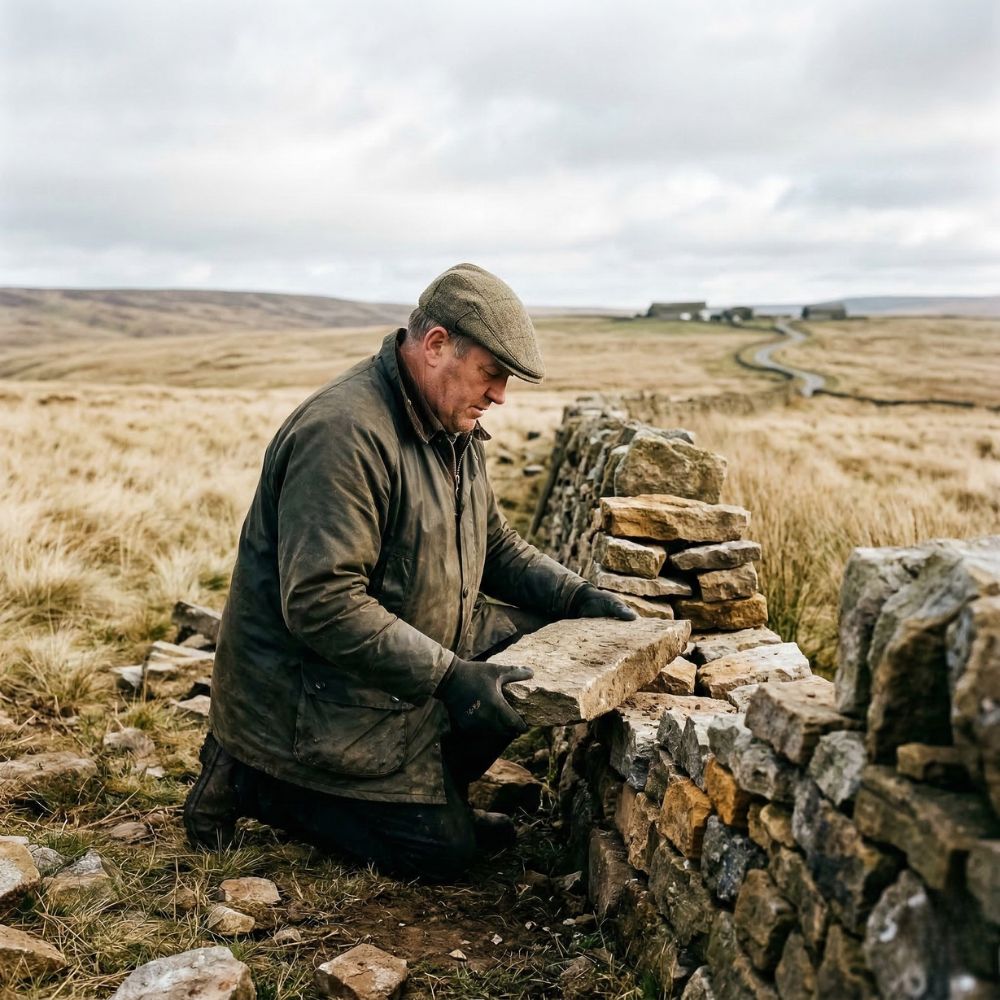
The Archive\'s Dales work, beginning in Year Two, will follow the agricultural calendar: lambing in spring, hay cutting in summer, sheep gathering in autumn, wall repair in winter. The hay meadow farmers of Swaledale maintain the most species-rich grassland in England through deliberate refusal to modernise. The drystone wallers shape the visible landscape with skills passed through apprenticeship. The fell farmers carry knowledge of their land that exists nowhere in writing.
The hay meadow farmers. Flower-rich meadows maintained by traditional methods - no fertiliser, hand-cut, barn-dried.
Drystone wallers and cheese makers. The material culture of limestone, maintained by craftspeople.
Fell farming at the margin. The highest, most remote farming communities in the Dales.
The species-rich hay meadows of Swaledale are maintained by farmers who cut late and graze carefully - a rhythm that has sustained the landscape for eight hundred years.
A thousand miles of drystone wall cross the Yorkshire Dales - limestone on limestone, without mortar. The wallers who maintain them carry knowledge in their hands.
The fell farmers of Upper Wharfedale work the marginal land above the dale - hefted flocks on open moor, a way of life older than the enclosures.
In the Yorkshire Dales, fell sheep learn their territory from their mothers across generations. The farmer, the flock, and the fell are a single system - and when one element is removed, the knowledge of centuries is lost.
A private custodian of the Little Mesters' trade heritage. Cutlery, tools, pattern books, tang stamps, and photographs from workshops that closed one by one as the economics of handmade cutlery became untenable.
“The stone walls climb the hillside without mortar. The hay meadows bloom without fertiliser. The farmers stay without reason - except that someone must.”