Makers Horology Pillar
Seth Kennedy
Watchmaker, Case Maker & Engine Turner
Grandeys Place, Much Hadham, Hertfordshire
Watchmaker, Case Maker & Engine Turner
Grandeys Place, Much Hadham, Hertfordshire
An engineer who taught himself to draw in metal, on two machines from another century.
Seth Kennedy is another of the people I kept meeting on this archive who walked away from a modern career for an older and harder one - by now I had stopped thinking it a coincidence. He came to watchmaking the long way round: first a design engineer, no apprenticeship, no family bench. What caught him was the mechanism itself, the problem of a made thing that keeps time, and once it had hold of him he did not put it down.
His training was informal. In his early years he learned from a highly accomplished watchmaker, and from there built his own way of working - his own tools, his own techniques, much of it reasoned out from the engineering up. The proof that it holds is a letter he keeps from George Daniels, the watchmaker who made complete watches single-handed and remains the modern measure of the craft, endorsing his restoration methods. In horology a line from Daniels outranks any certificate.
What he does now is antiquarian horology in the full sense. He services and restores pocket watches from the seventeenth to the mid-twentieth century, bringing the movements and their complications back to running as they did when they were made; where a part is missing or past saving, he makes a new one by hand. He restores old cases and makes new ones to order, in the style of the movement they will hold. He has worked on the Bowes Museum’s famous Silver Swan automaton and lectured on old London horology to the Horological Society of New York. And he is an accredited member of the British Horological Institute. None of it came down a pipeline; he assembled it the way he assembles a case, one piece at a time.
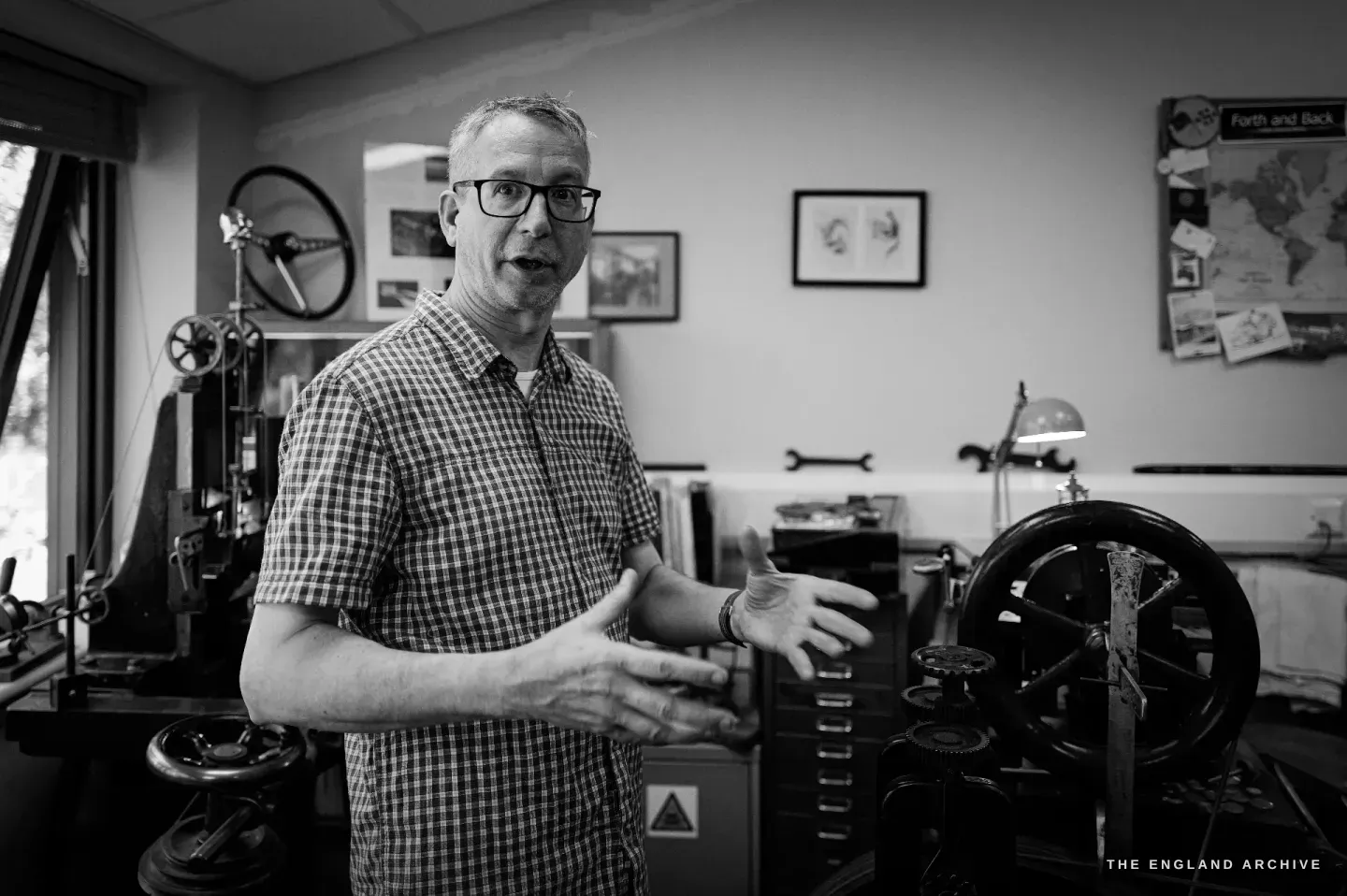
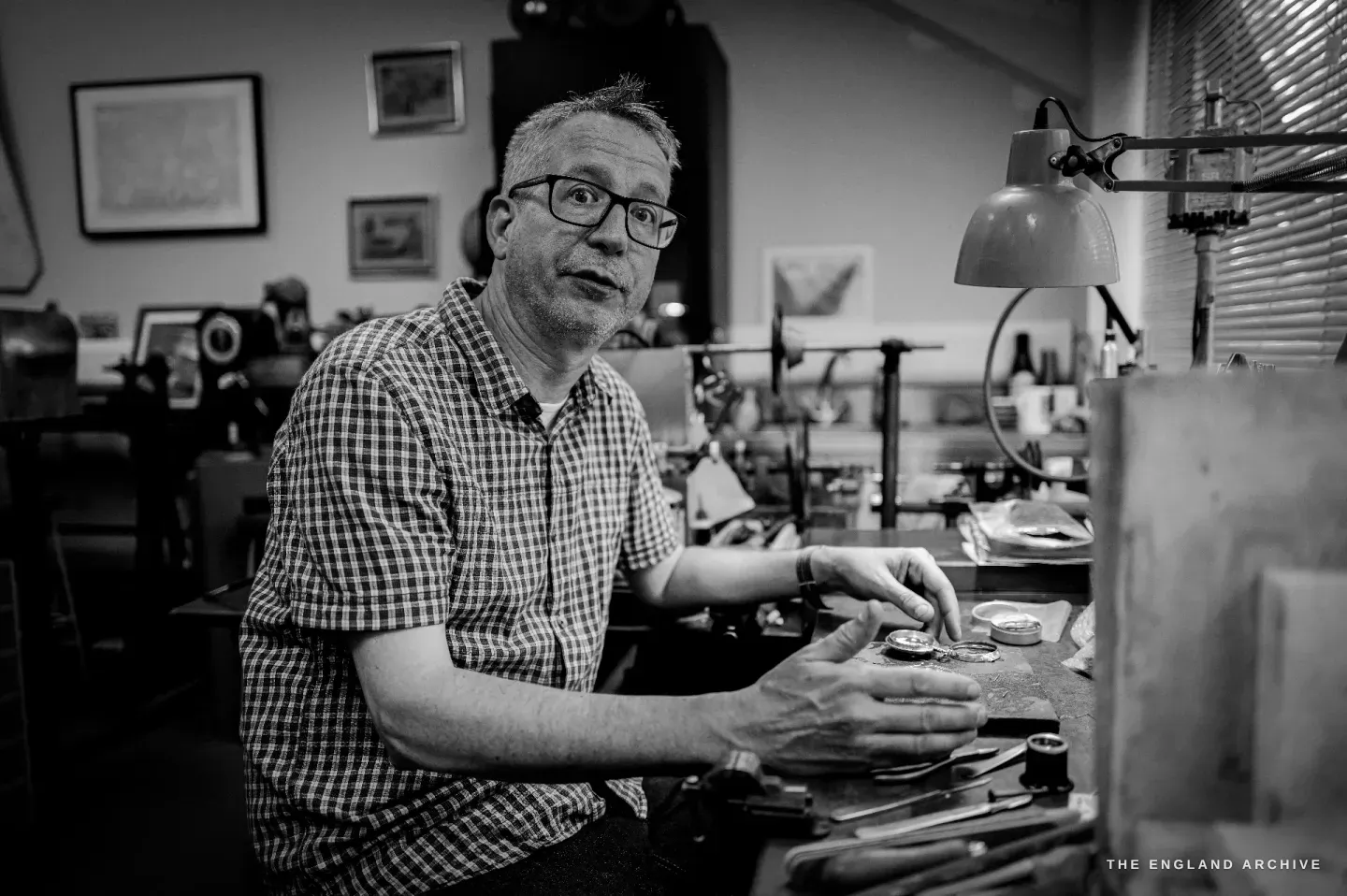
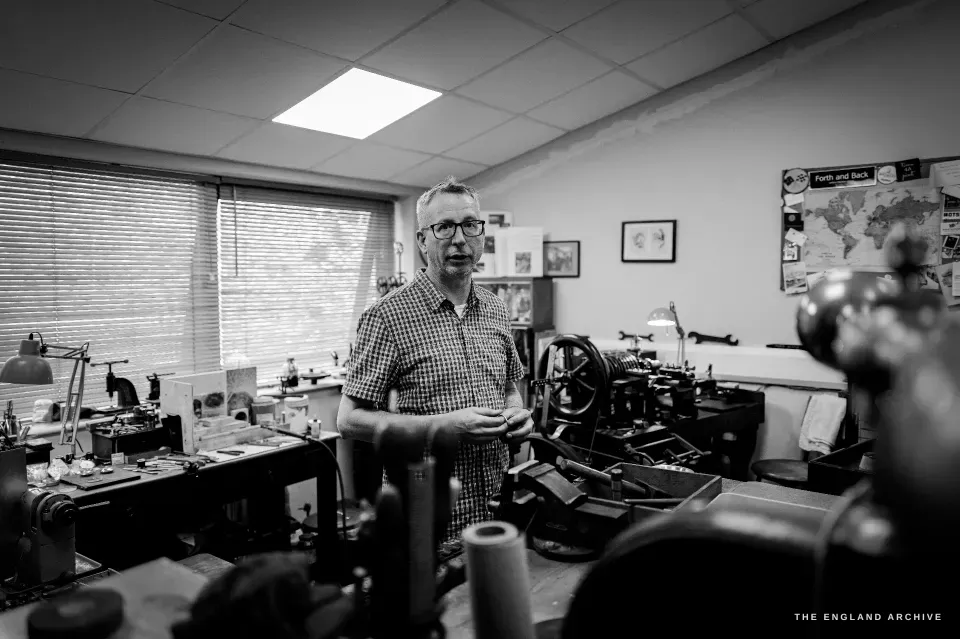
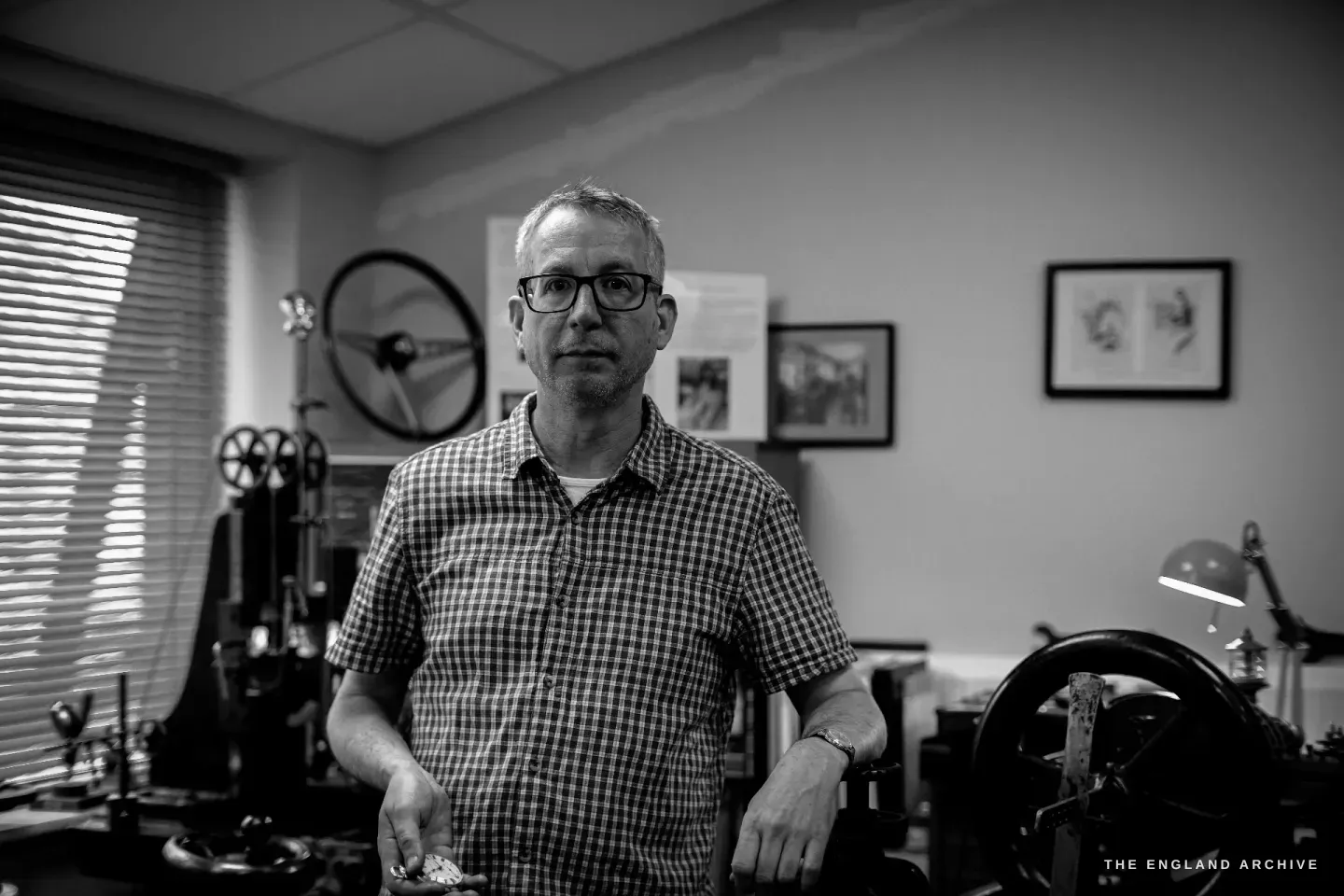
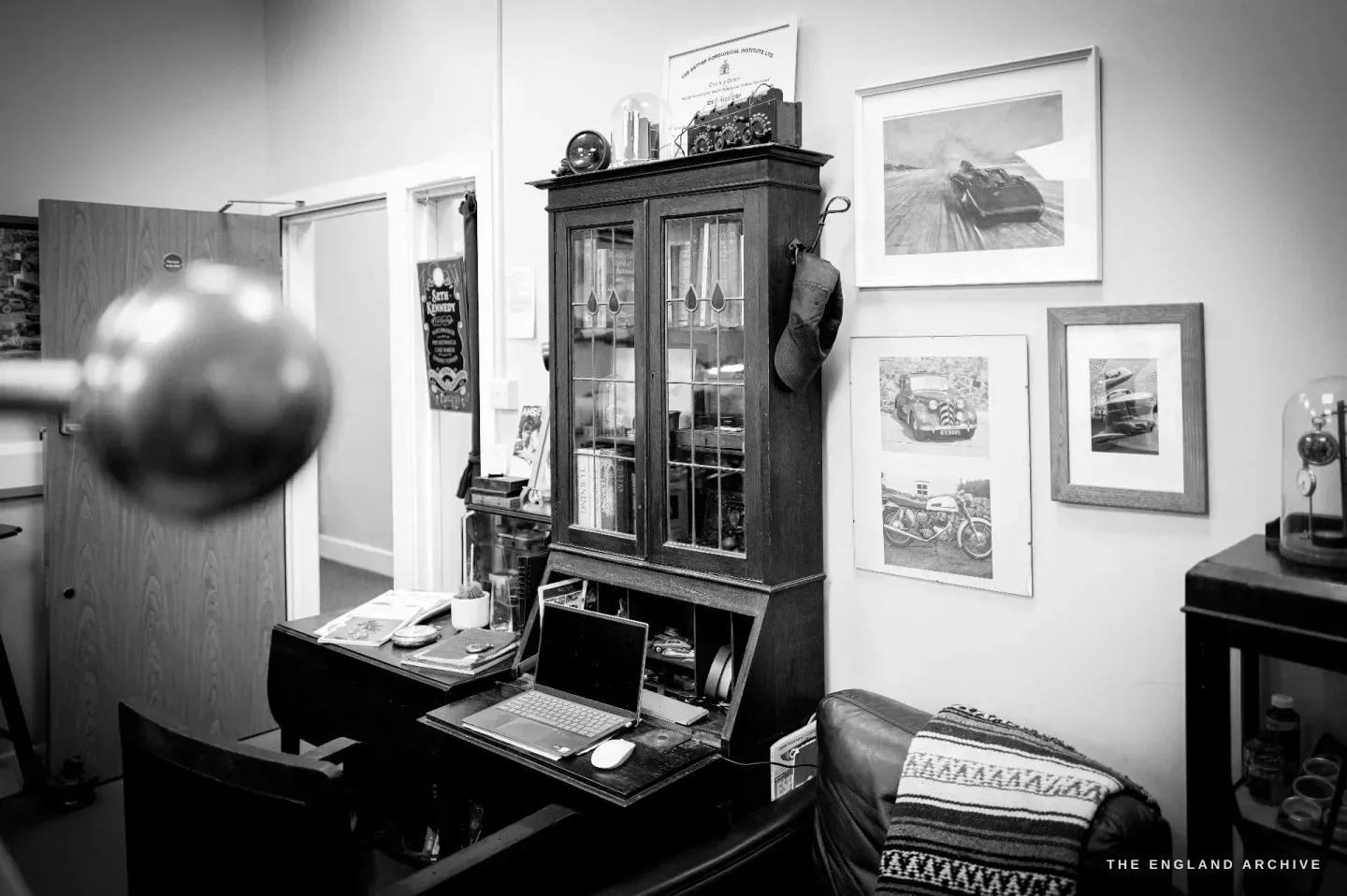
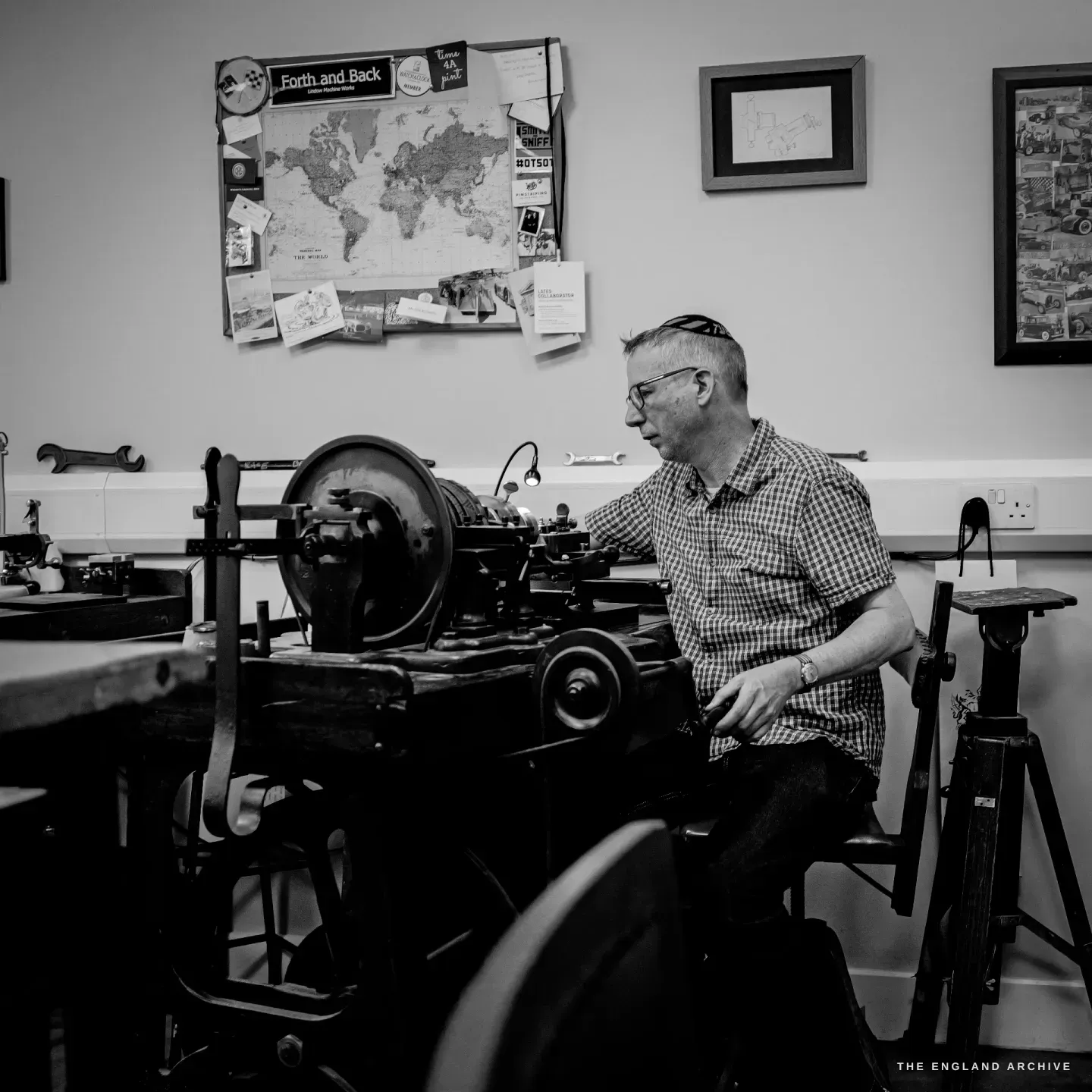
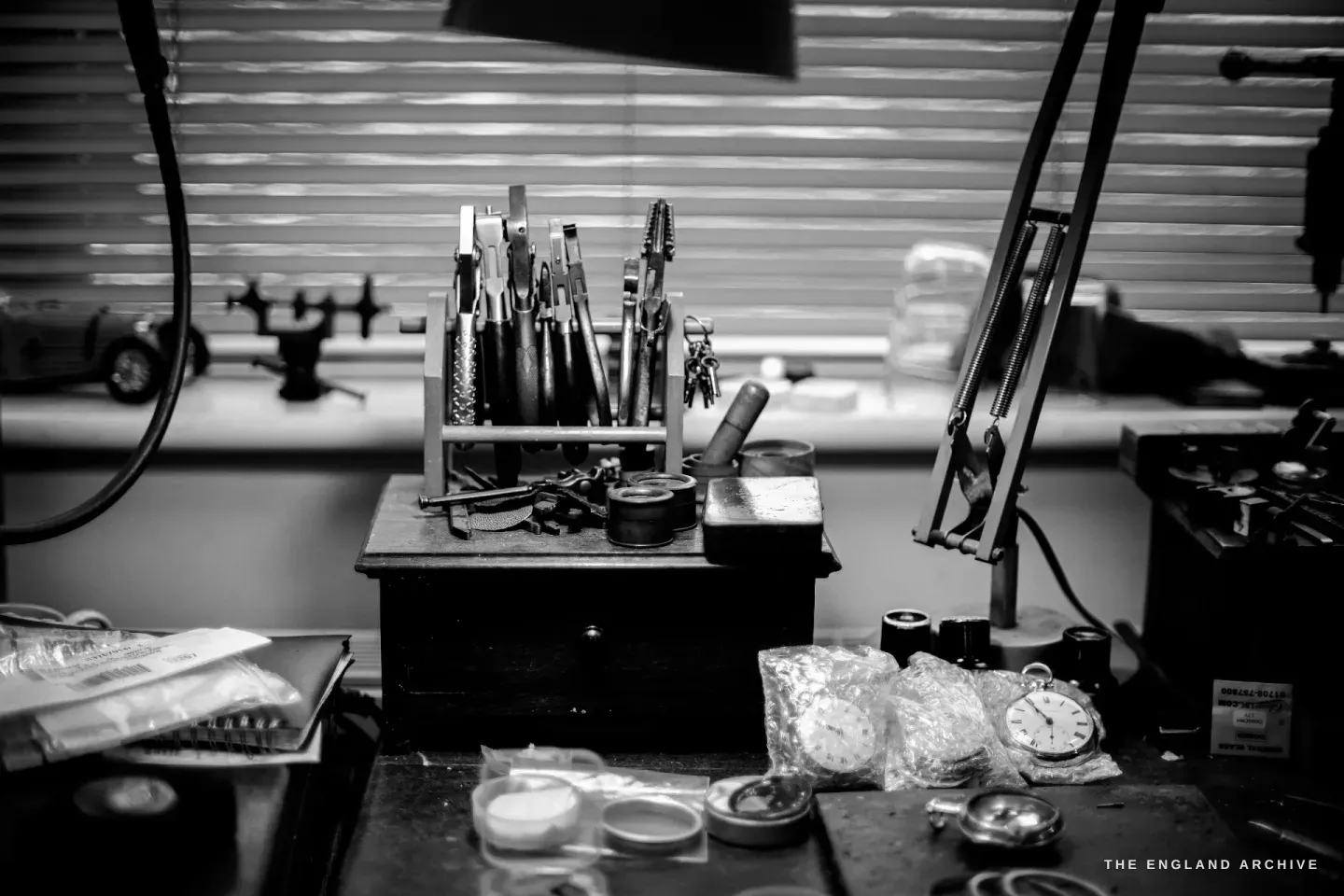
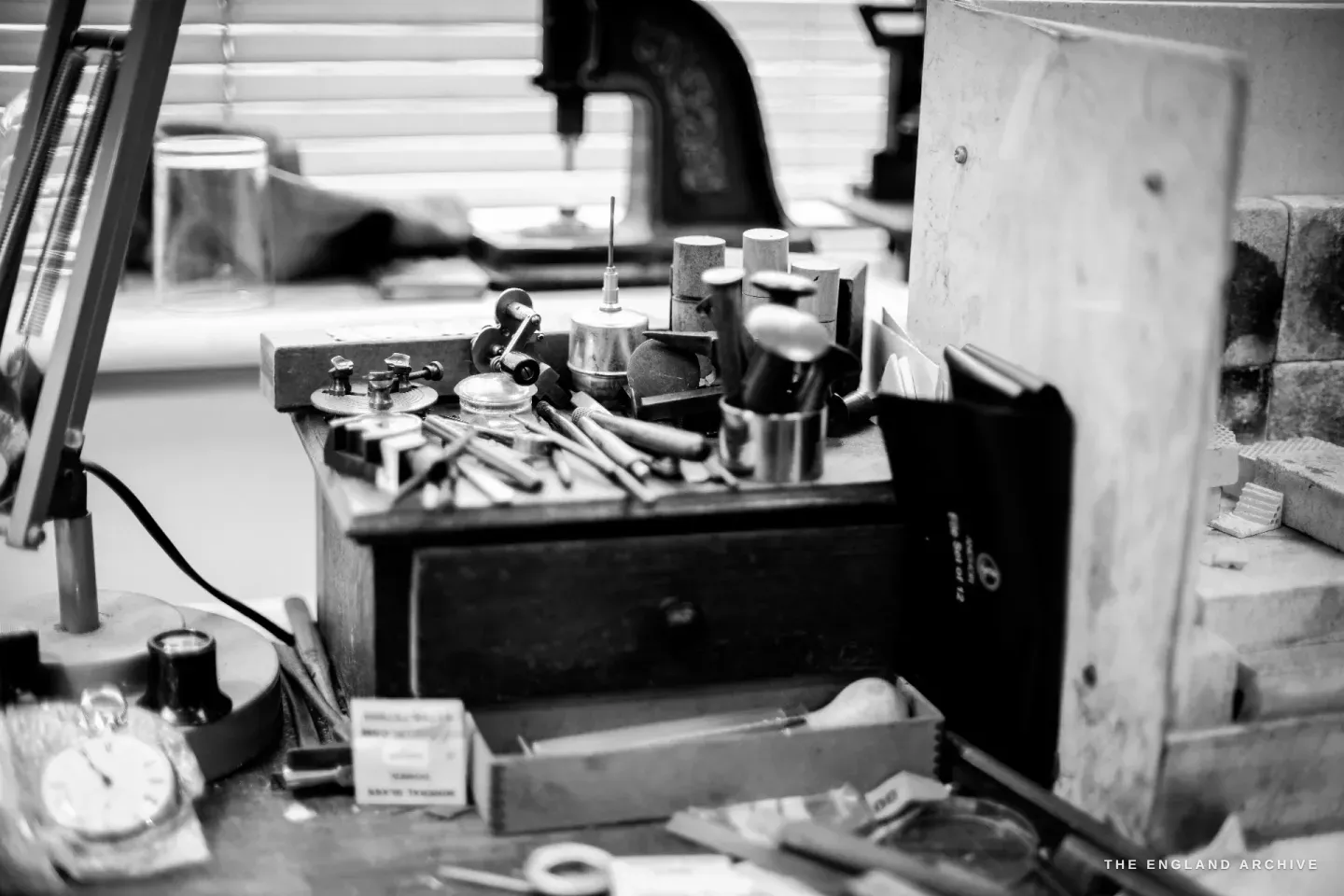
His workshop is at Grandeys Place, a heritage and craft centre near Much Hadham in Hertfordshire, and walking into it is a small act of time travel. You come through an ordinary, modern outer building; then a door opens and the room behind it has stopped somewhere around 1930. Cast-iron machines stand on wooden benches under anglepoise lamps. There is painted brick, there are window blinds, a glazed oak bookcase, framed motoring prints, a glass dome set over something precise. A world map titled Forth and Back is pinned to the wall.
Nothing was cleared away to make it look old. It looks old because the tools that work here are old, and they still work because no one has found a reason to replace them. The room is not a museum of watchmaking; it is a watchmaker’s room, in use, which is a rarer and more fragile thing.
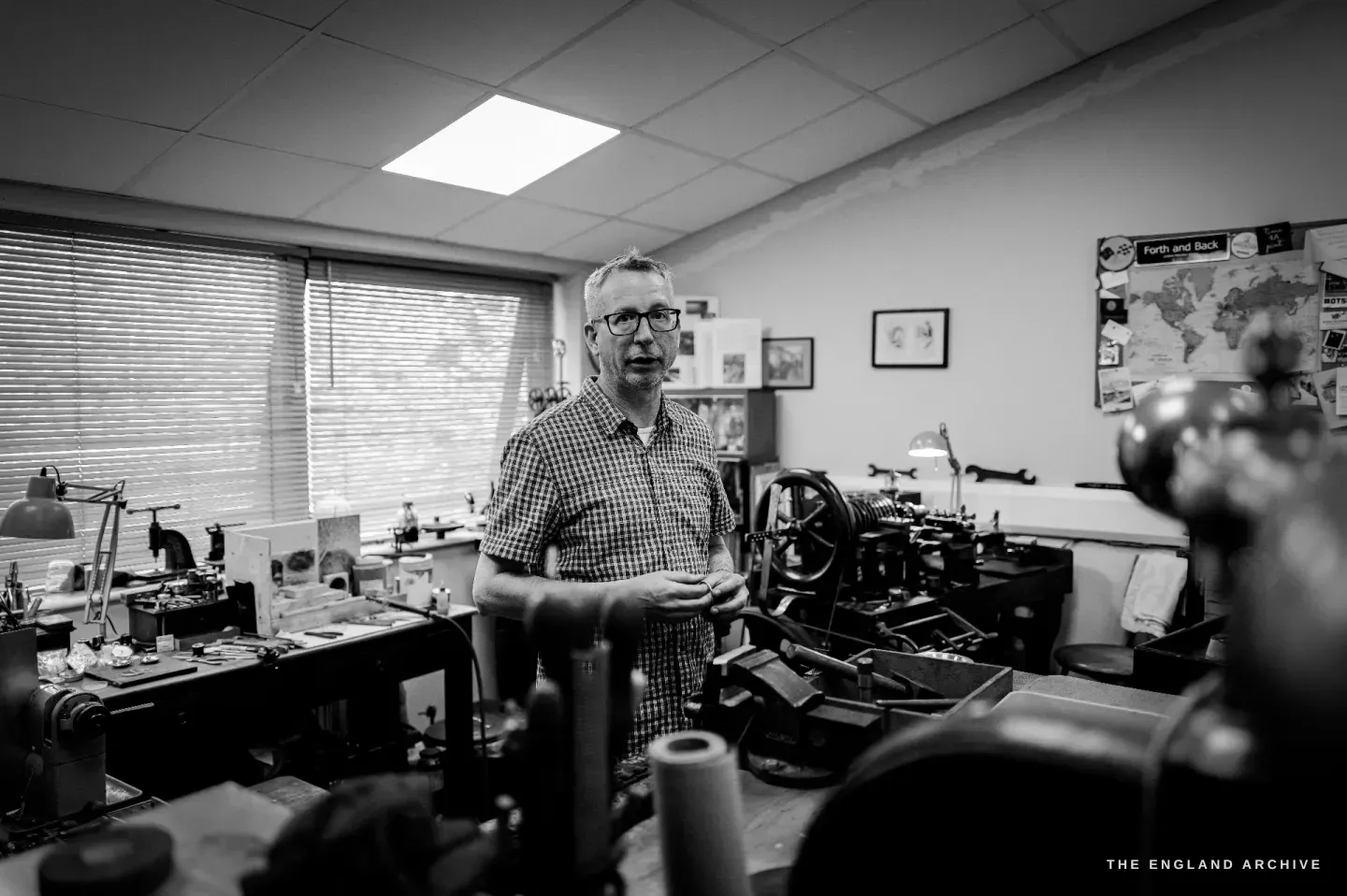
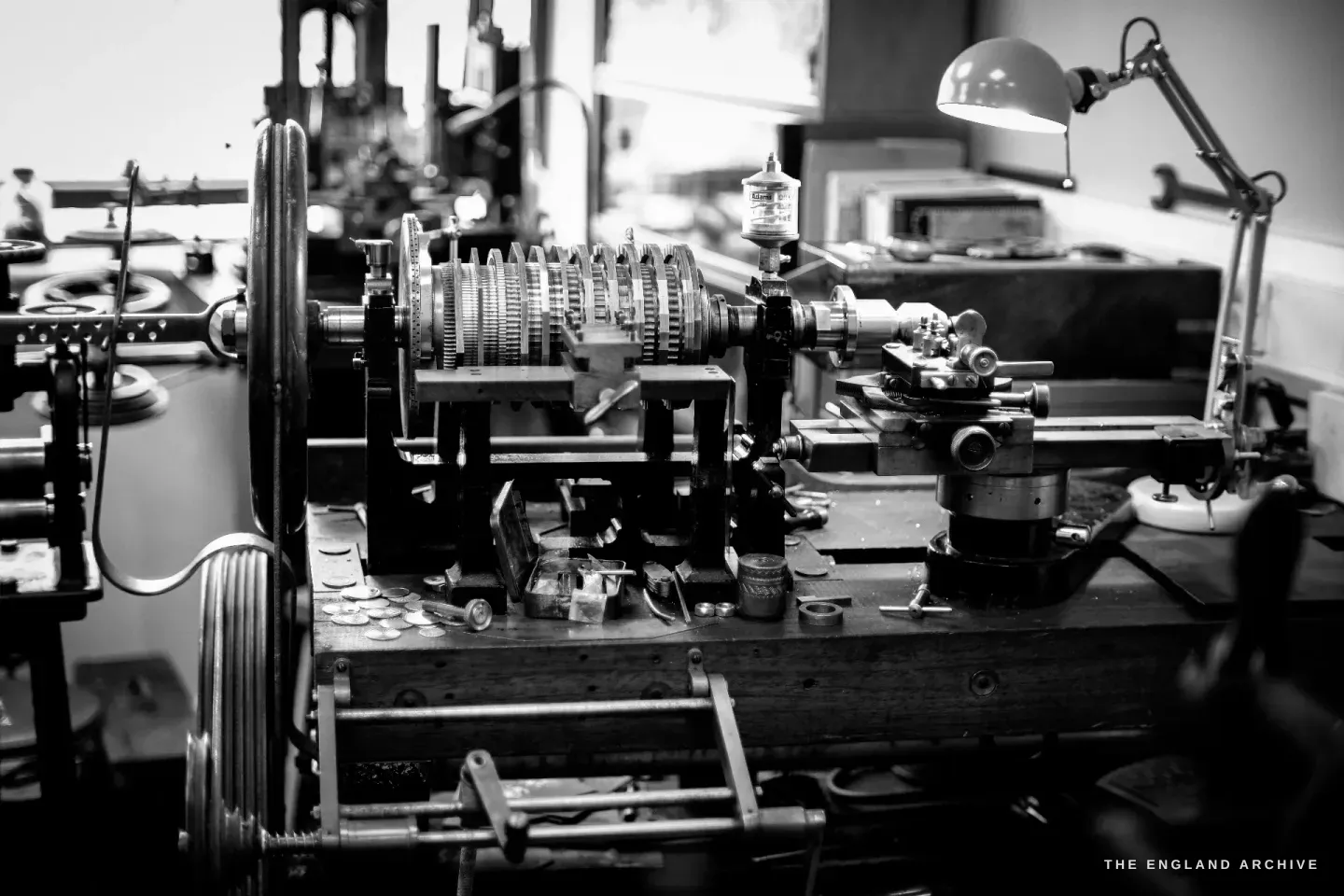
Two machines anchor the room, and they are the reason Seth Kennedy belongs in this archive. They are engine-turning machines - the craft also known by its French name, guilloche - and engine turning sits on the Heritage Crafts Red List as critically endangered. Very few people in England still do this work; fewer still can keep the machines themselves running.
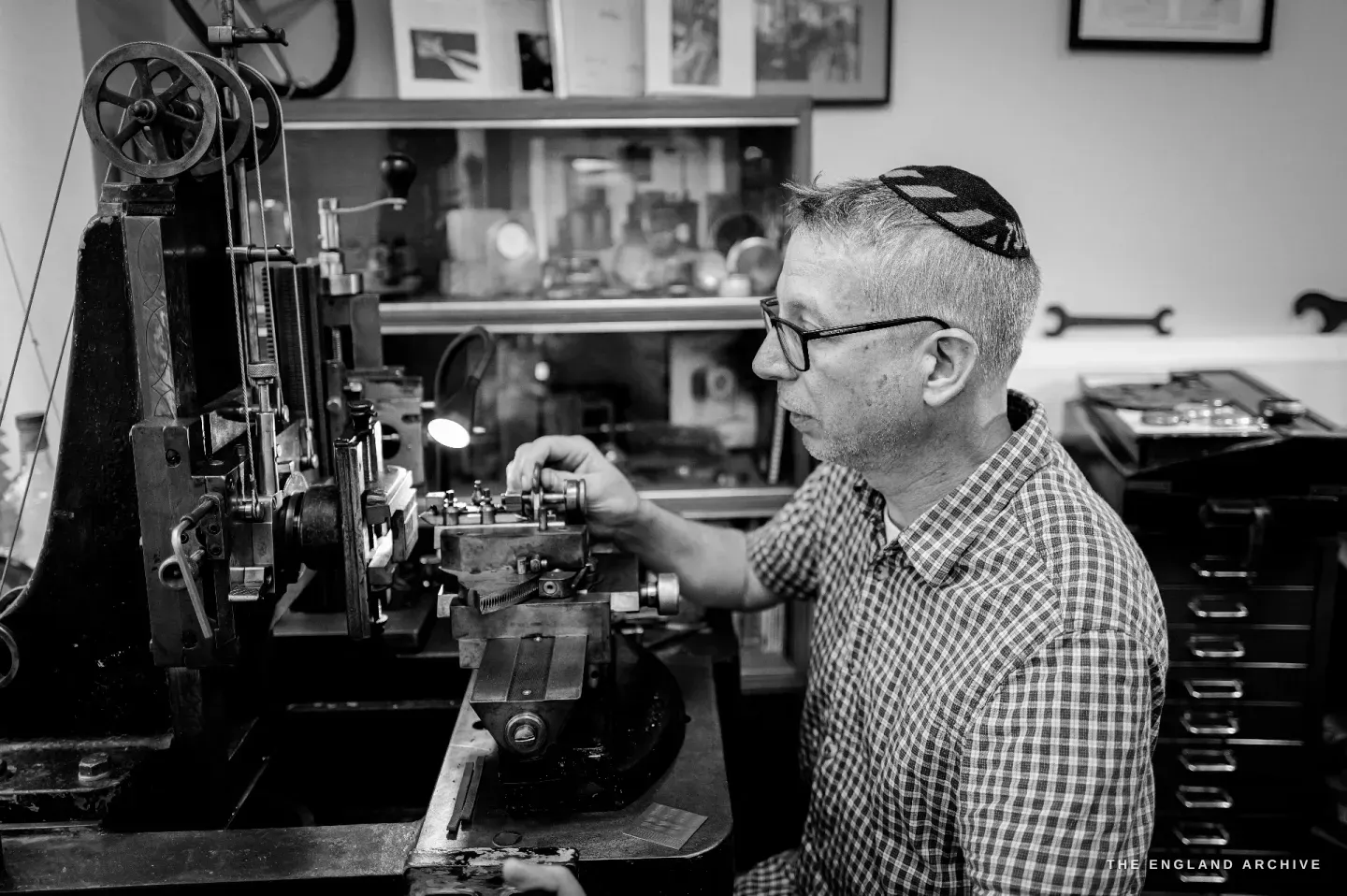
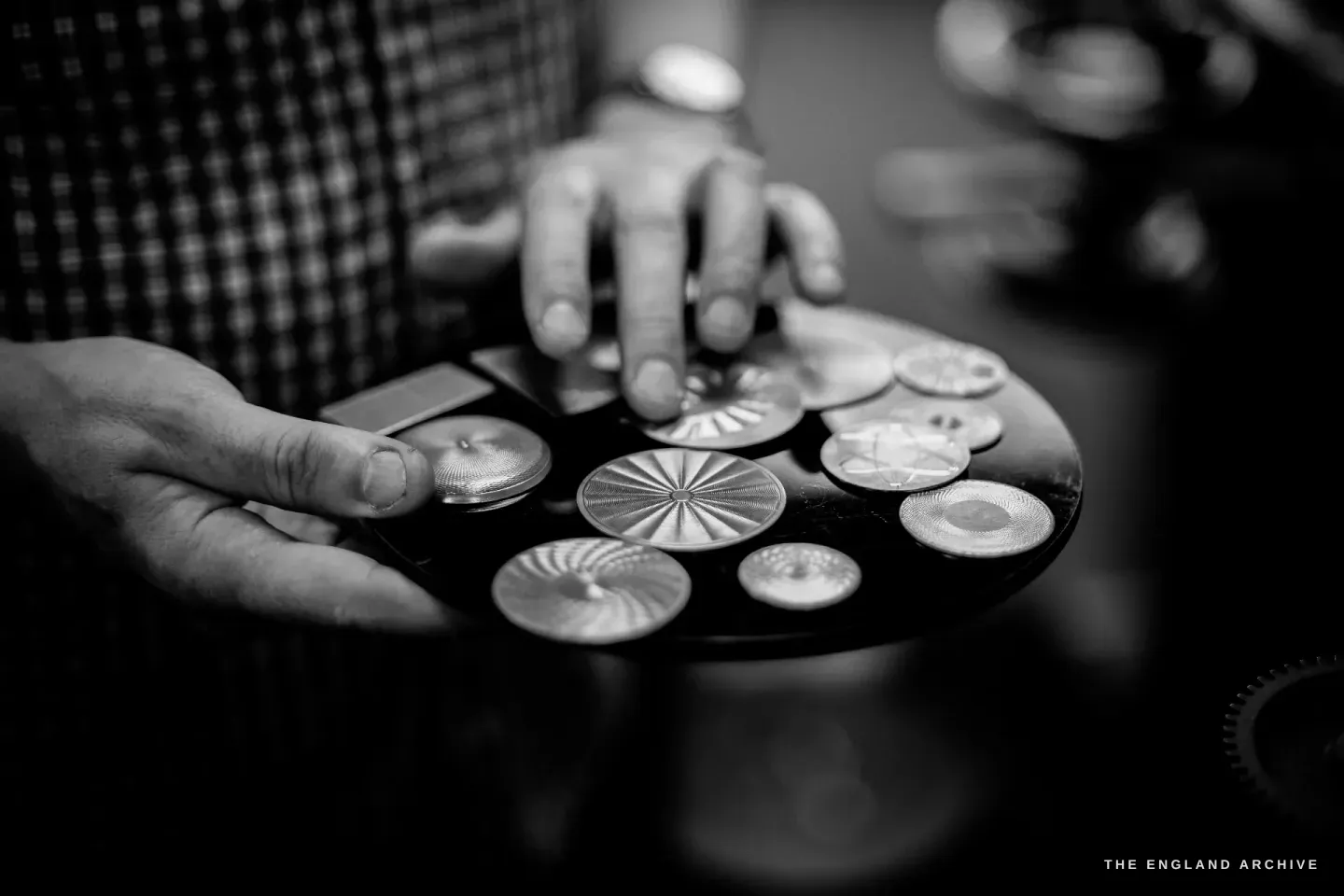
The rose engine is the one that curves. A stack of patterned brass cams - rosettes - turns against a fixed rest, and as the work rocks in and out, a single cutter scribes a bright line that follows the rosette’s wave. Change the rosette and you change the wave. The straight-line engine does the opposite: it draws straight, pulling the work under the cutter in dead-parallel passes to lay down the basketweave and barleycorn fields that run across the back of an old watch. Between them they make the patterns - clous de Paris, sunburst, basketweave - that look machined and are in truth among the most exacting hand skills in the trade.
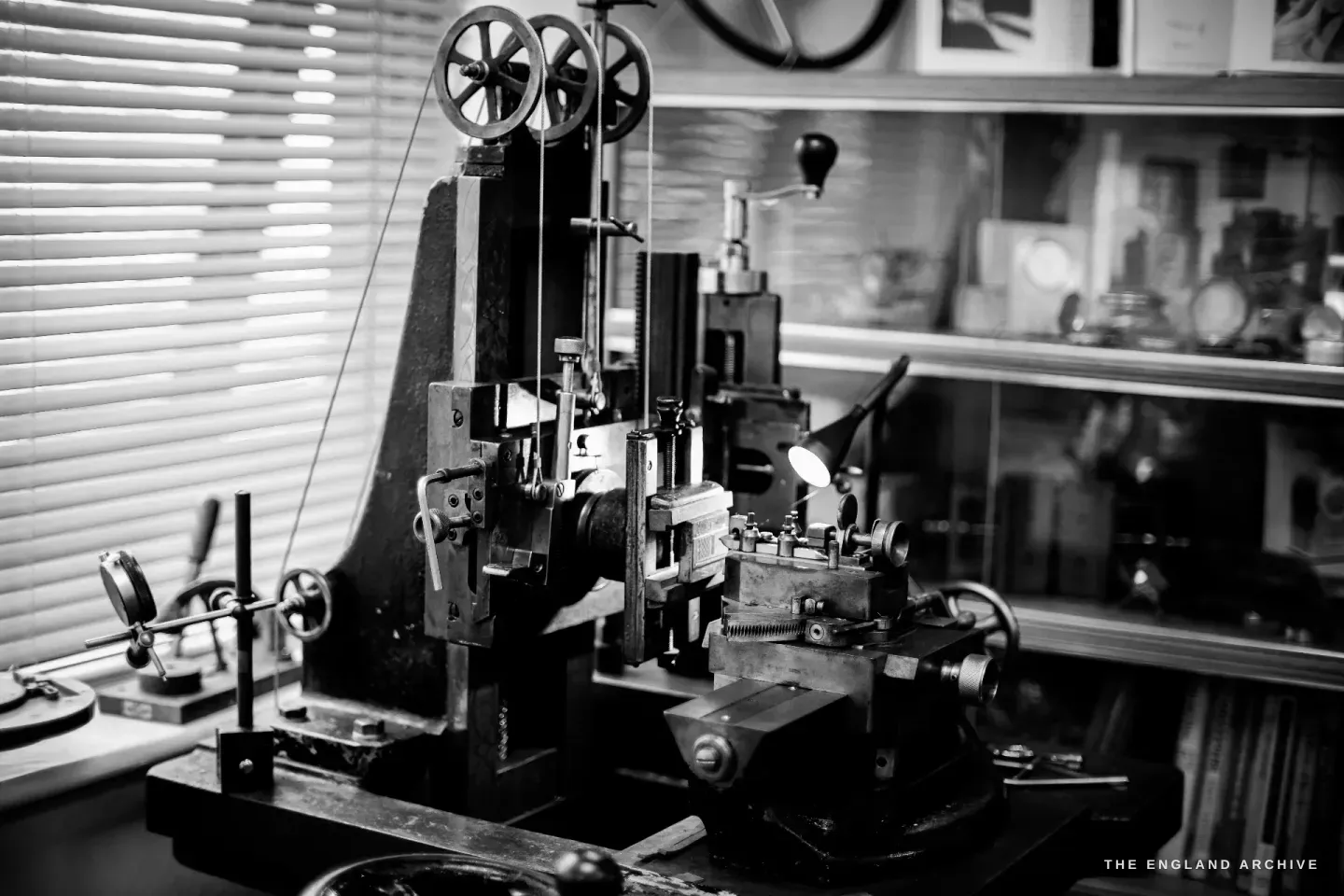
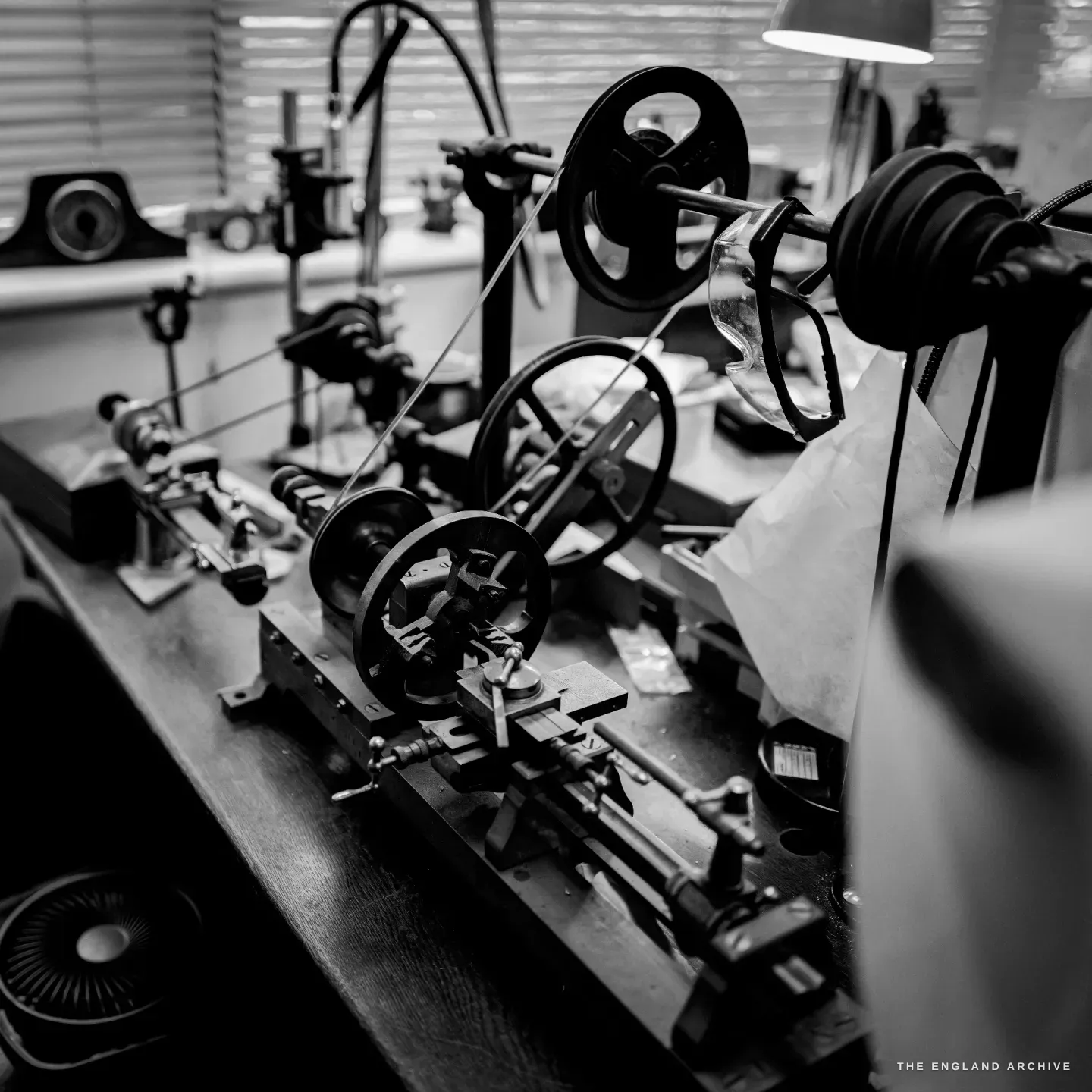
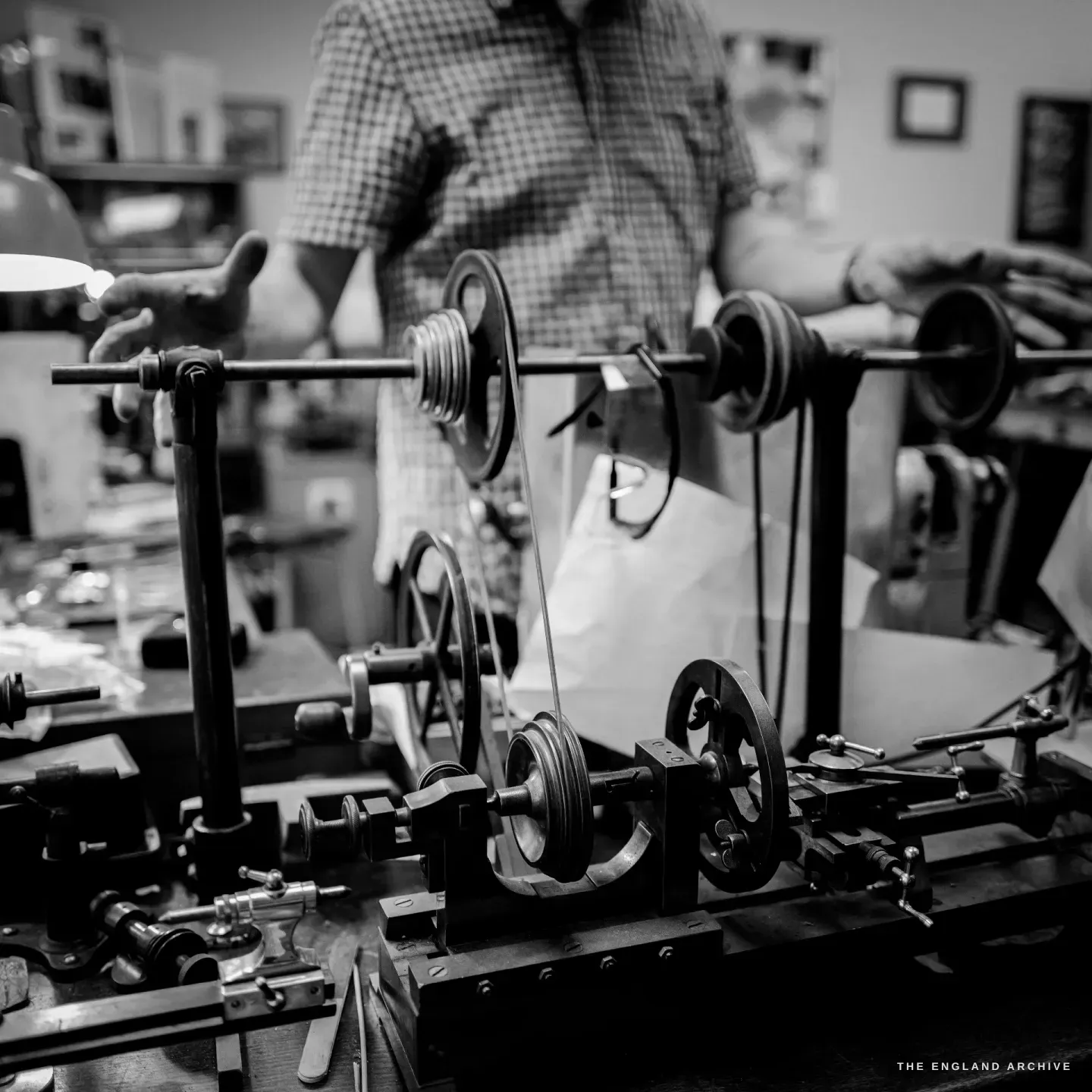
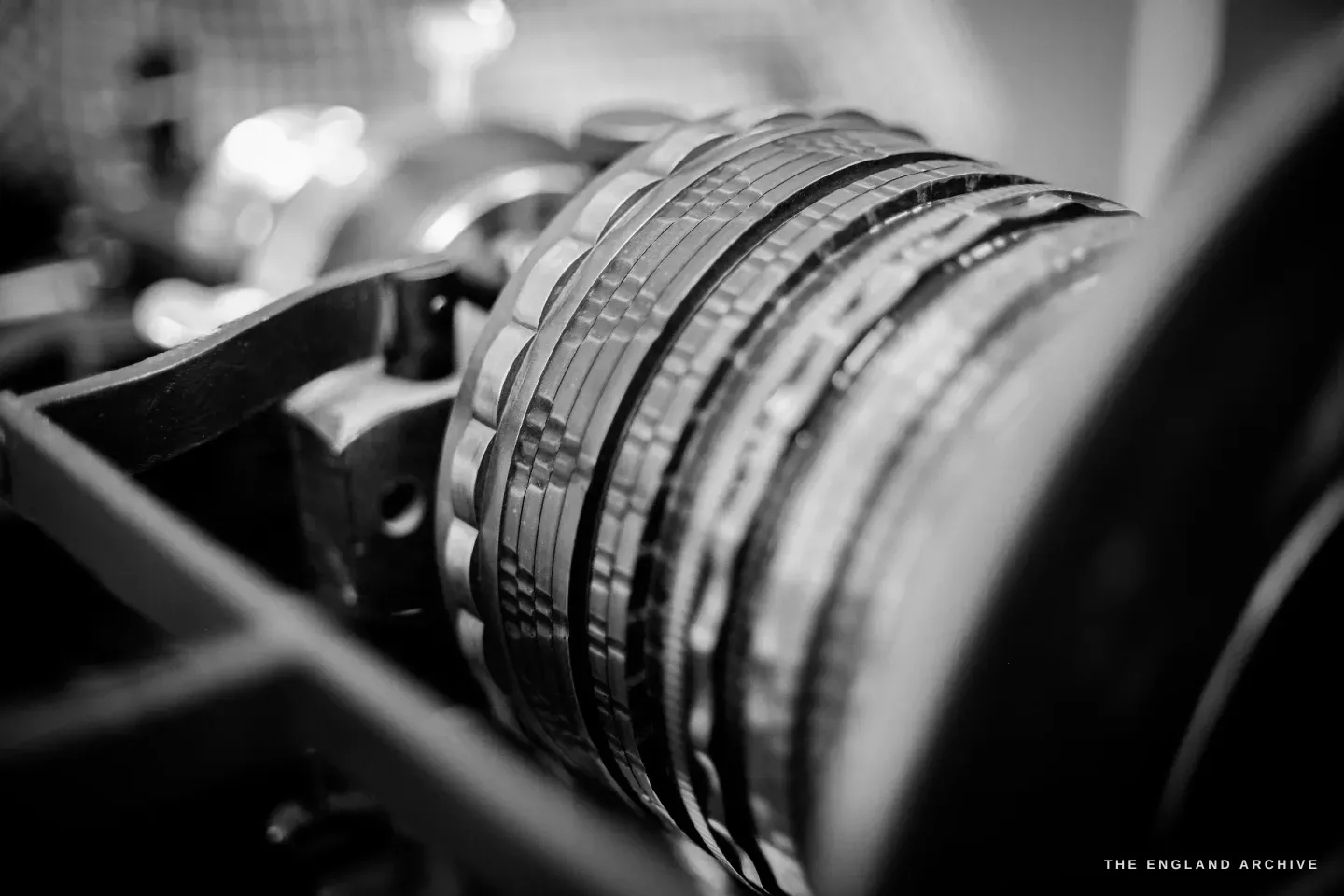
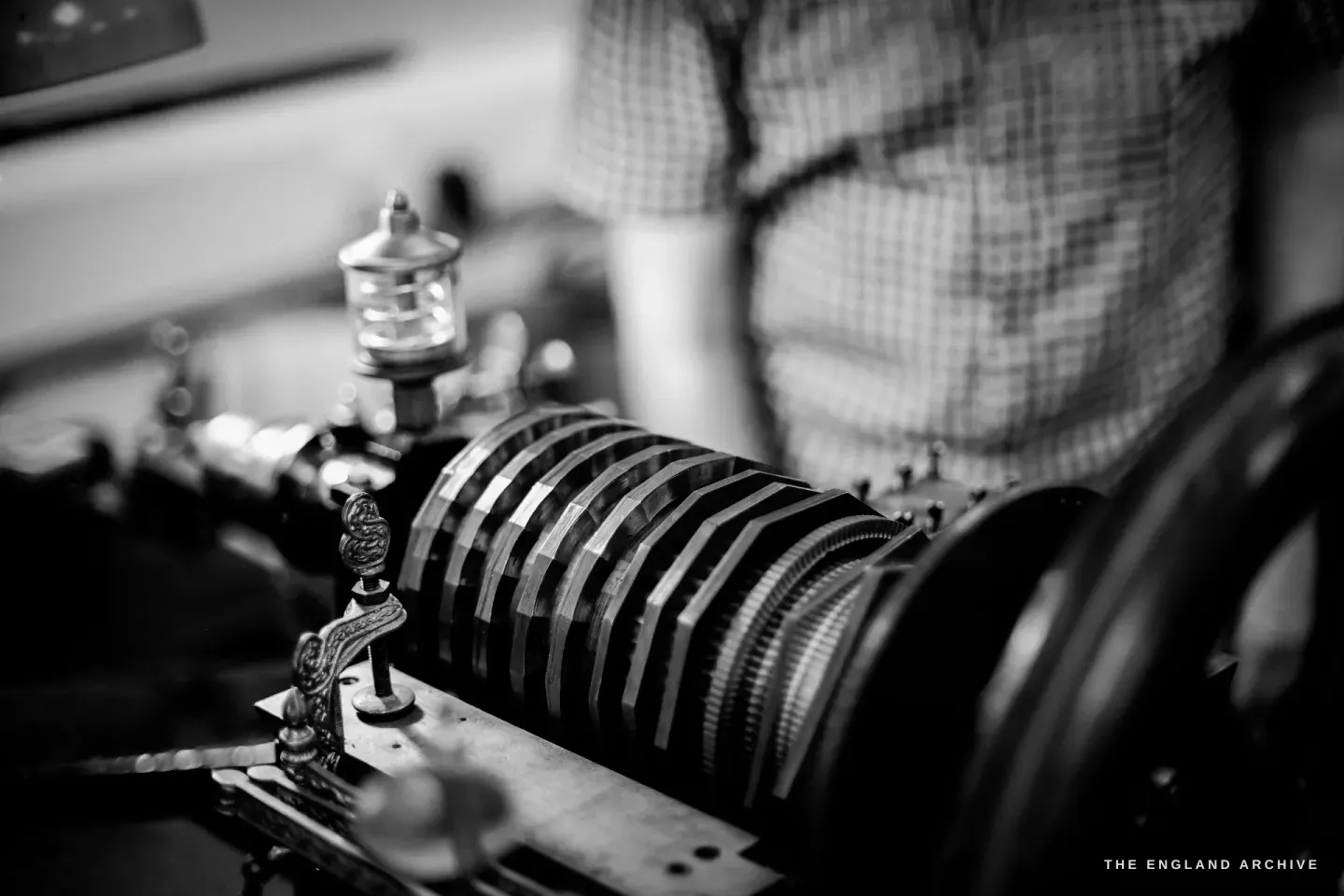
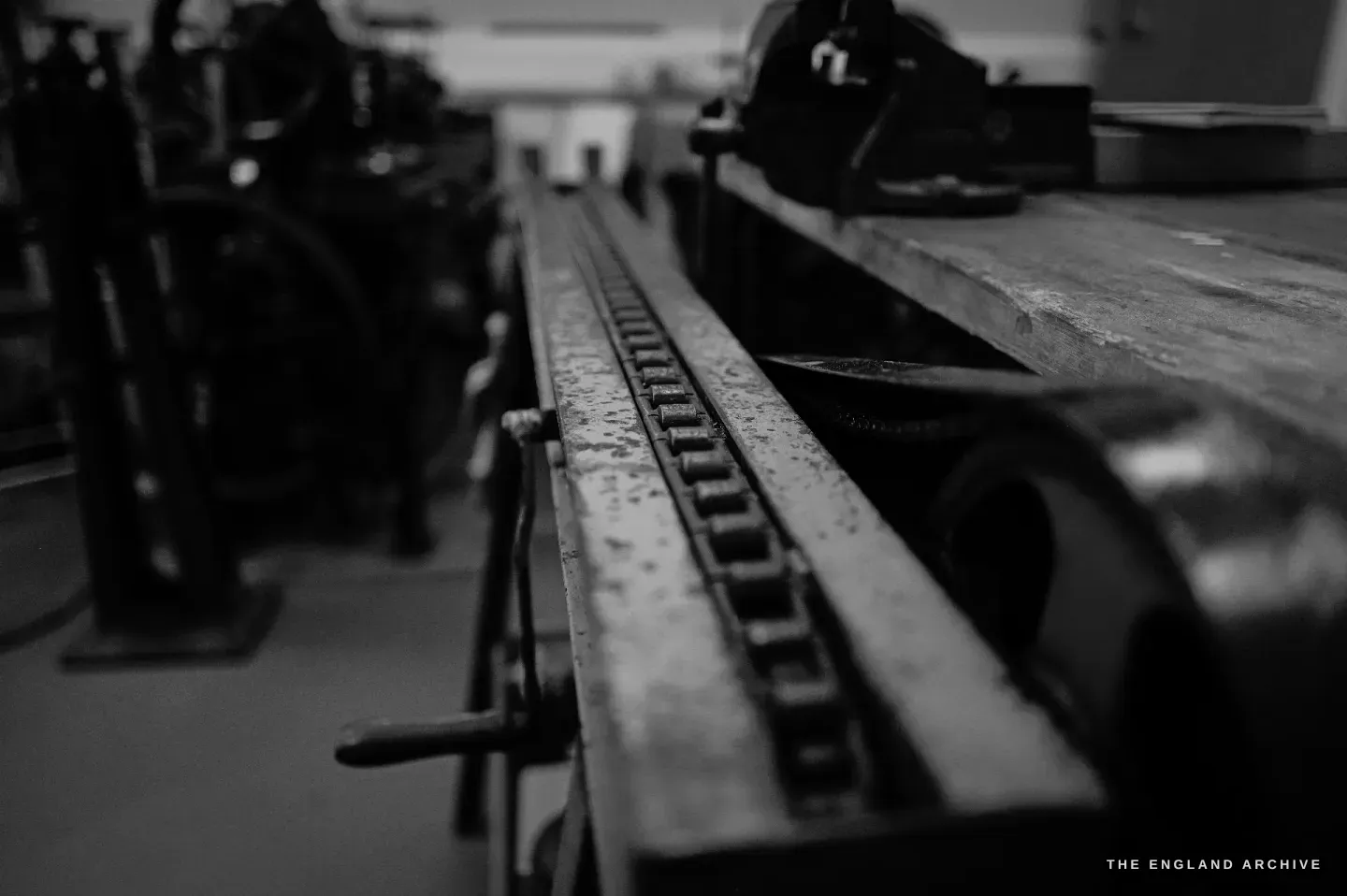
An engine-turned surface is not really decoration; it is light. A pattern of fine cuts catches and throws the light from a hundred facets, so a plain disc of silver or gold becomes something that shifts as you turn it in the hand. Getting there is slow and unforgiving - one wrong pass and the whole face is scrap.
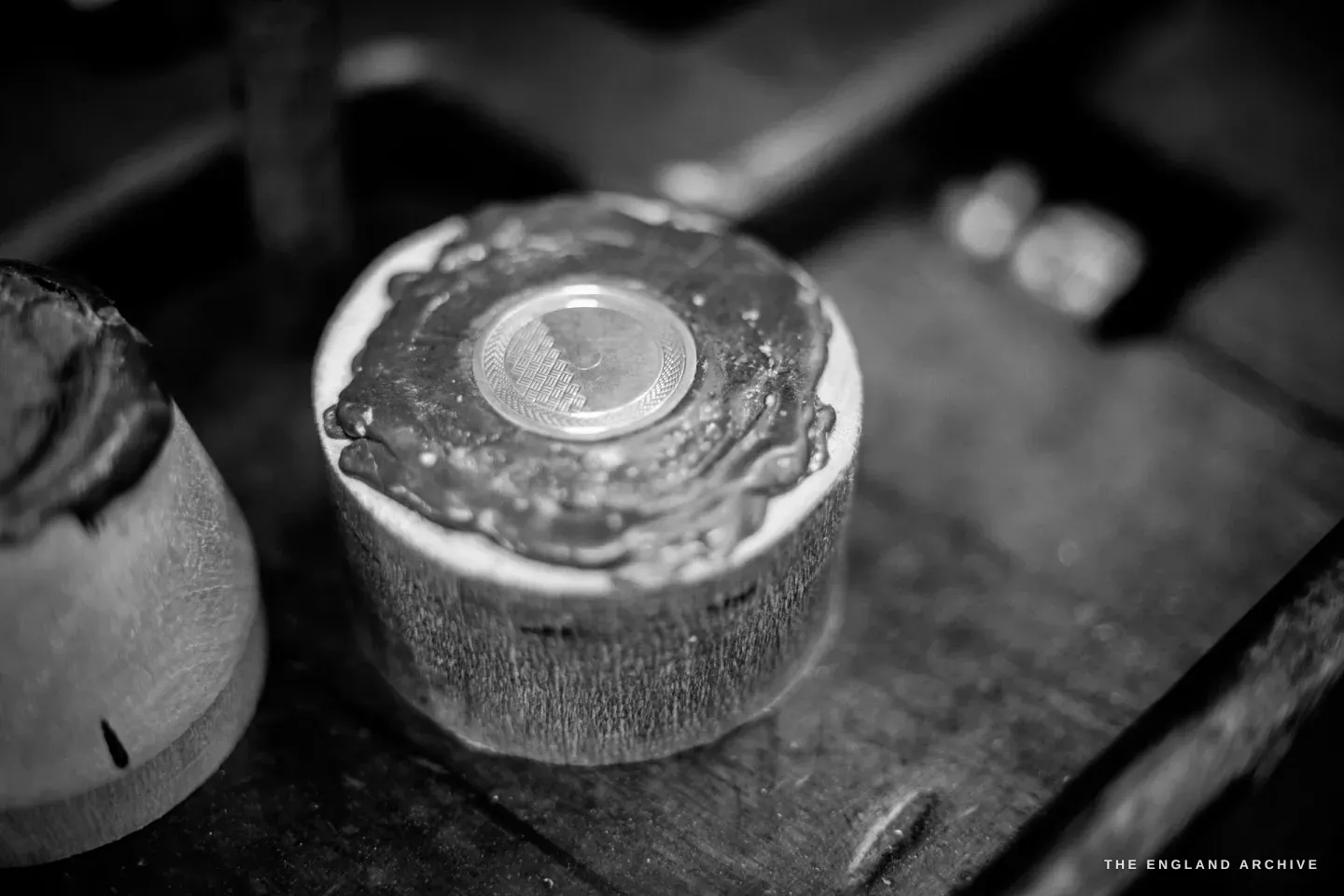
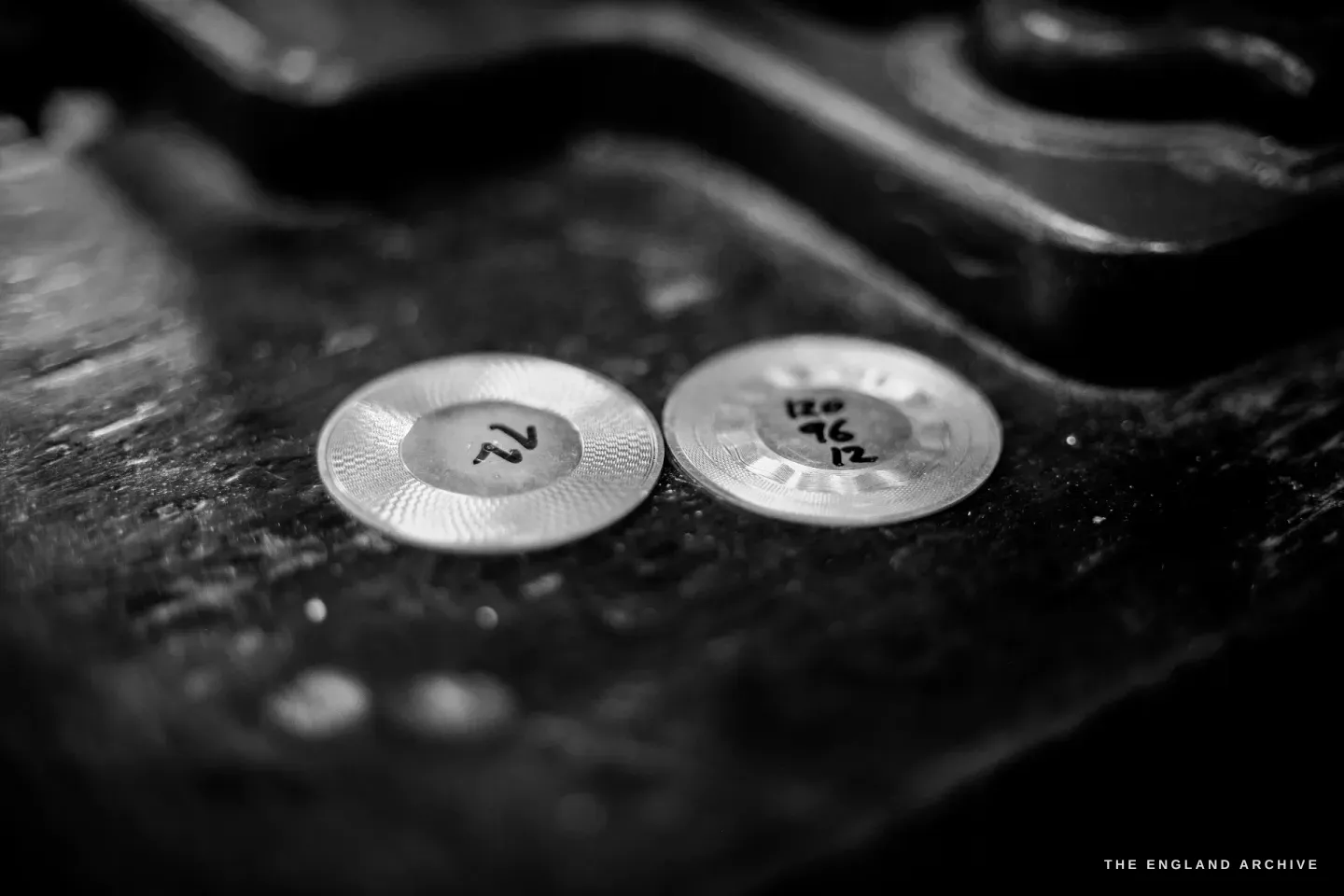
It starts with the blank set in pitch - a bed of warm shellac and resin that holds the disc dead flat and lets it be trued so it runs without a wobble under the cutter. Then the division is set: the index ring on the machine decides how many cuts will ring the disc, and the count is everything. Sixty divisions and ninety-six divisions make different worlds on the same surface.
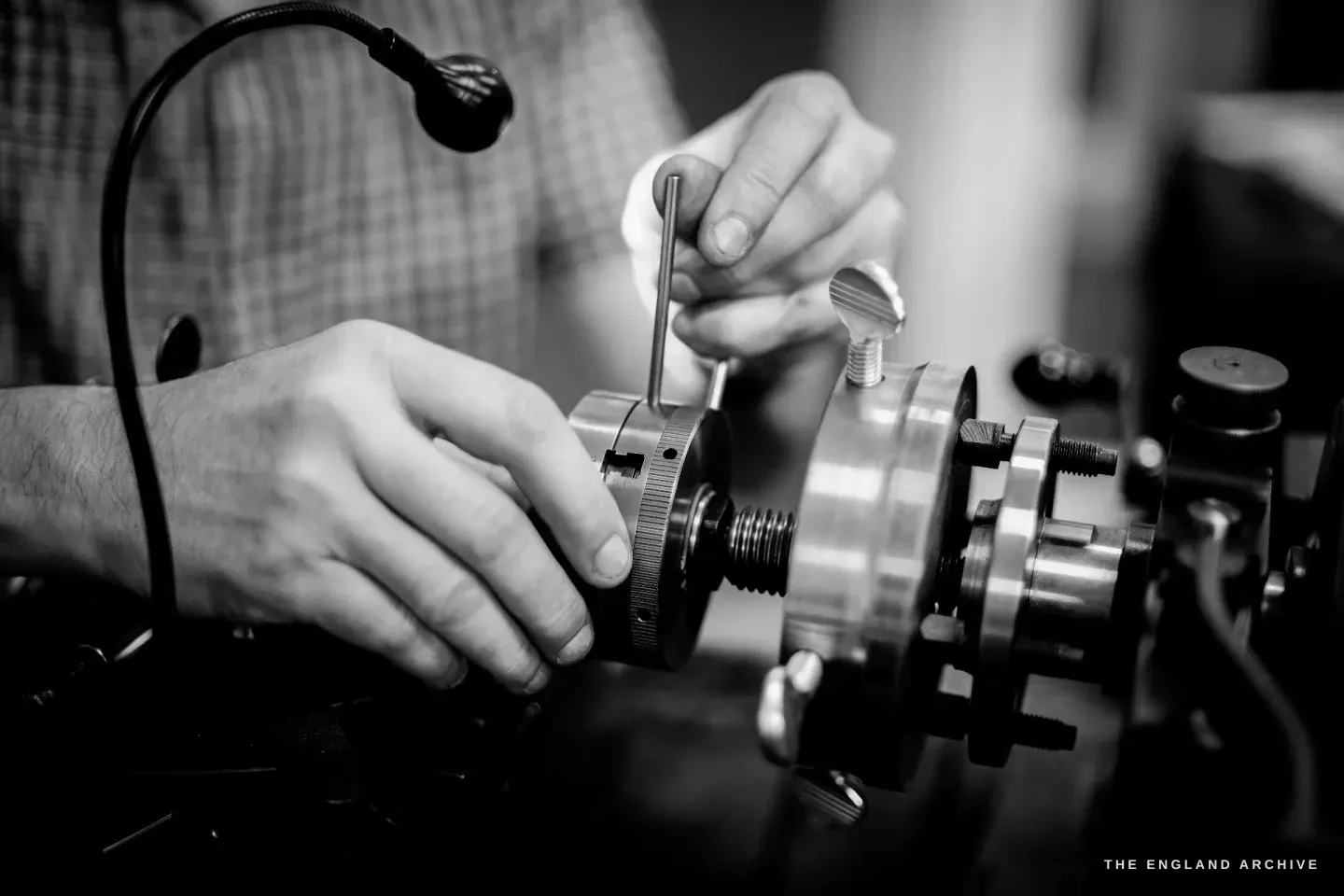
Then the cutting, and this was the part I could not look away from. On the rose engine, one hand rocks the work against the rosette while the cutter takes a single line; index one division, cut again, and again, around the whole face. On the straight-line engine the passes run parallel instead of around - the same patience, a different geometry. There is no undo. I kept waiting for him to hesitate, and he never did: the pattern exists only as long as the hand holds the rhythm, and his did not break.
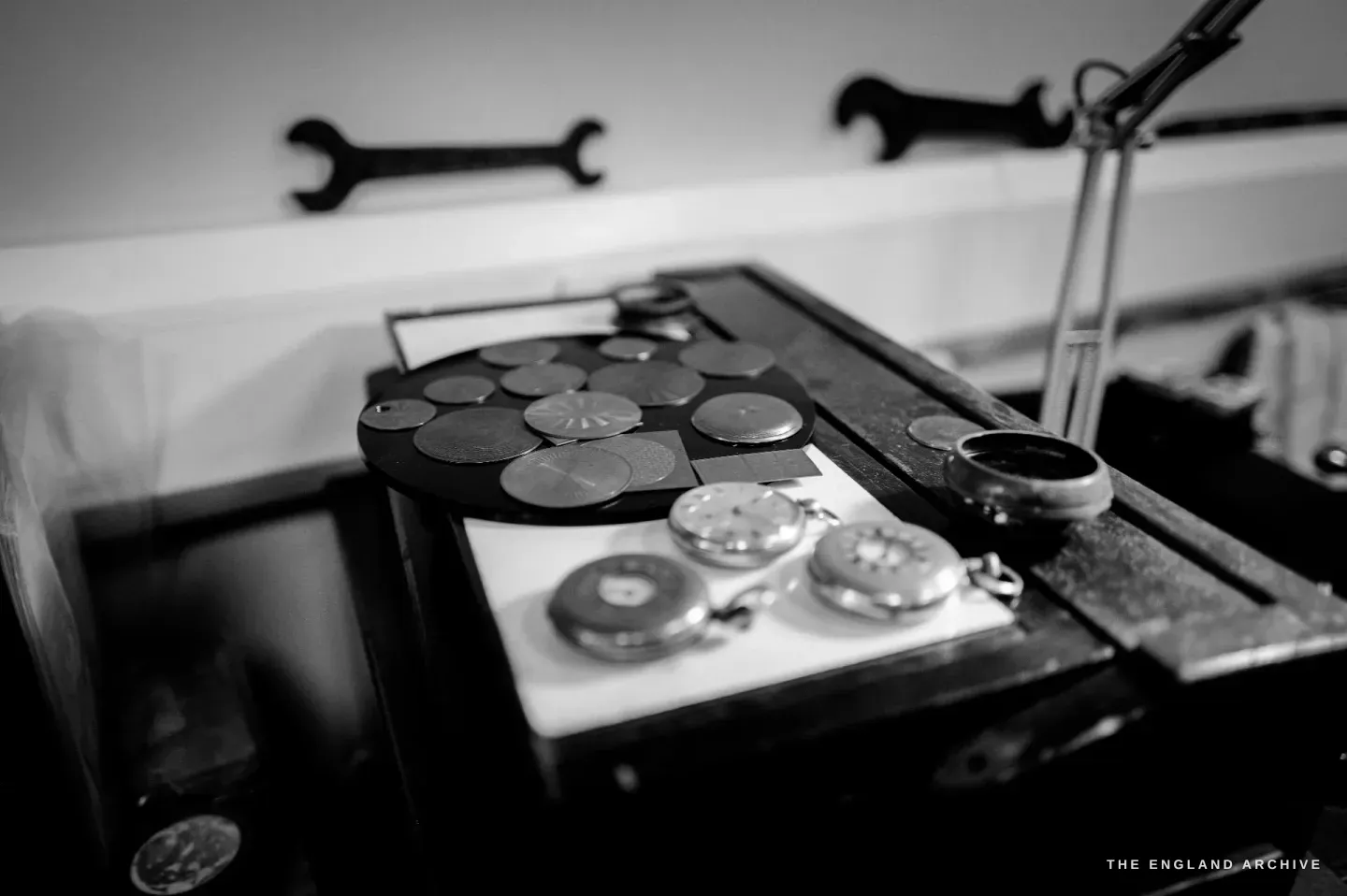
The counts are written in ink straight onto the trial discs - 72; 120 / 96 / 12 - the recipe for each pattern, kept the way a cook keeps a book. And then the finished cut: the bare disc turned into a field of light, every line of it laid by hand on a machine older than anyone now in the room.
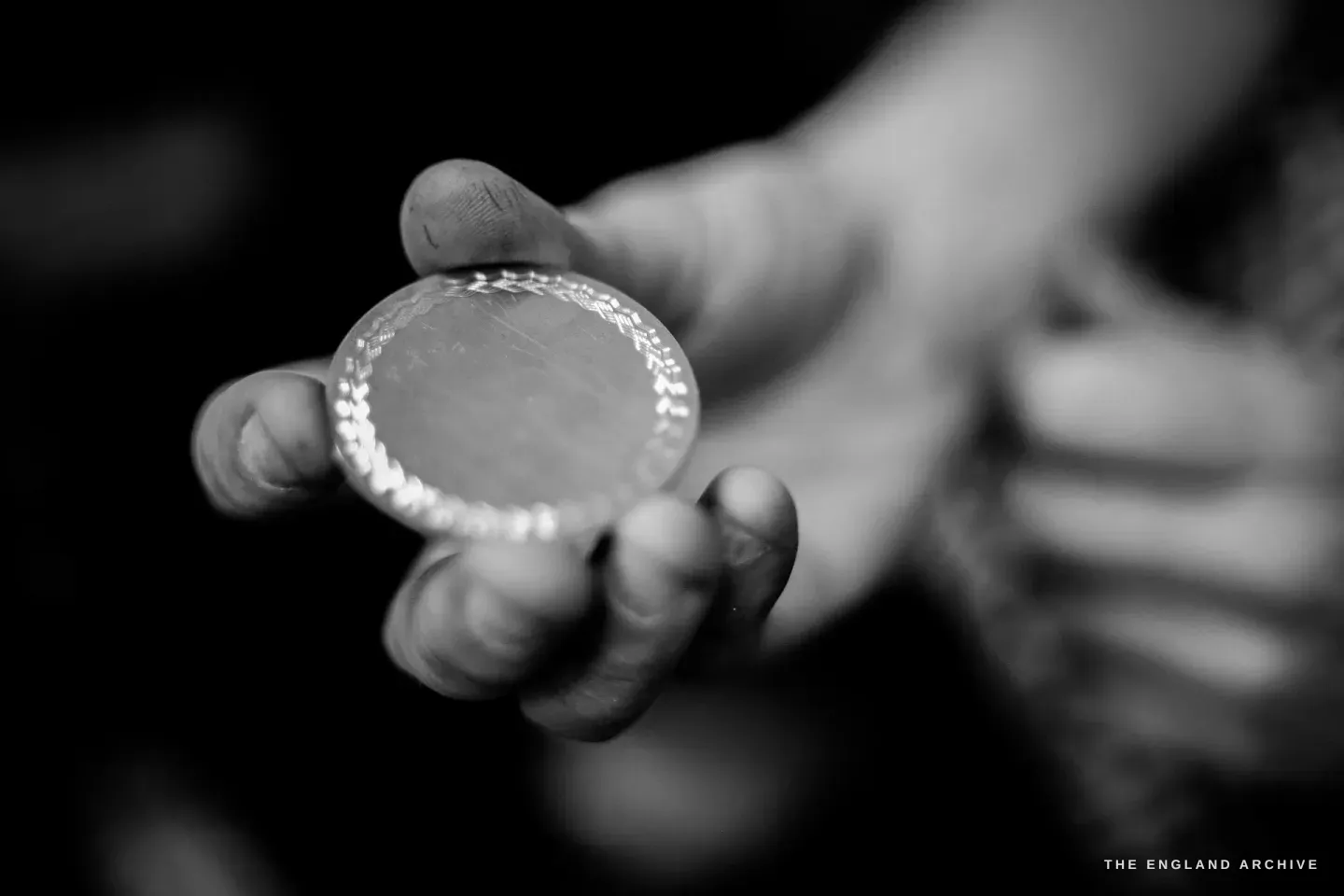
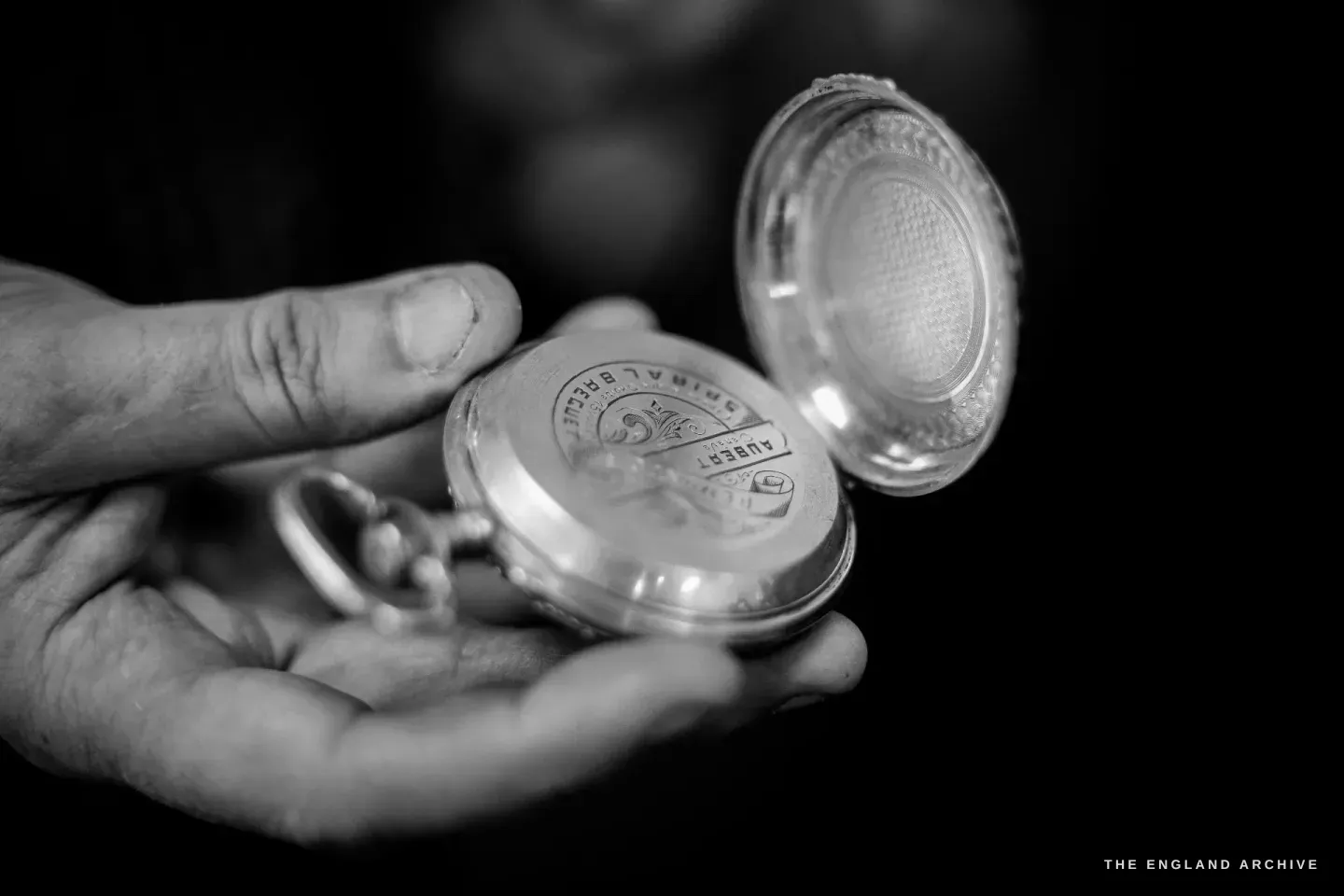
Engine turning is one half of what he does; the case is the other. Seth Kennedy makes watch cases by hand - the metal body that holds and protects a movement - in the period-correct way, which is a skill almost entirely lost to factory production. He also services and restores antique pocket watches, from the early English makers to twentieth-century complications. One open case on the bench carries the engraving Spiral Breguet, Aubert, Geneve; the inner lid is engine-turned, the kind of detail most owners never see and every good maker finishes anyway.
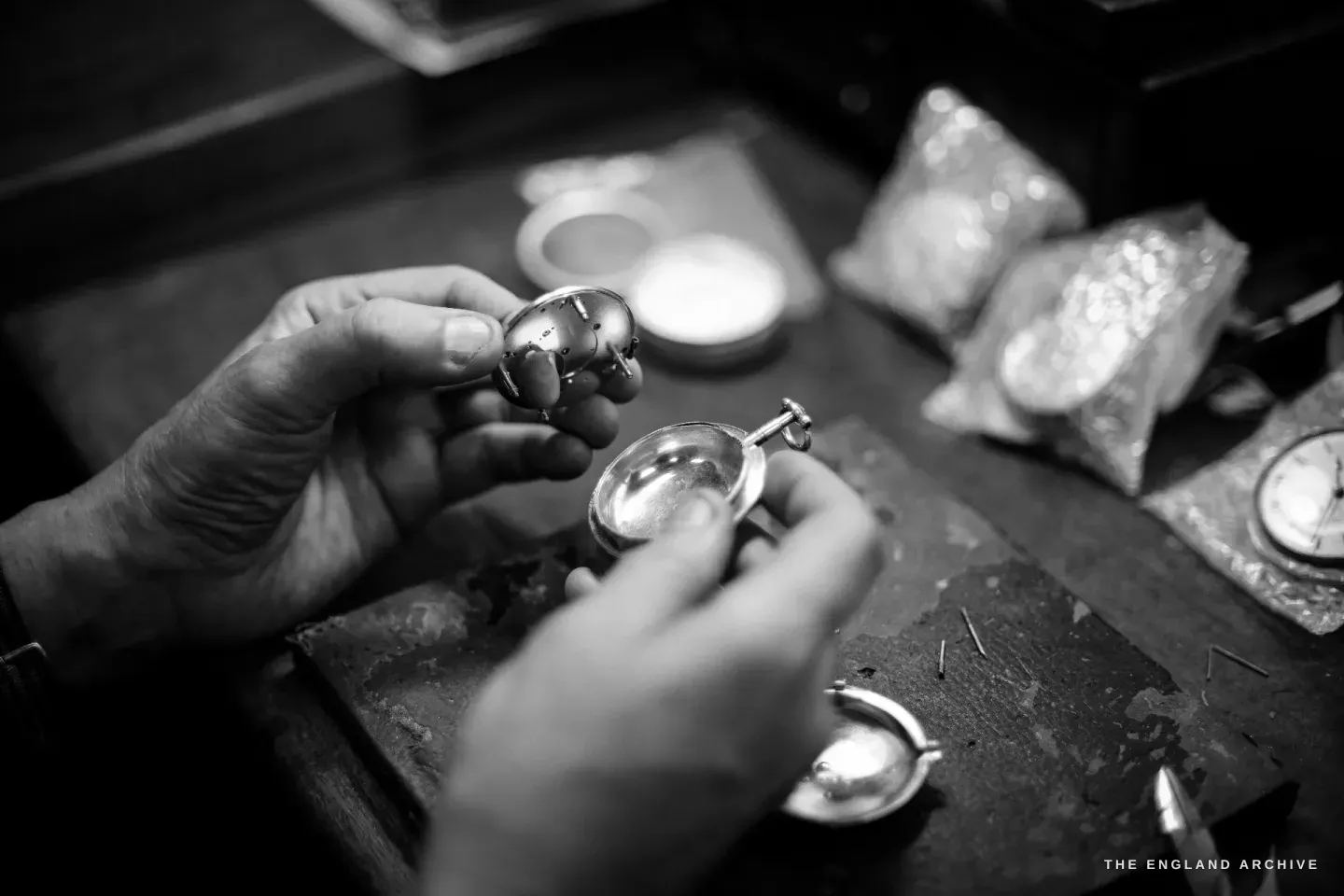
When he laid the work out for me it told the story better than any biography could: a tray of guilloche discs, each cut to a different pattern, and a row of silver pocket watches on white card. This is the output of a one-man workshop that does not advertise and does not need to - it travels by word of mouth among collectors, restorers and the trade. I have rarely seen so much skill kept so quietly.
In 2024 the Crown Jeweller sent him a plain dome of solid eighteen-carat gold and asked him to transform it. It was the mount for the Royal Family Order of King Charles III - the small painted portrait of the sovereign that the senior royal women wear, on a silk bow, at the most formal occasions. Kennedy engine-turned the back of it on the rose engine. Queen Camilla wore the finished order for the first time at the state banquet for Japan in June 2024. The work had passed before the King and Queen; the hands that cut it had not.
There is a good detail behind it. When the rose engine needed a particular part - a shaped, adjustable spring - he carried it down the hill to Much Hadham Forge, where Rich Maynard, eighteen years the village blacksmith, chalked the design out full size, heated and bent the steel, and made him one that worked and looked of a piece with the machine. A scrap of gold for the King, by way of a Hertfordshire smithy. The engine is as much a survivor as the craft it serves, and both are kept running by very few hands.
In 2023 the Queen Elizabeth Scholarship Trust gave Kennedy a Britford Bridge Trust Scholarship to push exactly this work further - case-making, and rose-engine turning above all. It paid for machinery, and for tuition from the people who still hold the knowledge: ten days with the engine turner Steven Keen, and a week with the Seattle conservator Brittany Nicole Cox, who came to his workshop to help set the machines up. That a man who had already built his own practice still sought them out tells you how thin the craft has worn. To go further, you have to find the few who can take you there - while they are still at the bench.
It is why I wanted Seth Kennedy to open the archive’s horology pillar. Engine turning is on the Heritage Crafts Red List as critically endangered: the machines are scarce, and the hands that can drive them and keep them running are scarcer still. Here is a maker at the height of his skill in a craft that could thin to almost nothing inside a generation - which is precisely the work I built this archive to record, while it can still be recorded from the man himself.
He is easy in the room, the way a person is in a space shaped around their own hands. We made the portraits where he works - at the bench under the lamp, seated at the rose engine, standing among the machines with the Forth and Back map behind him. Nothing arranged: a man at ease in the room he works in.
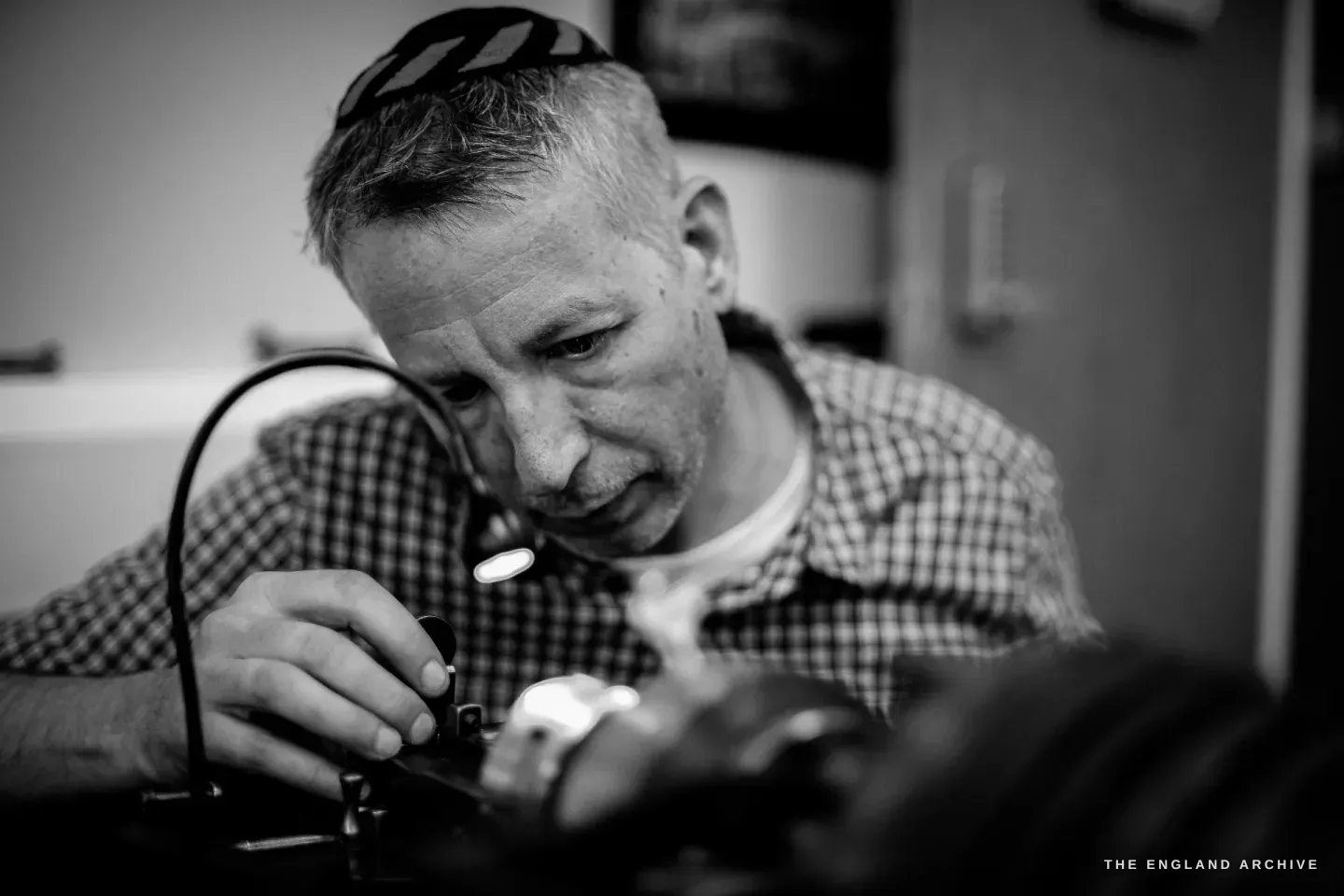
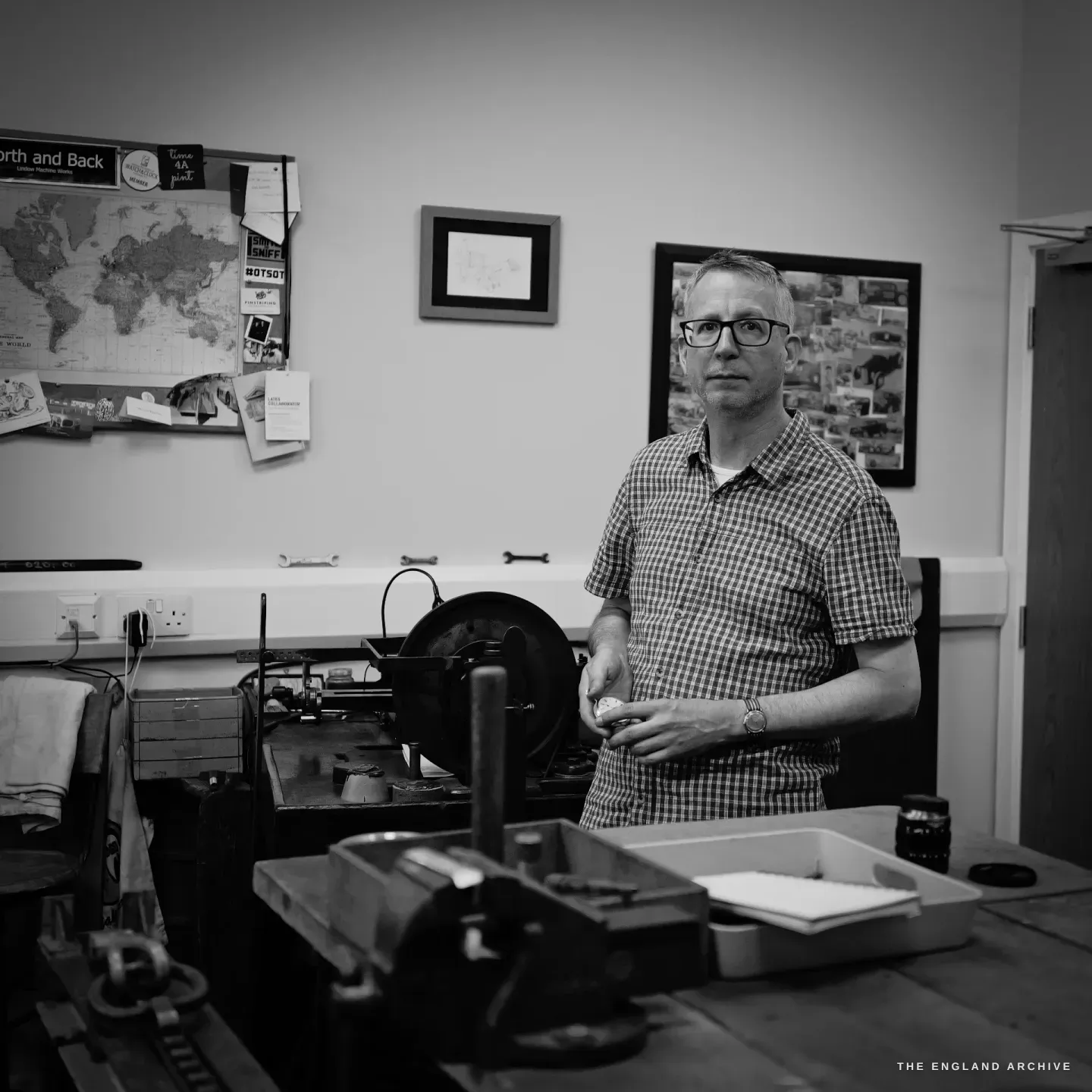
This is the archive’s first record of Seth Kennedy, and the first entry in its horology pillar, made in his workshop at Grandeys Place in May 2026: the route in from engineering, the informal training and the method he built himself, the two engines and the patterns they cut, the cases and the restorations, the gold mount for the Crown. Engine turning is critically endangered, and the people who can work it at this level are few. The archive will be back - there is a great deal more of this craft to record, and the time to record it is now.