Makers
Paul Weatherstone
Cutler · Chimo Sheffield
Sheffield, South Yorkshire
Cutler · Chimo Sheffield
Sheffield, South Yorkshire
The hard part is not the machine. The hard part is keeping a young person interested in a repetitive job long enough to become good at it.
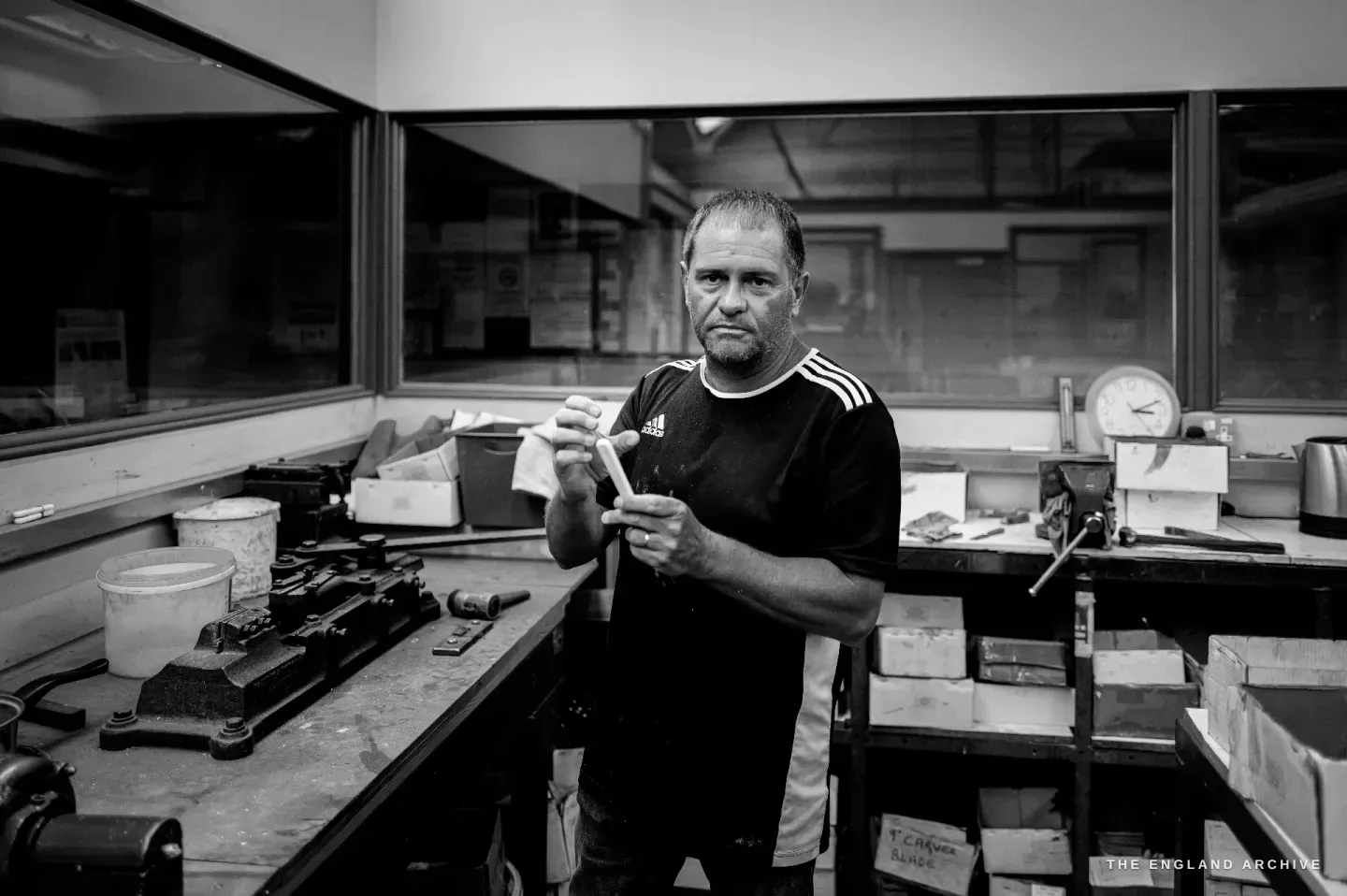
If Phil Benton’s end of Chimo is where a knife is stamped and formed, Paul Weatherstone’s end is where it becomes a knife you would actually pick up. His section takes the parts the rest of the factory has made and brings them together - blade to handle, edge to blade - and sends out the finished thing.
Paul has been at Chimo for fifteen years. He did not start in cutlery; he came to it from dye printing and a few other trades before that, walked in, apprenticed for about four months, and stayed. That is a recurring Sheffield story - the trade takes people sideways, late, by accident, and then keeps them - and Paul tells it cheerfully. He is warm, quick and funny, and the morning in his section was one of the easiest hours of conversation the archive has had.
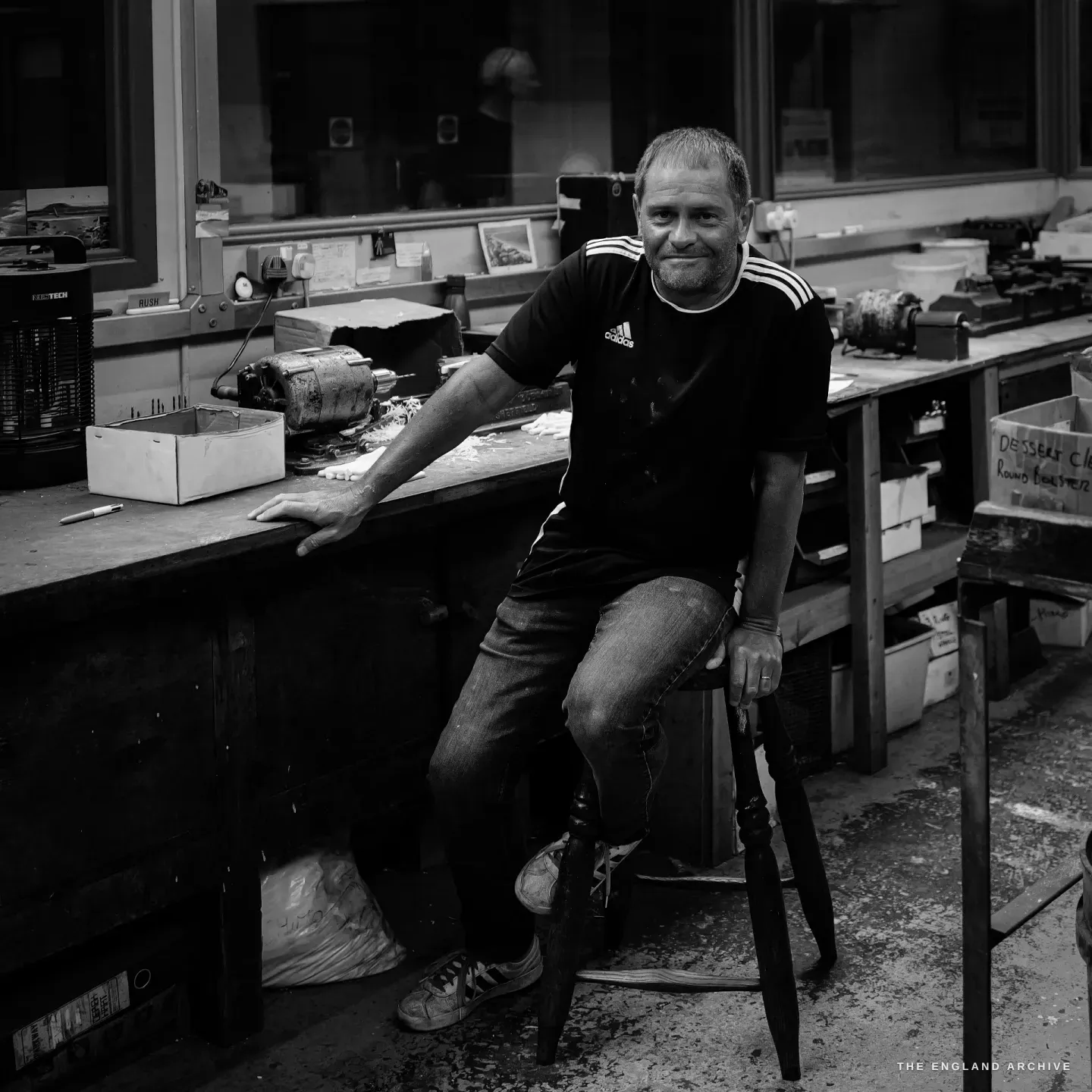
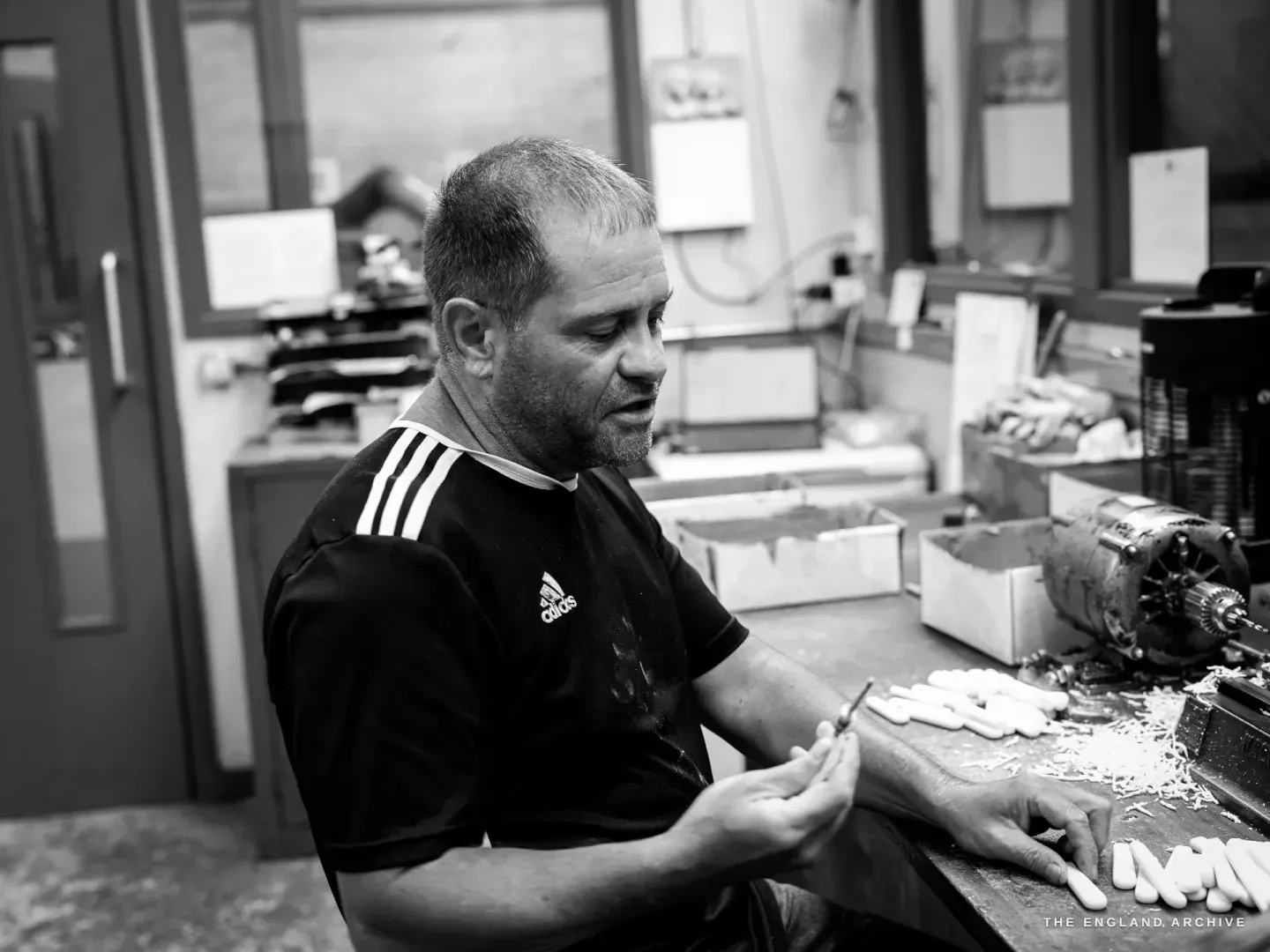
To understand Paul’s section you have to follow a single knife into it. A table knife is two parts - a steel blade and a handle - and they reach Paul separately. The blades come from the cutlery end of the works. The handles arrive already shaped: cut to their outline elsewhere in the factory, then run through tumblers - rotating barrels filled with abrasive media that roll over the parts for hours, knocking off every cut edge and burr until the surface comes out smooth and even. By the time a tray of them lands on Paul’s bench they are pale, cream-coloured, finished on the outside, and completely solid - no hole, no blade, nothing yet to make them a knife.
The handle looks like bone or ivory and is neither. Modern Sheffield cutlery of this kind uses a hard-wearing material that holds the warm, creamy look of old bone-handled cutlery but is dishwasher-safe and far tougher than the bone it replaced. Getting the right modern material to carry an old look is itself part of the craft and took numerous attempts to get right; it is what lets a knife like this be used every day rather than kept for best.
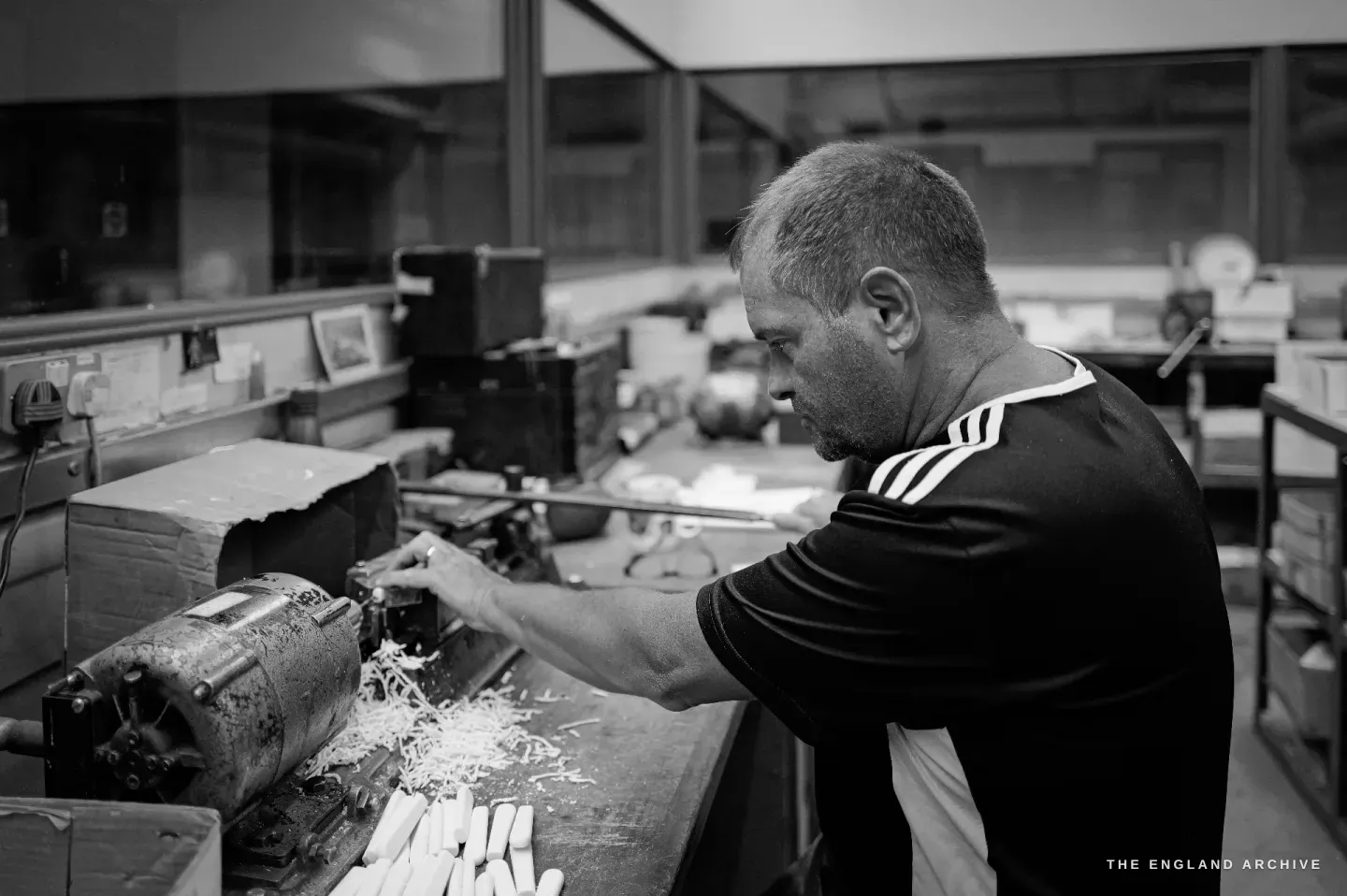
Paul’s first job is to make a home for the blade. Each solid handle goes to a drilling machine, and Paul sinks a hole into its end - bored to a precise depth and width, because it has to take the tang (the tapered spike at the base of the blade that anchors it inside the handle) snugly and straight. Drill it crooked and the blade sits crooked forever; drill it too wide and the join is loose. This is the quiet, exacting part of the work, done one handle at a time over a scatter of blanks, and it is why his bench is heaped with pale handles in every state from solid to drilled.
Then the blade goes in - and this is the part that surprised me. There is no glue. The tang is heated until it is hot enough to slightly melt and expand into the resin, and Paul drives it down into the drilled hole. As it goes in it softens the walls of the bore around itself; as it cools, the resin closes back and grips the metal along its whole length. The blade is now locked in by the handle’s own material, set around the tang like ice around a stick. No adhesive, no rivet, no visible fixing - just heat, a drilled hole, and one material seizing onto another. Paul turned each knife in his hands as it came off, checking the blade had seated straight and tight before it moved on.
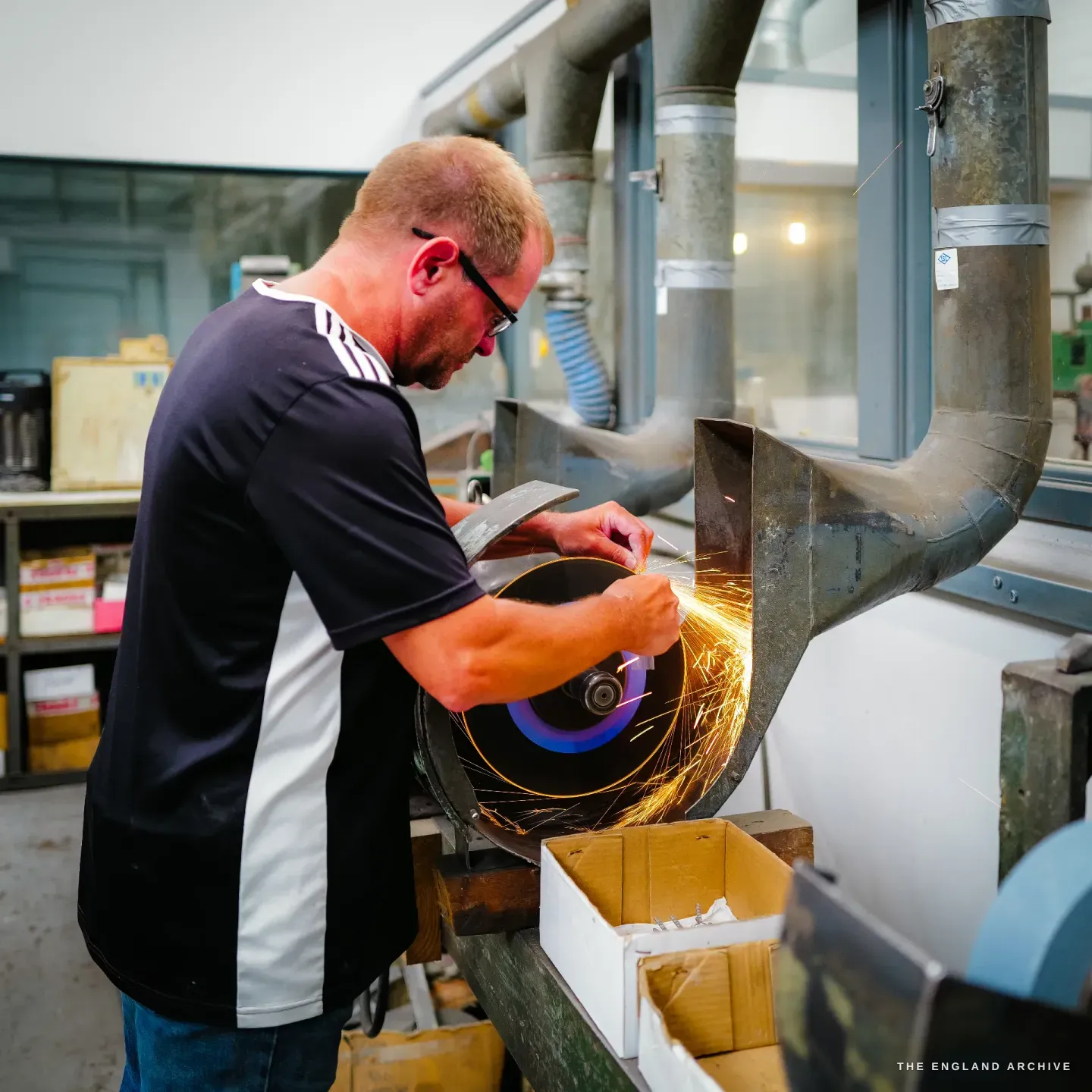
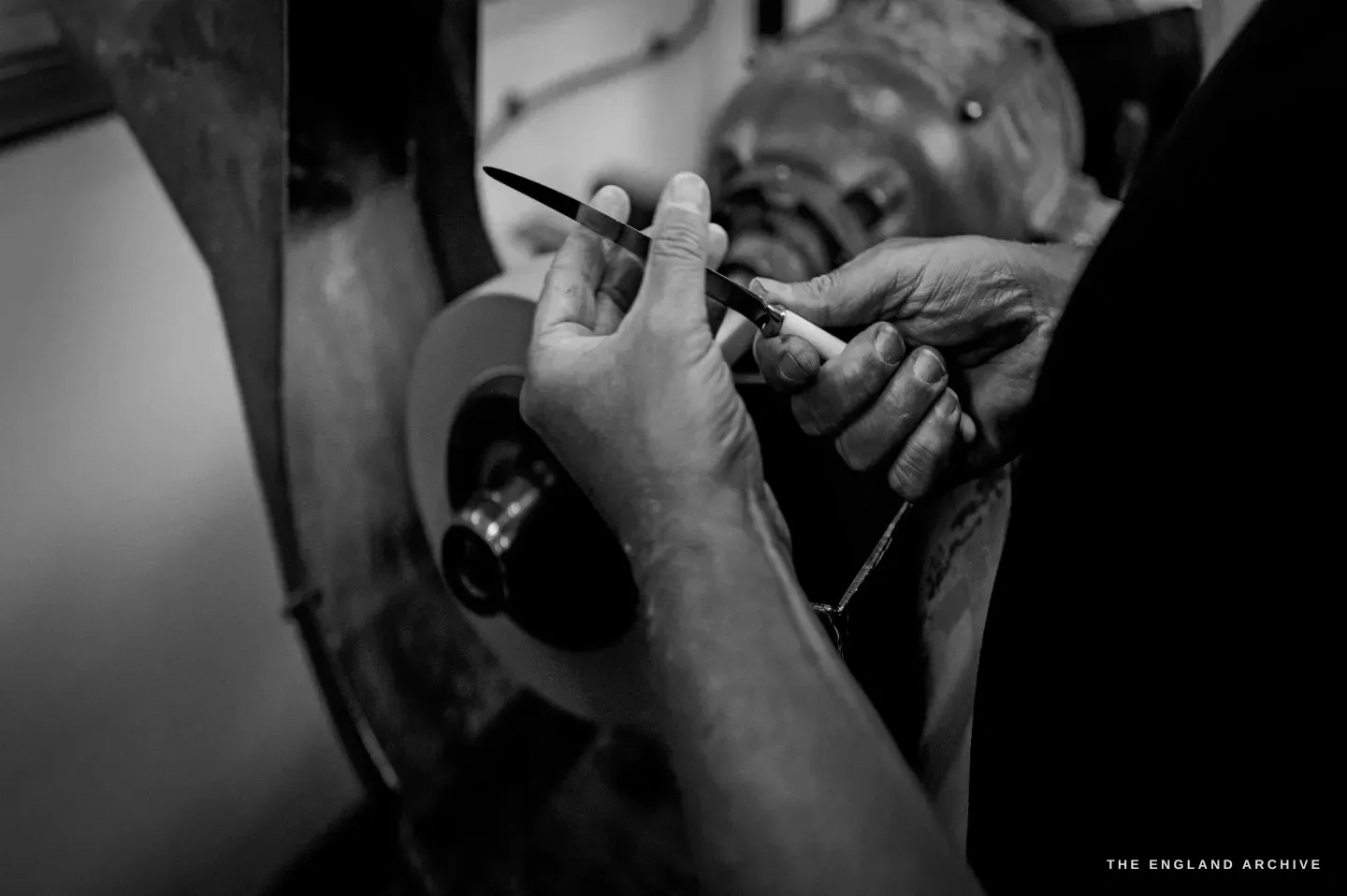
Now it is a knife, but a blunt one. The blade has to be ground to an edge, and on a table knife that edge is usually a fine serration - the row of small teeth that lets it cut without being dangerously sharp. Paul takes the blade to a grinding wheel and works the edge against it, and where the steel meets the stone it throws a hard, bright arc of sparks. He works in close, glasses down, both hands on the knife, leaning his whole weight into the wheel and reading the edge by eye and by feel - the judgement you only have after years of doing it, knowing exactly how long to hold the steel to the stone before it is right.
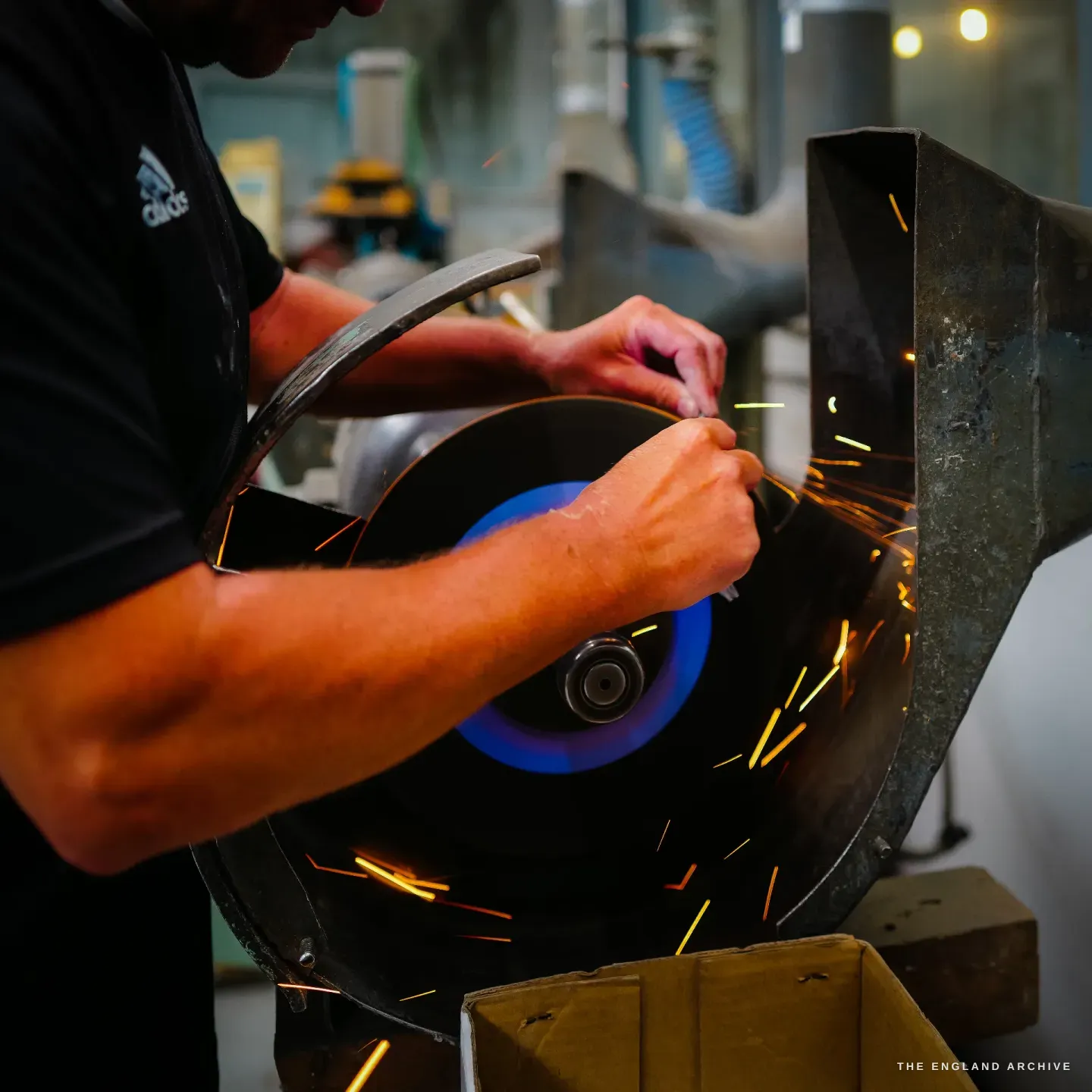
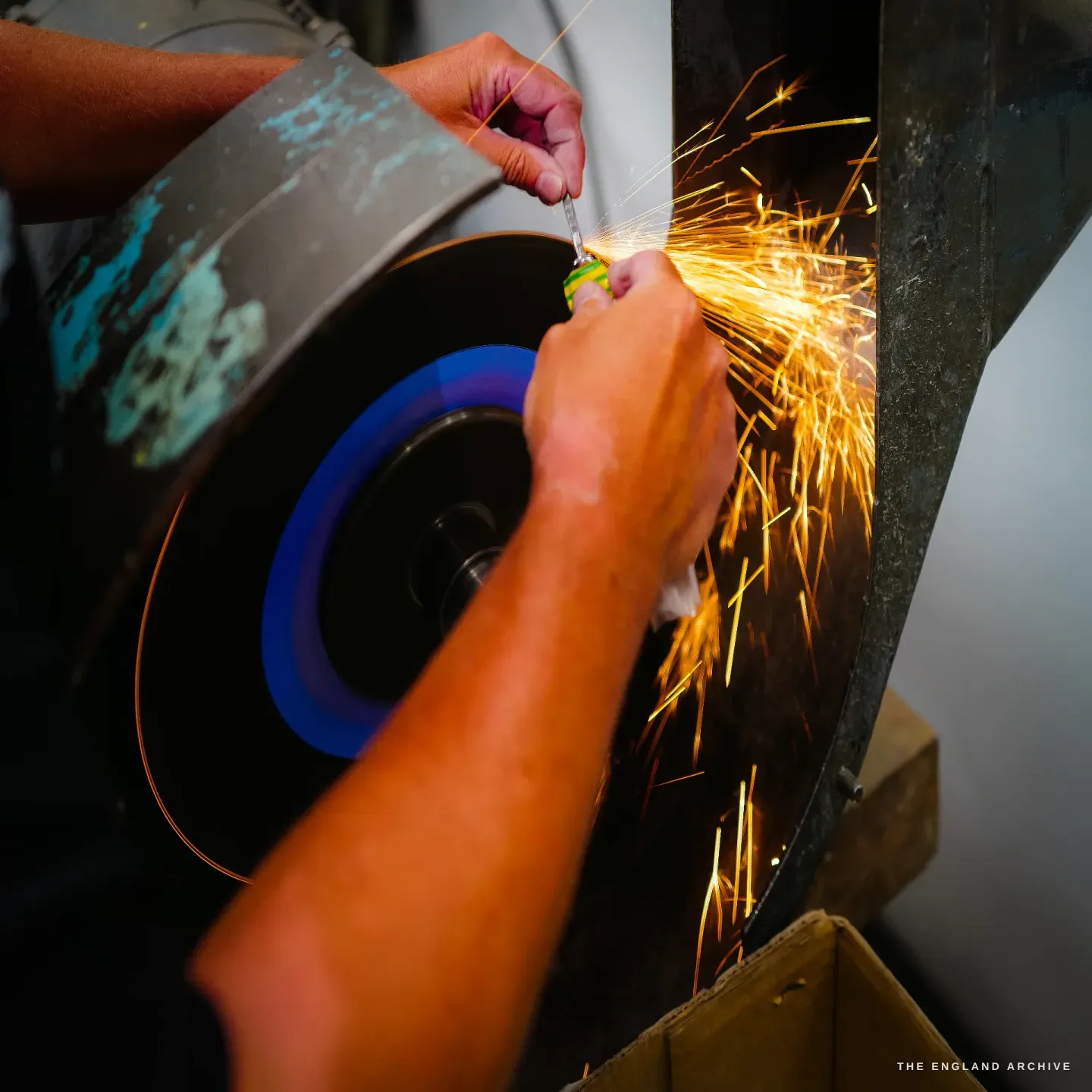
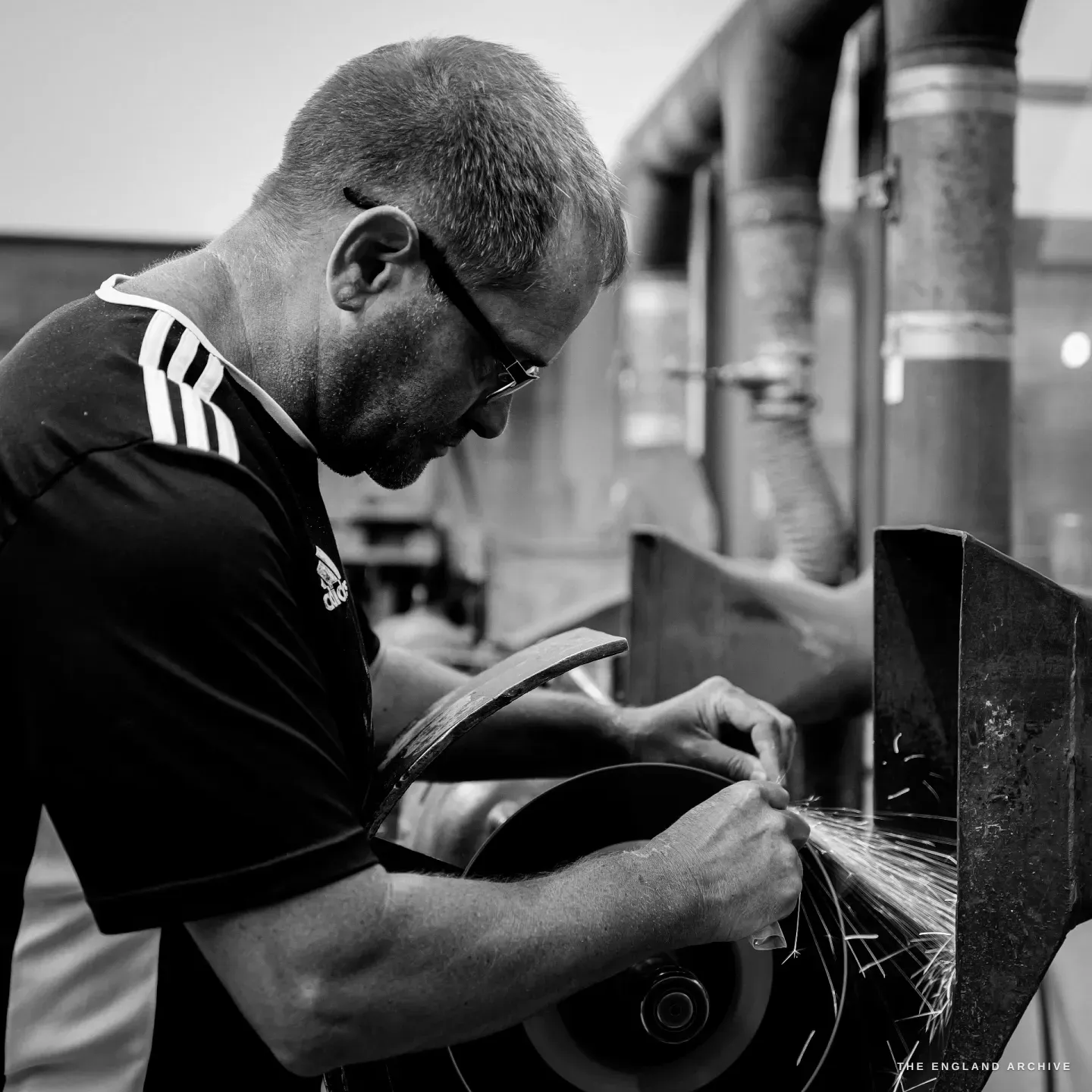
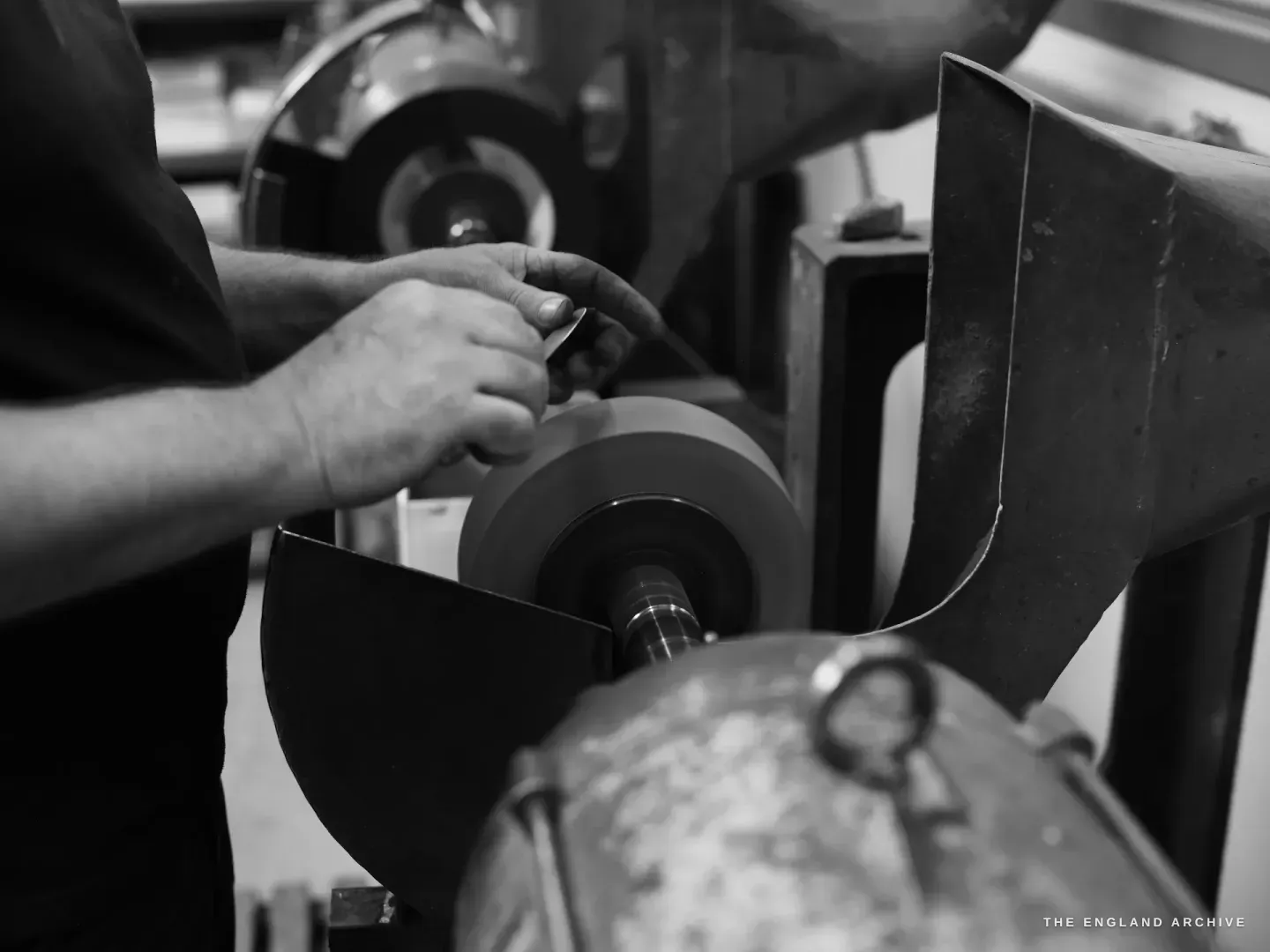
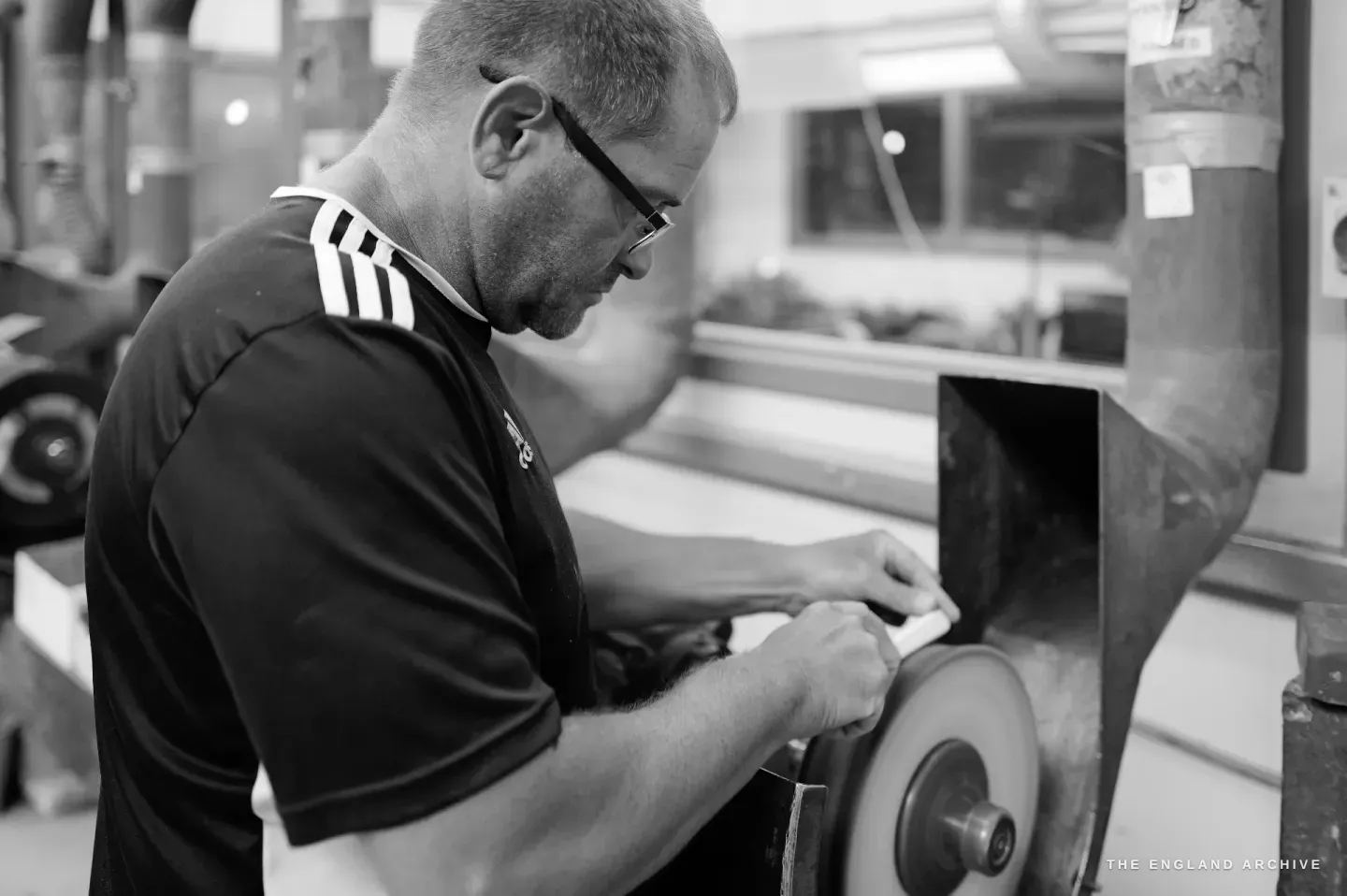
The last stage is the finish. The ground blade is taken down through softer wheels - glazing and polishing mops that carry progressively finer compound - until the grey, freshly-ground steel comes up bright and even. Paul works the blade against the wheel, then the handle where it meets the steel, easing out every mark left by the earlier stages so the join between blade and handle reads as one clean line. What goes into the box at the end is a single finished object: a knife that began the morning as a loose blade and a solid, blank handle on opposite sides of his bench.
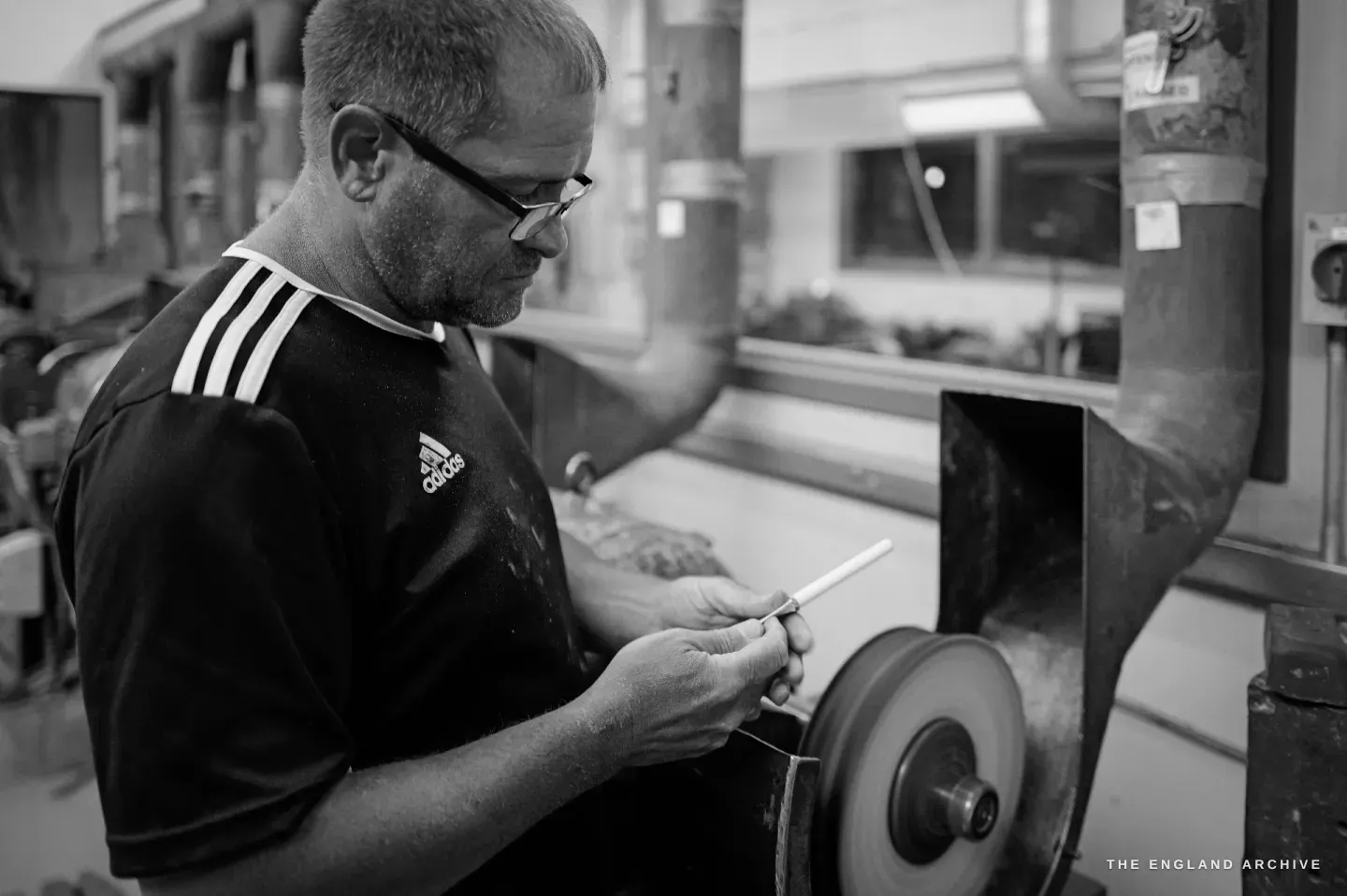
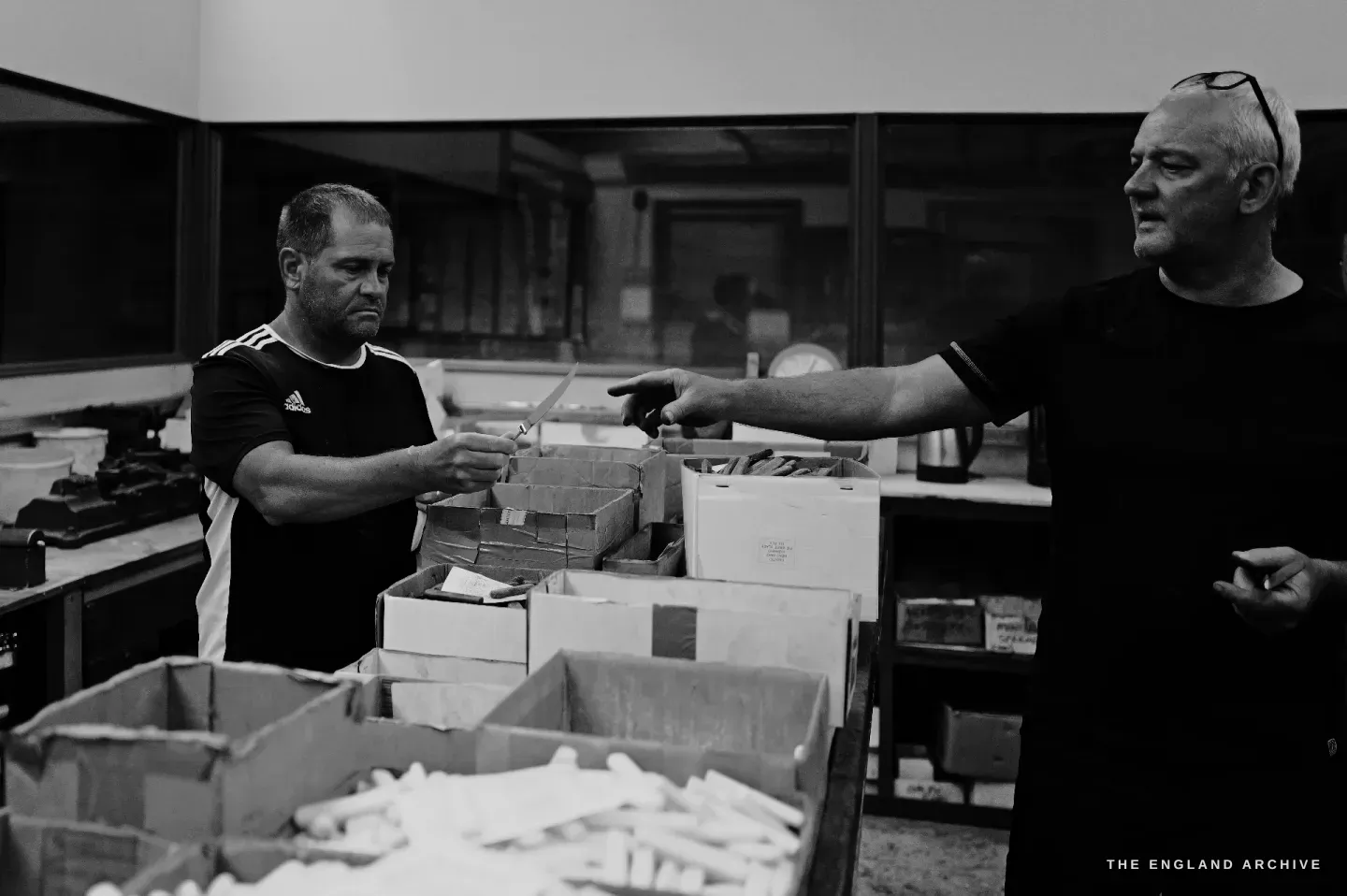
The part of Paul’s job that he talked about most is the part that has nothing to do with steel. Paul runs apprenticeships at Chimo - he is the one who takes on the young people who come in, and the one responsible for turning them into cutlers. And the hardest thing about that, he told me, is not teaching the hands. The hands are learnable. The hard thing is that the work is repetitive, and a sixteen- or seventeen-year-old will lose interest fast if no one is paying attention to them as a person.
So a great deal of his time, he said, goes on exactly that: keeping an apprentice’s head in a good place. Reading when someone is flagging. Knowing when to change the task, when to push, when to back off, when to just talk. He spoke about the mental state of his apprentices with real care - as the thing that actually determines whether a young person stays in the trade or drifts out of it. In a craft on the Heritage Crafts Red List, that pastoral instinct is not a soft extra; it is the whole mechanism by which the skill survives into another generation.
This is precisely the work the archive wants to support. When our apprenticeship fund goes live, Paul is exactly the kind of person we hope to work with - someone already doing the patient, unglamorous job of bringing people through, who could help make sure that funded apprenticeships actually land and actually last.
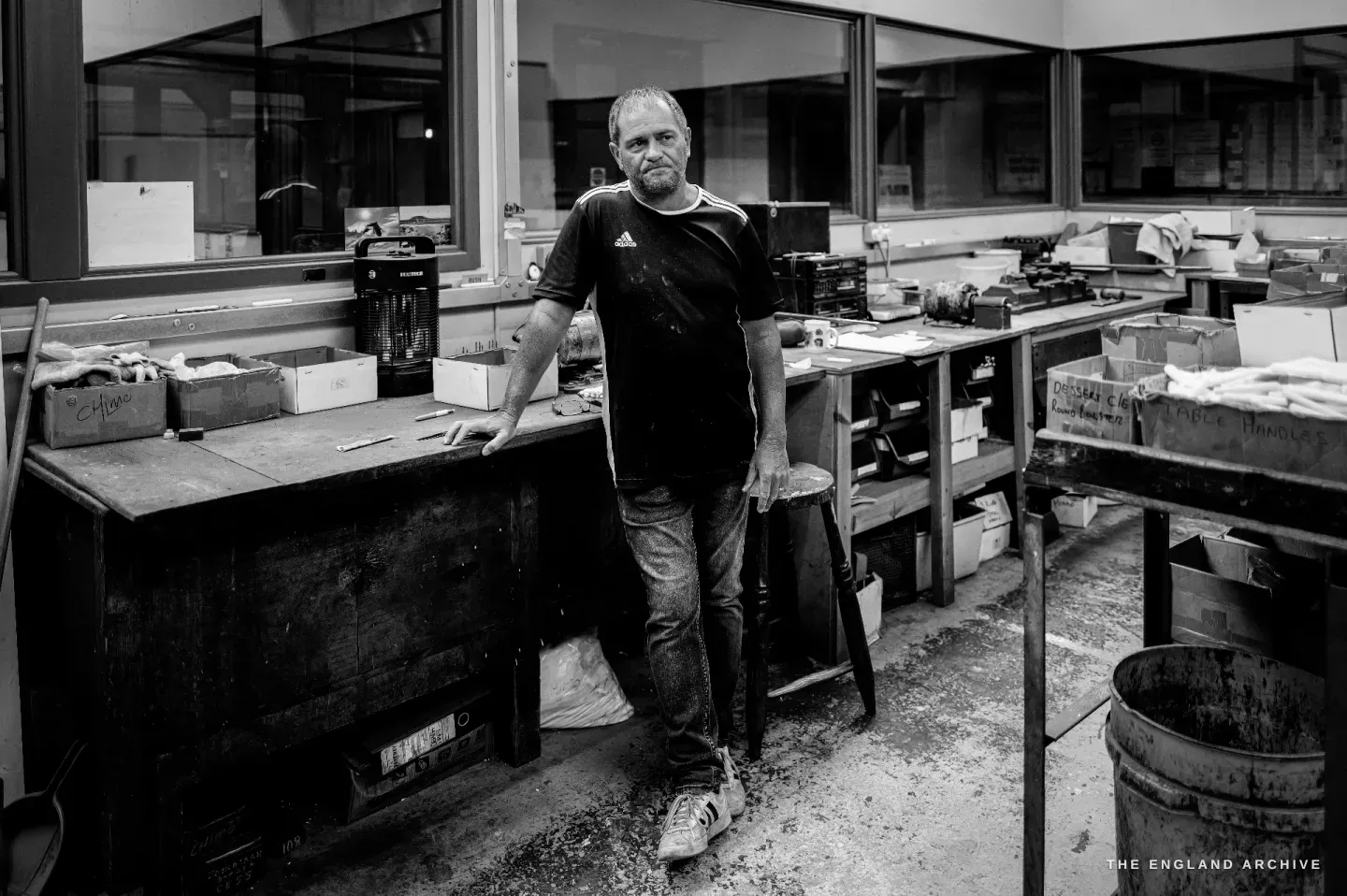
Paul is good company. He explains his work without a trace of mystery about it, jokes easily, and clearly likes both the craft and the people he brings into it. There is none of the guardedness you sometimes meet in a working factory; he simply showed me what he does and why, and made it fun while he did. The archive will be back to Sheffield, and Paul - both for his own section and for the apprentices coming up behind him - is someone we expect to keep working with.
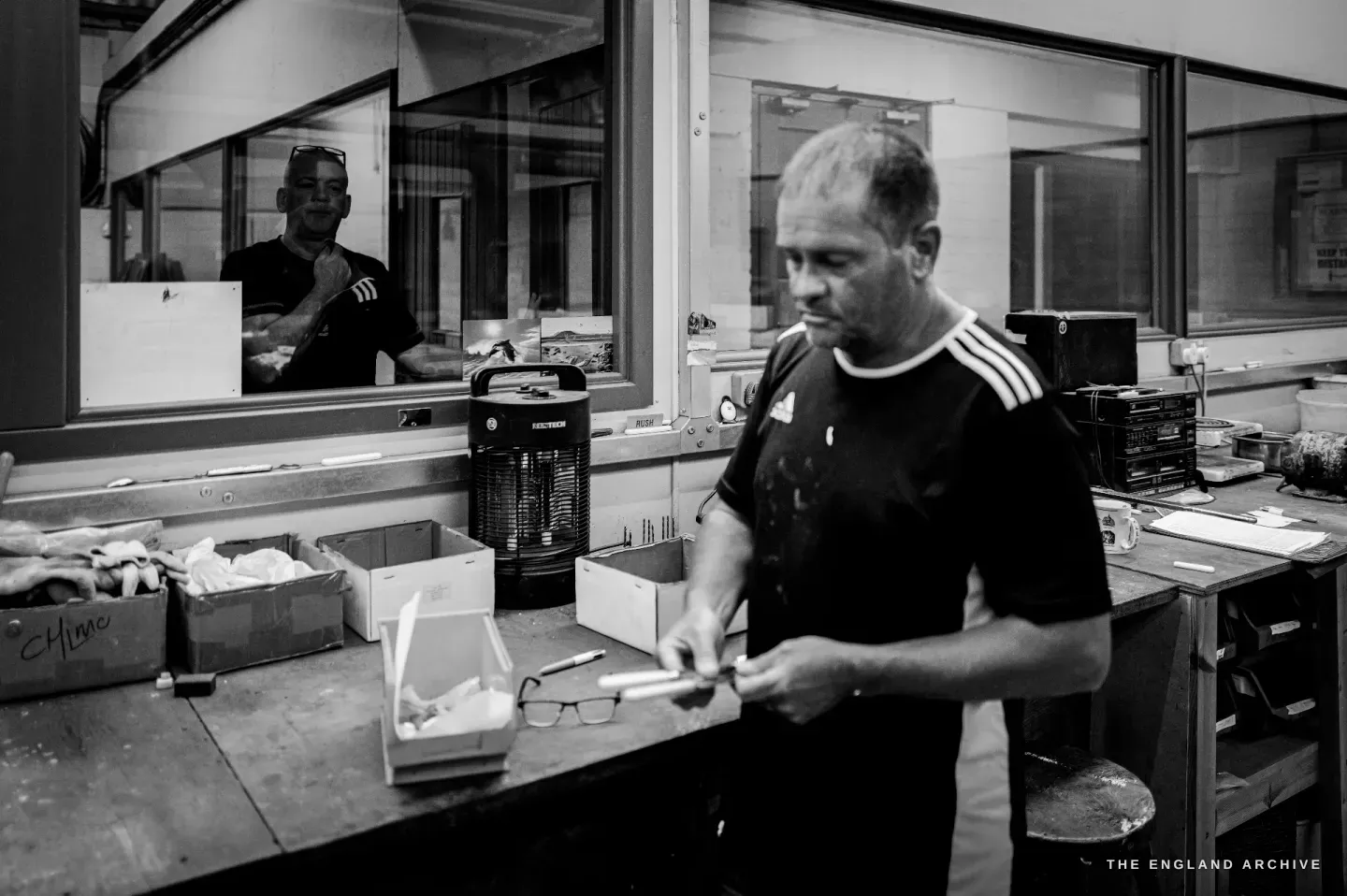
This is the archive’s record of Paul Weatherstone, made at Chimo Sheffield in June 2026: a cutler who came to the trade sideways and gave it fifteen years, who finishes the knives - drilling the handle, heat-setting the tang, grinding and polishing the blade - and who spends as much of his day looking after the young people learning the craft as he does at the wheel. Sheffield cutlery sits on the Heritage Crafts Red List; people like Paul, and the apprentices he keeps interested, are how it stays off the part of the list marked extinct.