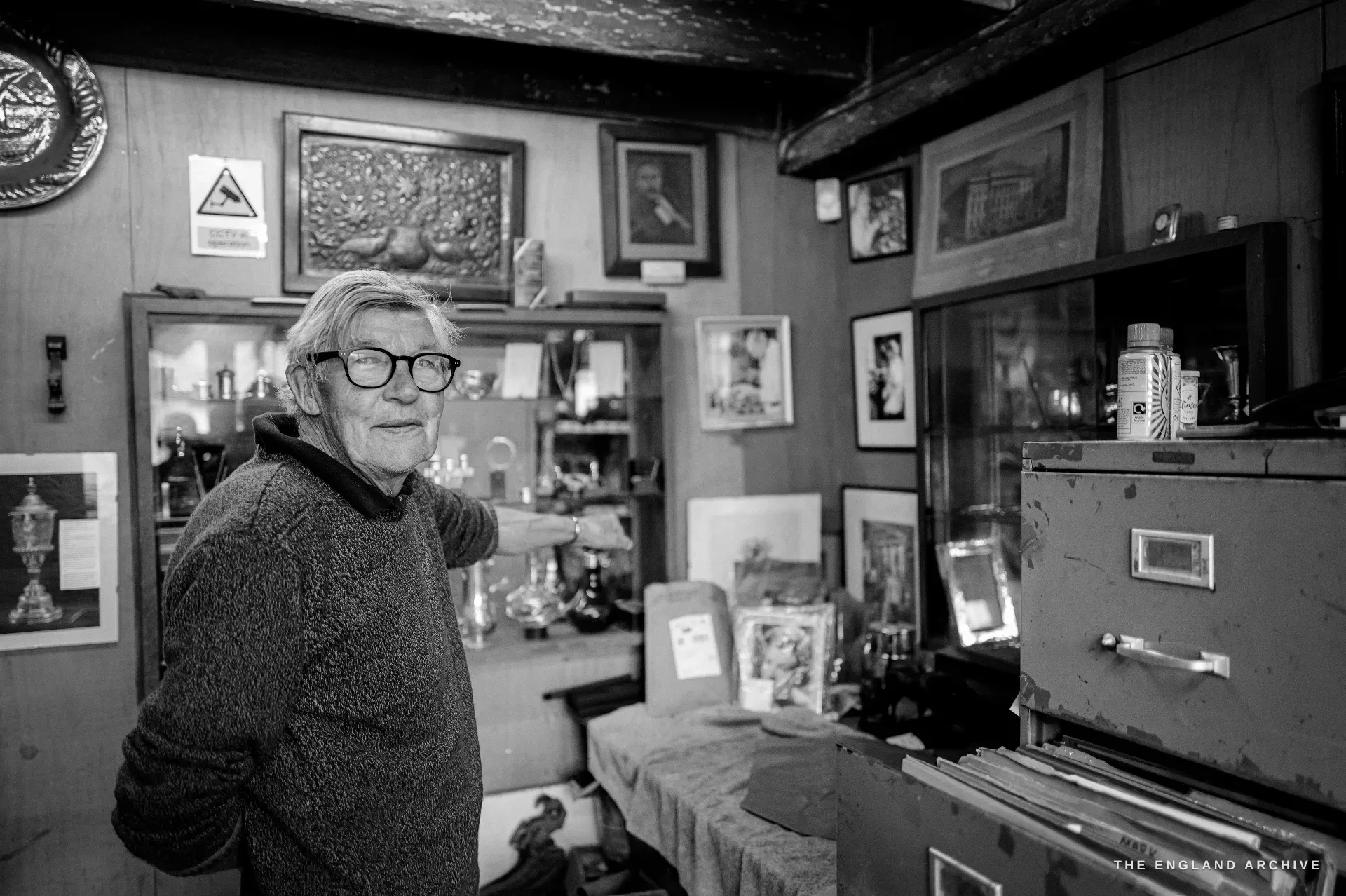
David Hart, eighty-seven, turning to face the camera in the showroom of the last continuously running workshop of Ashbee’s Guild of Handicraft - the circular Guild plaque on the wall behind him, a century of framed photographs around it. The frame is a portrait of the man who is the through-line of the whole room.
- The decision
- The temptation in a room this photogenic is to photograph the room. The decision was the opposite: keep the frame on the man and let the showroom - the framed photographs, the Guild plaque - fall to a soft, legible background that places him without competing with him. The workshop earns its own frames elsewhere in the record; this one is the portrait.
- The moment
- He turned toward the camera mid-thought, not posed. The half-turn is the picture: a man caught between the showroom he runs and the lineage on the wall behind him. A beat earlier or later and it is a snapshot; the frame waits for the moment his eyeline and the plaque sit in the same plane.
- The camera
- The Leica Q3, because the visit was documentary and the moment would not wait for a tripod. A fixed 28mm means you move your feet, not a zoom ring, which keeps you in the room and close to the work rather than standing back and reaching in.
- The tone
- Monochrome, without hesitation. The subject is a man and seventy years of practice, none of which depends on colour. Under the archive’s tone rule a portrait is always black and white; colour is reserved for frames whose meaning is the colour itself, and this is not one.