A Definitive Guide · CP-0006
Thames clinker boat building
The clinker-built wooden river boats that have carried passengers up and down the Thames since the Victorian period - the skiffs, slipper launches, gigs, and pleasure boats that defined the river's working rhythm for a century. The yards that still build and repair them are a small handful, mostly in the Middle Thames around Chertsey, Laleham, and Henley, working in a method (overlapping planks fastened to a frame, copper-clenched, caulked with cotton) that has changed only marginally since the 1880s.
§ 1 · The trade
What clinker building is.
A clinker-built boat is one whose hull is formed from overlapping planks - each plank set so its lower edge laps over the upper edge of the plank below, fastened together by hand-clenched copper rivets, the whole assembly bound to an internal frame of timber ribs. The overlap (the land) is what gives the hull its strength against the river's working forces; the rivets are what hold the laps tight; and the frames are what give the hull its shape. The technique is much older than the Thames pleasure-boat trade - clinker construction goes back through Viking longships to the early Iron Age - but the form documented on this page is the specifically English Victorian-into-Edwardian river boat that the Thames yards perfected.
What the Thames yards built were skiffs (rowing boats for one to four people), slipper launches (small motor pleasure-boats with the characteristic stern that slopes into the water), gigs (longer, narrower racing boats), umpire launches, randans, and a range of larger pleasure-craft including the steam-powered river launches that define the Edwardian Thames in popular imagination. By the late nineteenth century the river held thousands of these boats, built by dozens of yards, hired out at every reach by the day, the week, or the season. The river was a working pleasure ground, and the boats were its working stock.
The trade today is restoration first, new building second. Surviving Victorian and Edwardian boats are too valuable to scrap and too specific to be replaced with modern equivalents - their dimensions, their lines, and their handling characteristics are all part of the river's documented heritage. The yards that remain are the ones that can rebuild a hundred-and-twenty-year-old slipper launch back to working condition, and that can occasionally take a commission for a new boat built to traditional specification. The market is small, the labour is intensive, and the practitioners are few.
The Heritage Crafts Red List classifies the trade as Endangered: a small number of working yards, none with more than three or four working boatbuilders, almost all reliant on a senior practitioner whose retirement is the immediate threat. The yards that exist today often carry the same family name through three generations - the Dennetts at Laleham are typical, with the third generation now working alongside the second.
§ 2 · History
Two thousand years of clinker; a hundred-and-fifty of Thames pleasure.
Clinker construction is among the oldest documented methods of building a boat. The Hjortspring boat (Denmark, 4th century BC), the Nydam boat (4th century AD), and the Sutton Hoo ship (early 7th century AD, found in Suffolk) are all clinker-built; the technique reached its high-medieval refinement in the Norse longship and the English wic-cog. Clinker remained the dominant northern European method for working boats - fishing, river, coastal trading - until the seventeenth century, when carvel construction (planks butted edge-to-edge over the frames) overtook it for larger vessels.
Clinker survived as the method of choice for smaller boats, particularly inland and inshore working craft. By the early nineteenth century the Thames was producing clinker-built river boats in volume, and the second half of the century - as railway expansion brought Londoners up the river for weekend leisure - turned the trade into one of the river's principal industries. The 1870s through the 1900s were the peak. By 1885 the Henley reach alone held perhaps fifty hire fleets; the river between Oxford and London supported scores of yards.
Two contemporary documents define the period in popular memory. Three Men in a Boat (Jerome K. Jerome, 1889) describes a Victorian Thames boating holiday in detail; the boat itself is a clinker-built skiff hired from a Thames Ditton yard. The Wind in the Willows (Kenneth Grahame, 1908) opens with Mole and Rat in a river boat that is unambiguously clinker - "a little bow that swept down the line of the river" - and the book's quiet idolising of the river boat is the single most influential cultural image of the trade.
The First World War took many of the boatbuilders into navy service; the Second compounded the loss; the rise of fibreglass in the 1960s and 1970s removed almost all the demand for new wooden boats. By the late twentieth century the trade had shrunk to a handful of yards, mostly maintained by the Edwardian boats that surviving owners wanted preserved. What is left today is the restoration-and-occasional-new-build market, run by a small number of yards whose names recur across the heritage-boat-owner community: Dennett at Laleham, Freebody at Hurley, Stanley & Thomas at Windsor, and a few others.
§ 3 · The work
From a stem to a launch.
A new build begins at the lofting floor. The boat's lines are laid out at full size in pencil on a long timber floor, with sections drawn for each station along the boat's length. From the loftings the builder takes off moulds - timber templates that define the shape of the hull at each station - and sets them up on a building jig. The hull is built around them.
The keel is laid first. Then the stem (the timber at the bow) and the sternpost are scarfed in. The garboard - the lowest plank, lying alongside the keel - goes on next, fastened with copper rivets. Each successive plank is steamed to a pliable state, bent over the moulds, and clenched onto the plank below. The lap dimension is small but precise; the rivets are placed at regular intervals along the lap; each rivet is set with a dolly on one face and clenched over a copper rove on the other. A skiff carries several hundred rivets and is essentially fastened together by them.
Once all the planking is in place, the internal frames - thin steamed-oak ribs - are bent into the hull and through-fastened to each plank. The frames are what holds the hull's shape against the load it will take in service. The thwarts (cross-seats), the stern transom, the breast-hook (a structural piece at the bow), and the gunwales (the timbers along the upper edge) follow. A skiff at this stage is a complete hull but unsealed.
The hull is then caulked - cotton driven into the laps with a caulking iron - and pitched, painted, or varnished according to the boat's working role. The fittings (rowlocks, rudder, oars, knees, bow eyes) are added. The boat is launched, watered up to swell the timber, and trialled. A new build to traditional method takes a single skilled boatbuilder anywhere from six weeks (a small skiff) to most of a year (a slipper launch with full fit-out).
A restoration is the same operation in reverse and forward. The boat is stripped, surveyed, and the rotten or sprung components are replaced one at a time. The yards that do this well preserve the original timber wherever possible, copy the original lines exactly when replacement is needed, and document each component's provenance so the boat's history is not lost in the rebuild.
§ 4 · The yard
Tools, materials, and the working vocabulary.
Timber. Larch and English oak for the planks, with mahogany used in some periods and yards. Oak for the keel, stem, sternpost, and frames - traditionally English-grown oak, sawn green and air-dried in the yard's stack for years before use. Elm was the historical choice for keels (rot-resistant under water) until Dutch elm disease made it scarce. Modern yards often substitute iroko for elm. Spruce, pine, or Douglas fir for the lighter internal components.
Fastenings. Copper rivets and copper roves throughout the hull. Copper does not corrode in fresh water and the rivets work-harden as they are clenched, locking the planks tightly. A small Thames skiff might carry three hundred rivets; a slipper launch many thousand.
Steam box. A long box - traditionally timber, sometimes steel - in which planks and frames are softened by live steam before bending. Each plank is steamed for an hour or more, then taken straight to the hull and clamped into place while still pliable. The window between flexible and set is short; the work is hot, urgent, and physically demanding.
Caulking iron and mallet. Iron-bladed tools for driving cotton (and historically oakum) into the laps and seams. The caulking is what makes the hull water-tight; a poorly caulked boat leaks, a well-caulked one will run for decades without re-caulking.
Working vocabulary. The keel is the spine. The stem is the bow timber rising from the keel. The sternpost is the corresponding timber at the back. Planks overlap; the overlap is the land. Strakes is another word for planks. The garboard is the lowest plank. The sheer strake is the topmost. The hood end is a plank's end at the stem or stern. Frames are the internal ribs; floors sit across the keel to tie the frames. The thwart is a cross-seat. The breast-hook ties the stem to the gunwales. The knees are angled timbers reinforcing internal joins. To spile a plank is to take its shape from a template; to spring a plank is to bend it into place. To rebate the keel is to cut the angled groove where the garboard sits. The rove is the copper washer over which a rivet is clenched.
§ 5 · Documented on this archive
The boatbuilders the archive has met.
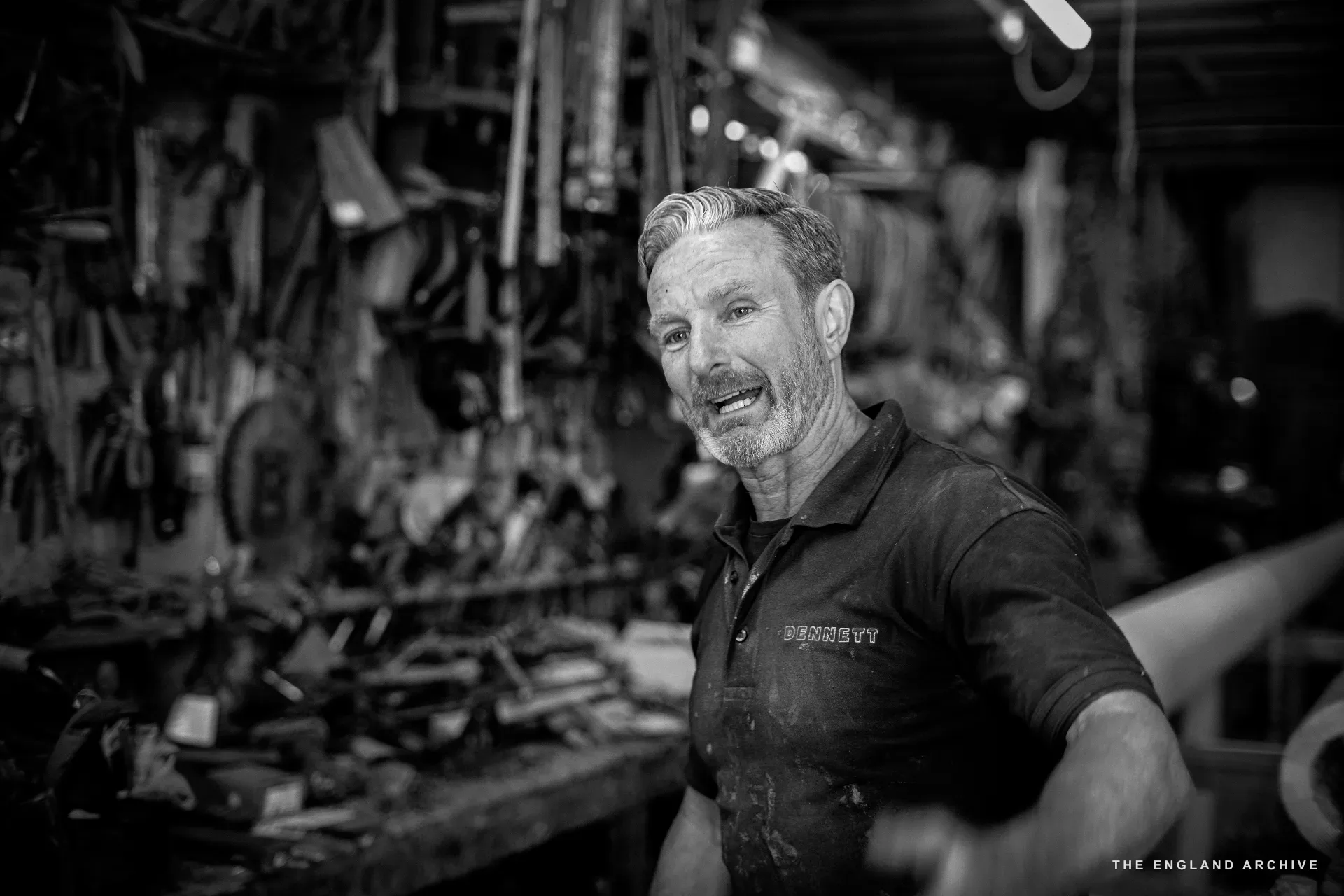
The archive's first Thames clinker boat-building subjects are father and son at Dennett Boat Builders in Laleham, Chertsey. The yard is one of the small handful still operating on the Middle Thames; the chain of trade-knowledge runs visibly through the family. The visit was a working morning on 23 April 2026, recorded in A Morning at Dennett Boat Builders.
§ 6 · The institutional landscape
Where the trade is held and taught.
The Thames Traditional Boat Society (TTBS). The principal institutional body for owners and builders of traditional Thames craft. Holds the annual Henley Traditional Boat Festival, publishes a regular journal, and is the gathering point for the community of restorers, owners, and yards. tradboat.com.
The River & Rowing Museum, Henley-on-Thames. Holds a major collection of Thames boats and boating history, including documented Edwardian skiffs, slipper launches, and Henley Royal Regatta racing craft. The museum is the closest thing the trade has to an institutional memory. rrm.co.uk.
The Boat Building Academy, Lyme Regis. The principal training body in the country for traditional wooden boat-building. Runs a long-form course (38-week professional course; shorter intensive courses) that produces most of the new entrants to the wider wooden-boat trade, including some who go on to specialise in clinker work on the Thames. boatbuildingacademy.com.
The International Boatbuilding Training College (IBTC), Lowestoft. The other significant English training body, with a long-running track record in clinker as well as carvel construction. Covers traditional and modern methods.
Working yards. The active practice of the trade lives in a small number of named yards: Dennett (Laleham), Freebody (Hurley), Stanley & Thomas (Windsor), Peter Freebody & Co. (Hurley), and a few others. Each yard combines new building, restoration, and maintenance work; each carries its own house style of craftsmanship. The yards know each other and occasionally cross-employ in busy seasons.
The Heritage Crafts Association (HCA). Maintains the Red List that classifies the trade as Endangered. heritagecrafts.org.uk/skills/redlist.
The Worshipful Company of Shipwrights. The City of London livery company. Funds bursaries and apprenticeship support across the wooden-boat trade, including occasional grants to clinker-building yards in the Thames area.
§ 7 · Pipeline status
What's already on the archive, and what comes next.
Stephen and Michael Dennett anchor the trade as it is currently practised at Laleham - one yard, one family chain, one specific bend of the Middle Thames. The next session is intended to set the Dennett record alongside a different yard's working tradition.
One further session planned
Next session. A separate Thames yard whose work covers a different reach of the river and a different generation of boat. The shortlist runs to two or three candidates - Freebody at Hurley, Stanley & Thomas at Windsor - each of which carries its own house tradition and its own working line. The aim is to set the Laleham record alongside one of them so the page reads as a record of the trade and not of one yard.
Status today: Partial. Two practitioners documented in one yard. One further yard's session in research; sponsorship would move it onto the calendar.
§ 8 · Sources
Citations and further reading.
- Heritage Crafts Association, Red List of Endangered Crafts, current edition. heritagecrafts.org.uk/skills/redlist.
- John Leather, Clinker Boatbuilding (Adlard Coles, 1973; reprinted). The standard practical reference for the trade as practised in mid-twentieth-century England.
- Jerome K. Jerome, Three Men in a Boat (1889). Period social history of the Victorian Thames pleasure-boating trade, with the working culture of the hire yards in close detail.
- Tony Lewis, Thames Skiffs and the Henley Regatta (River & Rowing Museum, 1995). On the racing-boat tradition that ran in parallel to the pleasure-boat trade through the same yards.
- Eric McKee, Working Boats of Britain: their shape and purpose (Conway Maritime Press, 1983). On the broader English clinker-built tradition outside the Thames.
- The Thames Traditional Boat Society, The Thames Trad. The society's regular journal. Back issues at the River & Rowing Museum library.
- A Morning at Dennett Boat Builders · the archive's own field record of the visit on 23 April 2026.