A Definitive Guide · CP-0004
Letter-cutting in stone
The English memorial letter, cut into stone with a hammer and chisel, in the lineage of Eric Gill and David Kindersley. The craft is on the Heritage Crafts Red List as Endangered: roughly thirty working letter-cutters across the country, most attached to two or three workshops, the rest in solo practice. The line of the trade runs unbroken from Trajan's Column to the bench at the Cardozo Kindersley Workshop in Cambridge, where the archive's first letter-cutting subjects work.
§ 1 · The trade
What letter-cutting in stone is.
Letter-cutting in stone is the cutting of an inscription - a name, a date, an epitaph, a dedication, a building's caption to itself - directly into the stone with a hammer and chisel. The forms are designed first on paper, drawn down onto the stone, and then cut by hand, V-section, into the surface. The cut is the letter; the letter is permanent.
The work is what produces a great deal of England's public lettering: the gravestone in the churchyard, the foundation stone over the door of a hospital, the war memorial in the village green, the engraved tablet on the wall of a college, the lettered memorial pillar that holds a name over a piece of ground for as long as the stone holds. None of those is a print or a stencil; each is a hand cut a chisel-stroke at a time.
The discipline sits at an intersection. It is partly typography - the design of the letter forms is a typographer's act, with the same attention to weight, proportion, and rhythm that a typesetter brings to a page. It is partly stone-mason's craft - the cutter knows how a particular limestone responds to a chisel, where it will splinter, where the bedding plane runs, what the stone will let them do and what it will not. It is partly editorial: an inscription says something specific, in a specific voice, for a specific reader, and the layout has to land that voice. A letter-cutter is all three.
Industrial sandblasting, CNC routing, and laser engraving have replaced hand-cutting for almost every routine commercial job. What remains for the hand-cutter is the work where the cut itself is the point - memorial stones, civic inscriptions, pieces commissioned because the maker's hand on the stone is what the client wants. That is a small market, and it is what the ~30 remaining working letter-cutters are sustaining.
§ 2 · Lineage
From Trajan's Column to the Cambridge bench.
The Roman capital cut into stone is the founding act of the lineage. The inscription at the base of Trajan's Column in Rome, cut around 113 AD, set down the proportions and rhythm of the classical Latin alphabet that everything English in this trade is descended from. Letter-cutters still measure their forms against it. The Trajan inscription is, in a real sense, the curriculum.
The English line that runs into the present day passes through three twentieth-century practitioners. Edward Johnston (1872 - 1944), the calligrapher who designed the Underground typeface and who taught Eric Gill how to hold a pen. Eric Gill (1882 - 1940), the sculptor and stonecutter who cut the lettering for the BBC's Broadcasting House and who designed the Gill Sans typeface. David Kindersley (1915 - 1995), Gill's apprentice from 1933, who founded the Cardozo Kindersley Workshop in Cambridge in 1946 and trained two generations of cutters into the same hand-discipline.
The line is unusual. Almost every other Red List craft has lost its institutional spine - the apprenticeships ended, the masters died without successors, the records were thrown out. Letter-cutting kept its spine. Kindersley taught his own children; his children taught their own apprentices; the apprentices teach their own. The Cardozo Kindersley Workshop runs continuously today, with Lida Kindersley as matriarch and Roxanne Kindersley as working head, training a small bench of cutters at any given time. The Lettering and Commemorative Arts Trust at Snape Maltings runs concurrent training. Other workshops exist, including independent practitioners outside the Kindersley line. The trade has not survived because the market is buoyant; it has survived because the people in it kept teaching.
What is on the Red List is not the lineage itself but the working count. The pipeline of new entrants is thin - the apprenticeships are unpaid for the first years, the commercial work is patchy, and many capable hands leave for typography, design, or other crafts that pay more reliably. If the count drops further the lineage will be intact but functionally inactive: the masters still alive, but no one cutting full-time. That's the threshold the Red List measures against.
§ 3 · The making
How a piece comes into being.
A commission begins on paper. The cutter draws the letterforms at full size, often in pencil at first, working through proportion and spacing for the specific phrase the inscription will hold. A name on a gravestone reads differently from a date over a doorway, which reads differently from a long literary quotation. The drawing pass works out, line by line, what each letter wants to be.
The drawing is then transferred to the stone. The cutter rules guidelines, redraws the letters in pencil directly on the surface, walks away, comes back, makes adjustments. A finished drawing on stone can take days to settle - the cutter is letting the eye find what is wrong before any chisel touches it. Once the drawing reads true, cutting begins.
The cut itself is V-section. The chisel is held at roughly thirty degrees to the surface, struck with a wooden or steel mallet, and run along the drawn edge of each stroke. Two cuts produce a V trough; the meeting point of the two cuts is the centre line of the letter stroke. The cutter works the cut in stages - rough first, then deeper, then refined - and each stroke ends in a serif or terminal that has to land cleanly. A wrong strike chips the edge and the letter is permanently flawed; the cutter cannot undo it.
The pace is unhurried. A modest gravestone - a name, a date, a short verse - might be six to ten days at the bench. A larger memorial pillar with a long inscription is weeks. The work is paid by the piece, not the hour, but the hourly rate that emerges is modest by professional standards. What the cutter is paid for is the permanence: the inscription is on the stone for as long as the stone exists, and the hand that cut it is in every cut.
The finishing varies by stone. Some inscriptions are filled with paint or gilded - the cut is V-sectioned and the paint sits in the trough. Some are left as cut, the V catching shadow and reading the letter through light alone. The Kindersley convention runs to unfilled cuts on most architectural and commemorative pieces, with paint reserved for inscriptions that need to read at distance.
§ 4 · The bench
Tools, materials, and the working vocabulary.
The chisel. Tungsten-carbide-tipped steel chisels in a range of widths from about 3mm up to 12mm. The cutter holds a small set ready at the bench and switches between them through the cut. A wider chisel is run for the long strokes; a narrow one for the curves of an O or the inside of a serif. The tips dull over time and are reground on a small bench grinder.
The mallet (or "dummy"). The striking tool. Traditional wooden dummies of beech or boxwood; some cutters use a steel-headed alternative for harder stones. The dummy is light and short-handled - the cutter is striking small, controlled blows, not driving the chisel.
The bench and the strop. A heavy timber bench, often with a sloping front, holds the work at the right height and angle for the cutter's eye and arm. A leather strop is used for keeping a fine edge on the chisels between regrinds.
Stone. The English commercial palette is dominated by Welsh slate (dense, fine, dark, paint-takes well), Portland limestone (creamy white, the Whitehall tradition), Bath stone (warmer cream, oolitic), and Hopton Wood limestone (the workshop favourite for Kindersley pieces, very fine and dense). Specialist commissions sometimes call for Yorkstone, Caithness, or imported French and Italian limestones. Each stone wants a different chisel angle, a different rhythm, a different finish.
The drawing. The pencil work that precedes cutting - "the drawing" is the thing the cutter is making until the moment they pick up the chisel. A workshop's reputation lives or dies on the quality of its drawings.
Working vocabulary. The terminal is the end of a stroke. The serif is the small lateral stroke that closes a terminal. The counter is the enclosed white space inside an O, P, or D. The bowl is the curved part of B, P, R. The spine is the diagonal of an S. Capital height is the height of an H, the reference dimension; x-height is the height of a lowercase x. The baseline is the line the bottoms of the capitals sit on. To set out an inscription is to draw the spacing on the stone before cutting. The gait of a piece is the rhythm at which it reads - a good gait is even; a bad gait is jerky. The colour of an inscription is the visual weight of the cuts as a whole - too dark a colour means the letters are too heavy or too closely set.
§ 5 · Documented on this archive
The letter-cutters the archive has met.
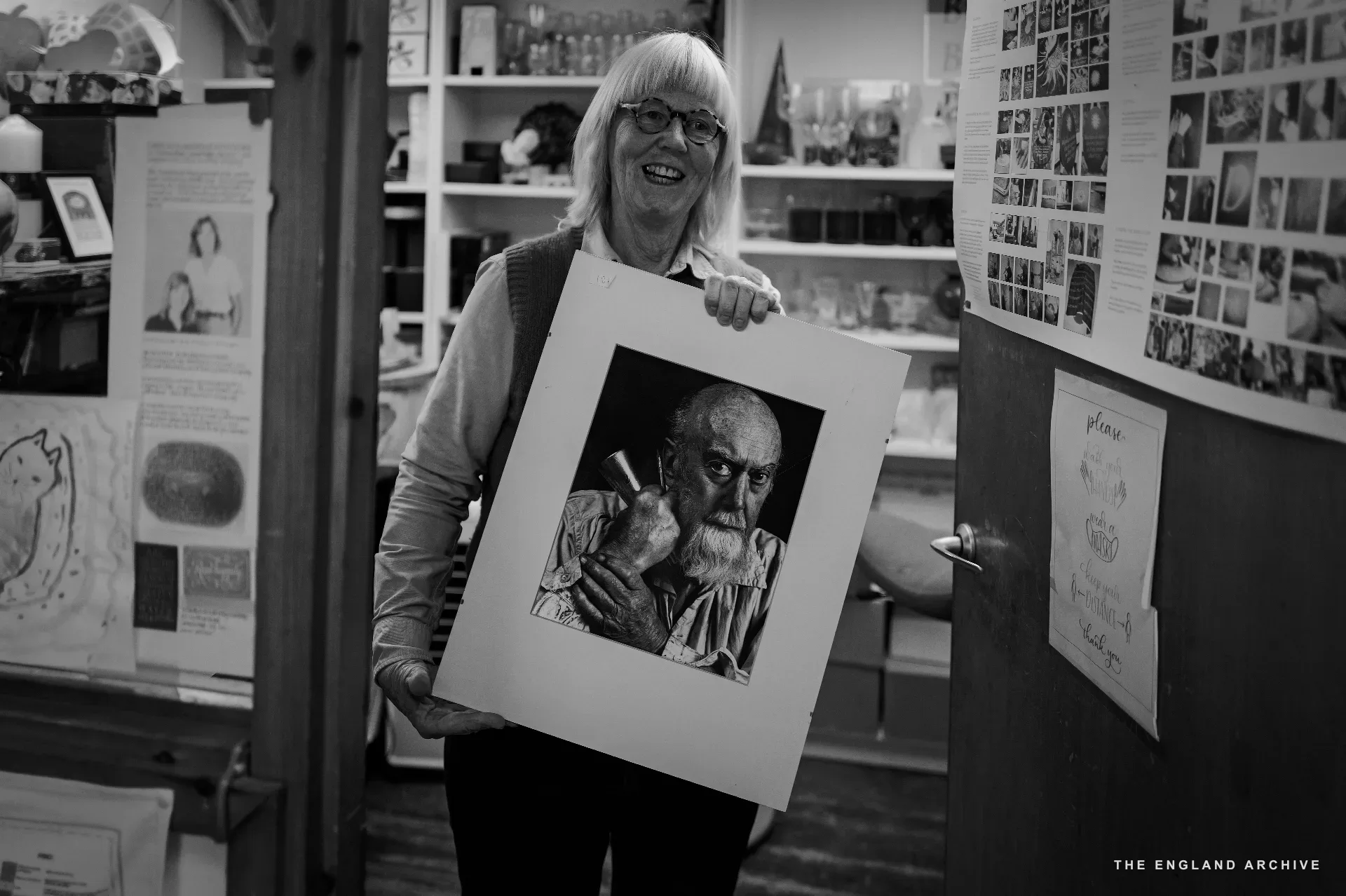
The archive's first letter-cutting subjects all work at the Cardozo Kindersley Workshop in Cambridge, the spine of the English line. The visit was a four-hour morning on 22 April 2026. The full record of the visit is the journal entry A Morning at Cardozo Kindersley; the per-person profiles are below.
-
MK-0002
Lida Kindersley
Matriarch, typographer, lettercutter. Widow of David Kindersley.
-
MK-0003
Roxanne Kindersley
Working head of the workshop. Trains the apprentices.
-
MK-0004
Vincent Kindersley
Designer and lettercutter. The design hand of the workshop.
-
MK-0006
Emily
Roxanne's longest-running apprentice. Eight years at the bench.
§ 6 · The institutional landscape
Where the trade is taught and held.
The Cardozo Kindersley Workshop, Cambridge. Founded by David Kindersley in 1946. Currently led by Lida Kindersley and Roxanne Kindersley. The single most influential workshop in the English line; trains a small bench of apprentices on a long-form (often unpaid) entry path, with apprenticeships of three to seven years before independent commissions. Public commissions visible across Cambridge college estates, Westminster, and English cathedrals. The website is kindersleyworkshop.co.uk.
The Lettering and Commemorative Arts Trust, Snape Maltings. A trust supporting both training and commissioning of lettering and memorial work. Runs short courses, summer schools, and supports apprenticeship placements. Holds a public collection and a small gallery. Its work intersects directly with the active letter-cutting trade. Site: letterarts.com.
The Letter Exchange. A long-standing professional association of lettering artists, including stone-cutters, sign-painters, calligraphers, and type designers. Membership is by election. The association's lectures, exhibitions, and publications are the trade's professional civic forum. letterexchange.org.
City & Guilds and the conservation/restoration route. A separate path into the trade runs through stone-conservation training (often City & Guilds-accredited) and into the restoration sector that maintains historic English buildings and monuments. Letter-cutters working in this part of the field are often employed by cathedral works yards, English Heritage contractors, or conservation practices, rather than by independent workshops.
The Heritage Crafts Association (HCA). Maintains the Red List that classifies the trade as Endangered. The HCA is the project's primary anchor for Red List status and practitioner counts; their listing for letter-cutting is at heritagecrafts.org.uk/skills/redlist.
The Crafts Council. The national development organisation for craft in the UK. Provides bursaries and exhibition support that occasionally supports letter-cutters' independent practice, particularly for cutters working at the boundary between craft and contemporary art.
§ 7 · Pipeline status
What's already on the archive, and what comes next.
The four practitioners listed above are the archive's first pass at the craft. They are all in one workshop, in one English city, in one teaching lineage. That is editorially complete for what it is, but it is not complete coverage of the trade.
Two further sessions planned
Session 1. A working letter-cutter outside the Cardozo Kindersley line - either an independent practitioner with their own bench, or one of the cutters on the Lettering Arts Trust's Snape Maltings circle. The aim is to set the Cardozo Kindersley record alongside another working hand so the page reads as a record of the trade and not of one workshop.
Session 2. A younger apprentice still finding their hand. Five to seven years in is roughly when an apprentice begins cutting independent commissions; the visit would document the apprentice at the bench, alongside their training master, in a session paralleling Emily's profile but at an earlier stage of the trade.
Status today: Partial. The first session is documented and live. The two further sessions are in research; sponsorship would move them from the pipeline onto the calendar.
§ 8 · Sources
Citations and further reading.
- Heritage Crafts Association, Red List of Endangered Crafts, current edition. heritagecrafts.org.uk/skills/redlist.
- David Kindersley and Lida Lopes Cardozo, Letters Slate Cut (2nd edition, Cardozo Kindersley Editions, 1990). The standard reference on the workshop's slate-cutting practice.
- Eric Gill, An Essay on Typography (1931). The polemical statement of the design philosophy that runs through the English lineage.
- John Neilson, Letters in Stone (Stobart Davies, 1989). On hand-cutting outside the workshop tradition.
- The Letter Exchange, Forum (the association's journal). Quarterly, peer commentary on contemporary lettering practice.
- The Lettering and Commemorative Arts Trust, Snape Maltings - public collection and exhibition programme. letterarts.com.
- A Morning at Cardozo Kindersley · the archive's own field record of the four-hour visit on 22 April 2026.