Cut in Steel and Gold
How a best gun is engraved by hand

A best gun leaves the men who make it as bare, bright steel. It shoots; it locks shut like one piece of metal; and it is, at that point, almost entirely undecorated. What turns it into the object a customer waits years and pays the price of a house for is the last trade to touch it: the engraver, who cuts fine scroll, game scenes and lettering into the finished metal by hand, and lays gold into the cuts. This essay is the archive's record of that craft, written from a July 2026 morning I spent at the Westley Richards engraving studio in Birmingham with the firm's master engraver, Léo Lambert, who walked me through the whole of it.
It is worth saying at the outset what engraving is for, because it is easy to read as mere decoration. It is not. The engraving is the visible proof of everything underneath it - the filing, the jointing, the fitting - and it only means anything because that work is true. Fine ornament laid over a badly made gun is a lie the trade will not tell. So the engraver is the last link in a chain of specialists, and the one whose work the world actually sees.
I. What gun engraving is
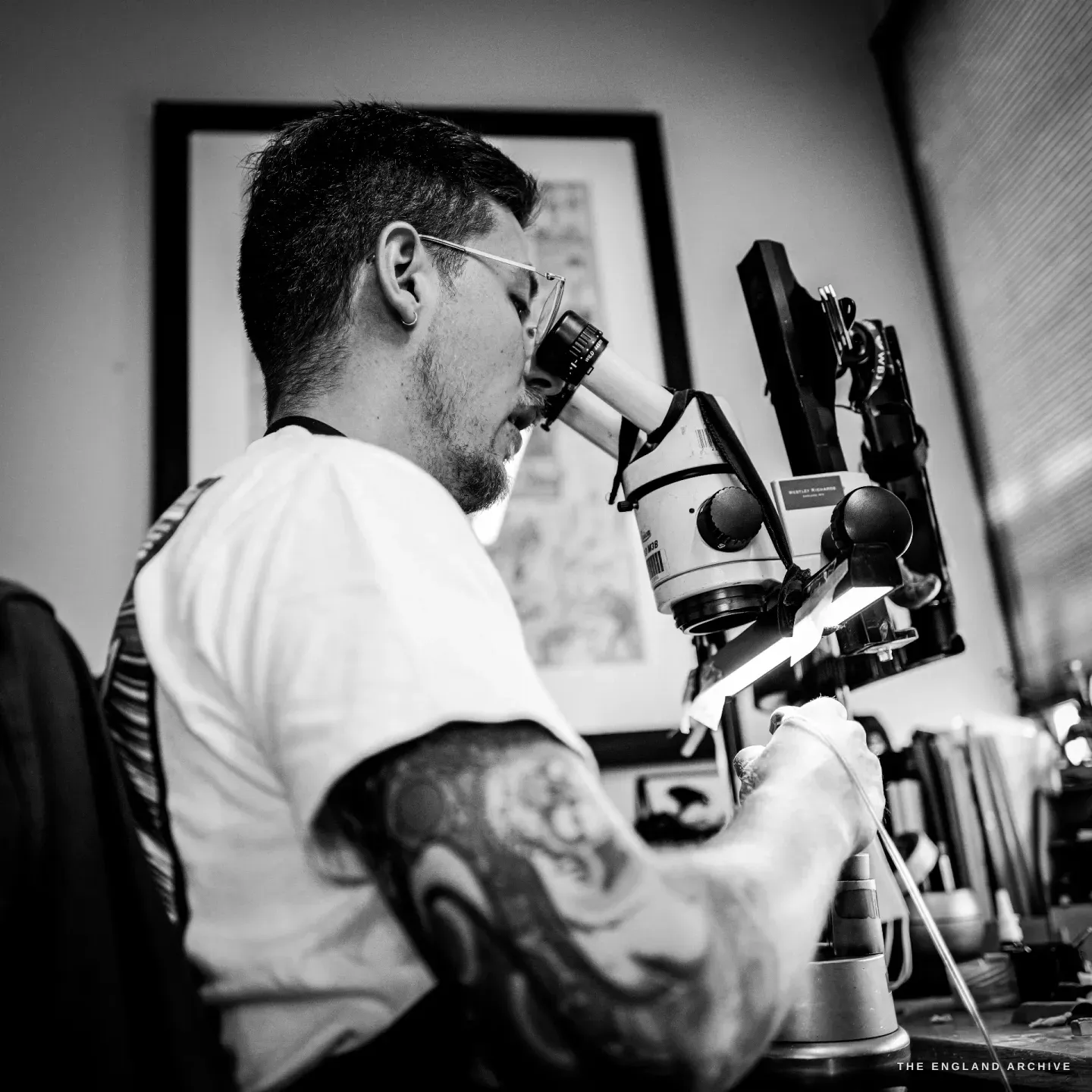
Gun engraving is the cutting of decoration and lettering into the metal of a finished gun by hand, and the inlaying of gold and other metals into those cuts. The tool is the graver: a short rod of hardened steel, ground to a cutting face, either pushed through the metal by the heel of the hand or driven by a pneumatic handpiece that delivers rapid, tiny hammer-blows of compressed air. The work is held on a ball vice, a heavy round block that turns freely on its base, so the engraver keeps the graver moving in one direction and rotates the whole gun into the cut instead.
Almost all of it is done down a microscope. The cuts that make up fine English scroll or a game scene are finer than the naked eye can safely place, and a slip does not rub out: it is a scar on hardened steel that may already carry hundreds of hours of other people's work. So the engraver sits still, for hours, cutting a line a fraction of a millimetre wide, and the room is quiet in the particular way of work that cannot be hurried. I sat with Léo a good while before I understood how little of it shows on the surface and how much is happening in his hand.
The ornament is not generic. On the best work it is designed to the exact shapes of one gun: the way a scroll turns around a pin, the way a lion is placed on a lockplate, the way lettering sits on a curved rib. Two guns of the same model, engraved by the same hand, are not the same gun. That is the difference between engraving and the machine-rolled or laser-etched patterning found on lesser guns, which repeats a fixed design at a set depth and knows nothing of the object it is on.
II. The tradition
Engraving is far older than guns; it is the ancient craft of cutting a line into metal, shared with the die-sinker, the seal-cutter and the printmaker. What the English gun trade did was bend that craft to its own object. As the great London and Birmingham firms built their reputations through the nineteenth century, a house style of decoration grew up alongside the mechanisms: fine, tight foliate scroll, cut small and even across the whole surface of an action, restrained rather than flamboyant, so that the ornament flattered the shape of the gun instead of shouting over it. Fine English scroll is still the signature of the English best gun, and it is one of the most demanding things an engraver can be asked to cut, because its evenness leaves nowhere to hide.
Alongside the scroll runs the picture work: game scenes of the birds and animals the gun was made to shoot, built up in fine dot-and-line shading the Italians named bulino, so that a setter or a stag appears in tone, almost photographic, cut entirely by hand. And running through all of it is lettering - the maker's name, the model, the cartridge - each letter cut into the steel, and a firm's own lettering as much its signature as its scroll.
The other half of the tradition is gold. Where a design calls for a line or a figure to hold the light, the engraver cuts a recess into the steel, undercuts its walls so it will grip, and works soft gold - wire or sheet - down into it until it keys and holds. The surface is taken back flush, and then the detail is cut into the gold itself. It is the slowest part of the whole job, and on a finished action the inlaid gold birds look inevitable, as though the steel had always meant to carry them.
England was never the only school. The Continental tradition, centred on Liège in Belgium and on the Italian workshops, trained engravers to a great depth and exported them; much of the finest work in the English trade today is cut by engravers who came up through those schools. That is not a decline so much as a widening: the craft has always moved with its best hands.
III. The living hand
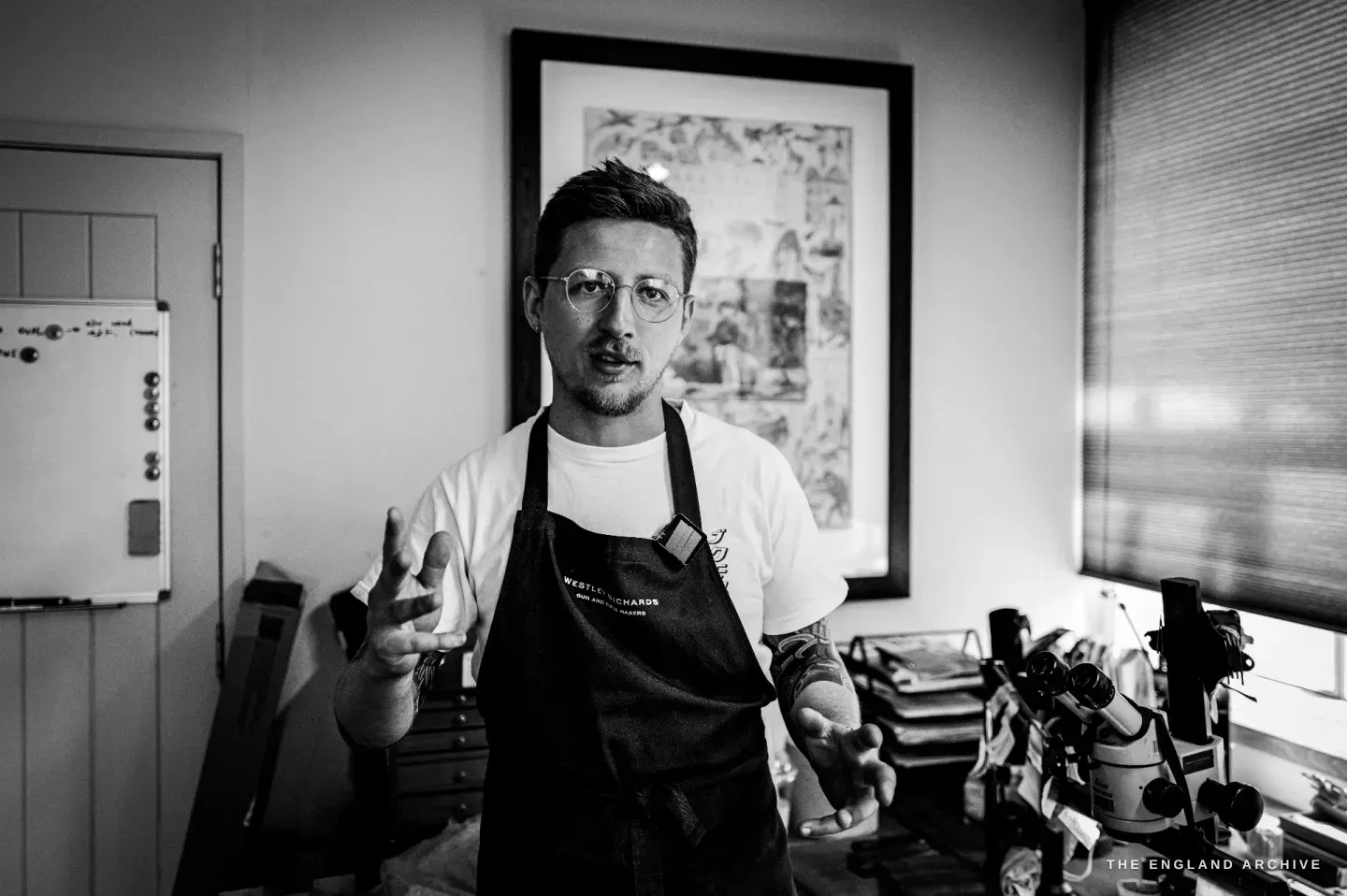
Léo Lambert, whom I met that morning, is one of those hands. He grew up in a village outside Liège, trained in engraving at the Léon Mignon school there, and wrote a letter to Westley Richards from Belgium asking about an apprenticeship. The firm took him. He arrived, by his own telling, expecting to serve years under a master engraver, and asked where the master was; he was told he was the one they had in mind, and would have to become one. He was thrown straight into the deep end, doing the work while he was still learning it, on guns worth more than houses.
The thing that nearly caught him out was lettering - the part he had skipped in Belgium. So he taught himself, and kept going well past coping, until he had designed lettering styles of the firm's own, alphabets that did not exist until he drew them. That is the part of the studio's work that stayed with me most: not the scroll, which you expect, but the fact that a firm's house lettering can be the invention of one young man who decided to master the thing he had avoided.
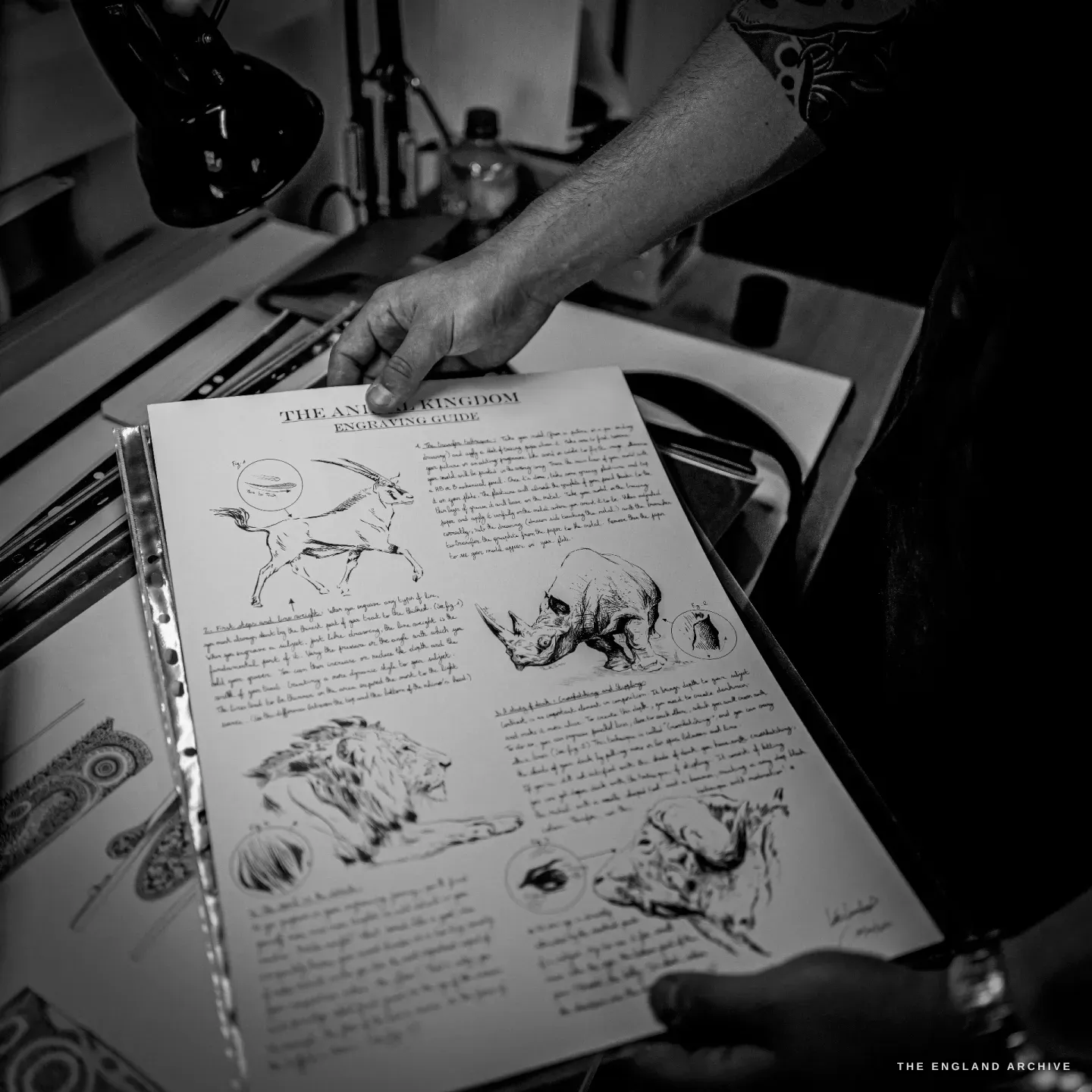
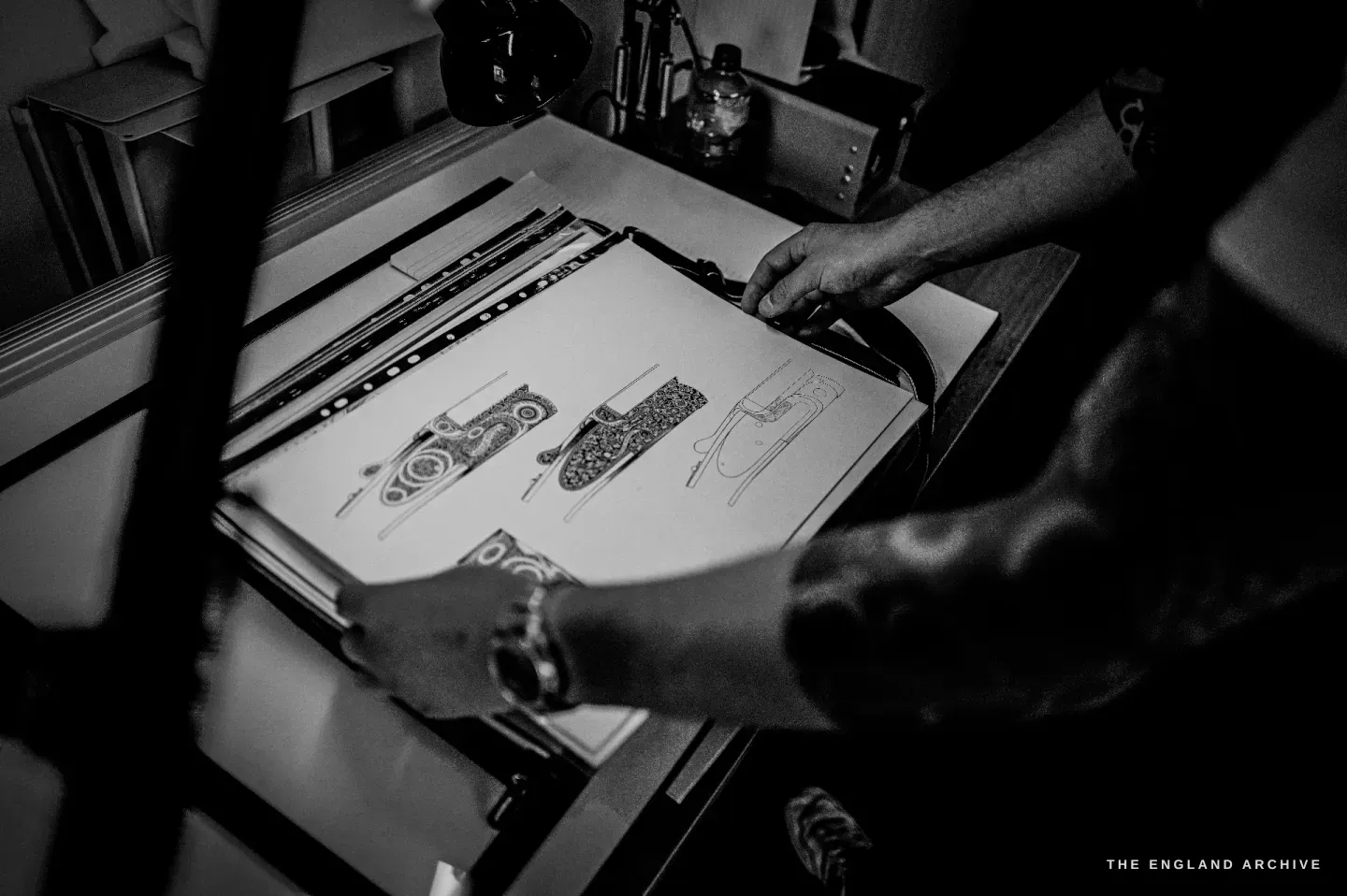
None of it starts on the gun. It starts on paper. Léo draws constantly, and keeps his own reference books - sheet after sheet of pen studies of scroll, borders and animals, one of them headed, half in earnest, The Animal Kingdom Engraving Guide. By the time a lion reaches the steel he has drawn it many times over. Only then does the design go onto the metal, and the cutting begin, down the microscope, with the pneumatic graver and the ball vice.
He is an artist who happens to work in steel and gold, and you see it away from the bench as much as at it: the bright Japanese tattoo work up both arms, the art books on the shelves. The same eye lays out an alphabet, the ink, and the gold. His full story - the letter from Liège, the apprentice coming up behind him - is on his own page, Léo Lambert; the morning at the firm is A Morning at Westley Richards.
IV. The state of it in 2026
Fine gun engraving survives because best gun making survives, and only just. Very few firms in England still build complete guns by hand, and only a handful of engravers work at that level; the wider craft of hand gunmaking is a recognised endangered craft on the Heritage Crafts Red List. The engraving is the visible end of a fragile chain: it needs the filers and stockers and lock makers ahead of it to have something to decorate at all.
It is learned the slow way - by apprenticeship or a specialist course and then years at the bench - because designing ornament to the shape of a gun, cutting it cleanly, and inlaying gold are judged by eye and built by repetition. The most hopeful thing I saw at Westley Richards was not a finished gun but the arrangement around it: a firm that keeps its own engraving studio, a master engraver still in his twenties, and an apprentice already coming up behind him. That is how a craft this small stays alive - one hand teaching the next, inside a firm that still believes the ornament has to be earned.
If you want to see the craft, or to learn it, the archive's Learn a Craft directory points to where engraving is taught, and the glossary entry what is gun engraving is the short reference. This essay is the long one, and the record of one morning of the work being done.