A Definitive Guide · CP-0008
Spring Equinox at Tower Hill
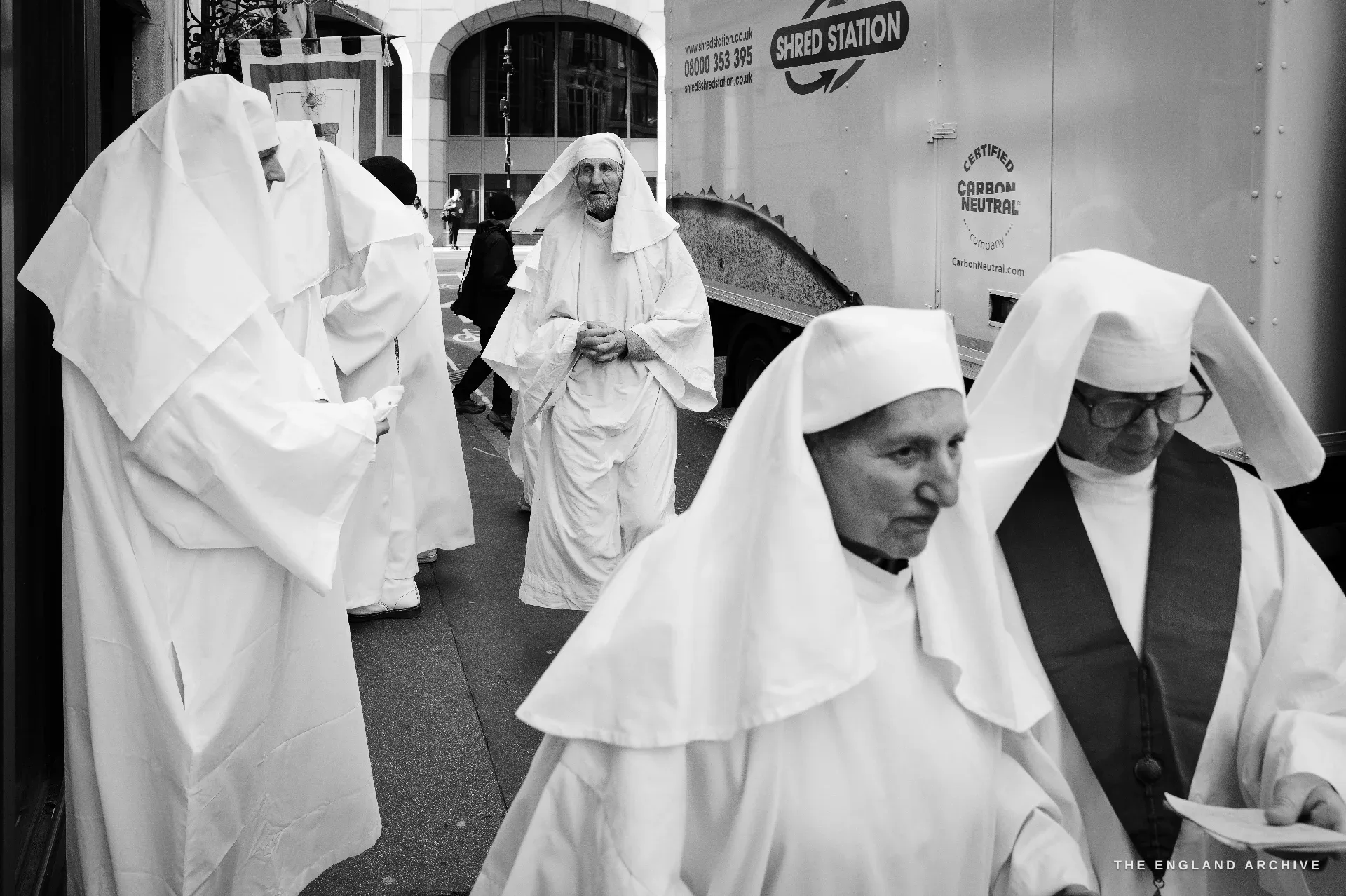
The Druid Order's annual rite at Tower Hill in the City of London - performed at noon on every spring equinox since 1956. The oldest continuous public ritual gathering in the City: the white-robed circle, the staffs and chalice, the call-and-response, the silent procession back to All Hallows-by-the-Tower. The ceremony is not on the Heritage Crafts Red List - the Red List covers crafts, not ceremonies - but it is held by a small institutional body whose succession question is real.
§ 1 · The ceremony
What happens on Tower Hill at noon on the equinox.
At noon on the day of the spring equinox - either 20 or 21 March, depending on the year's astronomical reading - members of the Druid Order assemble in robes on Tower Hill, on a small piece of green close to the Tower of London and the river. The Order is led by a Chosen Chief, supported by Bards and Ovates and Druids of the inner orders. They form a circle on the grass. Officers stand at the four cardinal points. The Chief presides at centre.
The ceremony itself is short - around forty minutes, though the timings vary year to year. It opens with a call to the four directions, an invocation, and the ringing of a small bell. Bards recite passages, generally in English (the Order is not a Welsh-language tradition; its language is the language of its founders). A central rite involves the sharing of bread, salt, and water, and the passing of a chalice around the inner circle. The call-and-response involves the public, who form an outer ring around the robed members; passers-by often join the outer ring spontaneously and the ceremony is not closed to them.
The ceremony closes with a final invocation and the dispersal of the circle. Members and the public then walk in loose procession to the church of All Hallows-by-the-Tower, the Saxon-era City church a few hundred yards away, where a private fellowship gathering follows. The transit from a public open-air rite to a private indoor gathering at a Christian church is itself part of the working of the day; the Order's relationship to the Christian church is not adversarial, and this is the visible sign of that.
Three rites of the Order land at Tower Hill in any given year: the Spring Equinox (the ceremony documented above), the Summer Solstice in late June at Primrose Hill, and the Autumn Equinox in September back at Tower Hill. Of the three, the Spring Equinox is the one most consistently performed in the City and most accessible to the public.
§ 2 · Lineage
From Iolo Morganwg to the present circle.
The Druid Order is the senior English-language druid body. It traces its public lineage to the Ancient Order of Druids (founded in London in 1781 as a friendly society in the masonic mould) and through it to the eighteenth-century revival that began with Edward Williams (Iolo Morganwg, 1747 - 1826), the Glamorgan stonemason, antiquarian, and forger-of-genius whose Barddas manuscripts assembled the modern body of druidic ceremonial out of partly-genuine, partly-invented sources. The Tower Hill ceremony in its present form was instituted in 1956 under the Order's then Chosen Chief, Robert MacGregor-Reid, son of the previous Chief George Watson MacGregor Reid; the Reids led the Order through most of the twentieth century.
Druidic ceremony of any kind was not openly practiced in England before the twentieth-century revival. The persecution of self-identifying druids continued (in legal terms) until the Witchcraft Act was repealed in 1951, and the open public rite at Tower Hill in 1956 was the first time the Order had assembled in robes in public space without legal cover. The siting at Tower Hill was symbolic: this was where the heads of executed political prisoners were displayed on spikes for centuries, and was the location associated with several druidic-tradition martyrs. The choice of an open public site, rather than a private Stonehenge gathering or a closed lodge, set the tone of the Order's modern public face.
The tradition is, then, a twentieth-century institutional creation built on much older imagery and partly-invented antecedents. It is not "the original druids continued in unbroken succession" - that would be a historically untenable claim. What it is, is a living seventy-year ceremonial tradition in its own right: a continuously-performed public rite, an institution that has named successive Chosen Chiefs in unbroken sequence since 1908, and a body of ritual practice that has its own internal coherence regardless of how partial its claim to ancient antecedents may be. The seventy years of Tower Hill itself is the strongest claim the ceremony makes - and the most documentable.
The Order is small. Its full membership across all three Orders (Bards, Ovates, Druids) numbers in the dozens; its working circle at Tower Hill is typically around twenty robed members. The succession question - who carries the Chief role next, who trains the Bards through the next generation - is the Order's principal contemporary anxiety, and the reason the ceremony belongs in the archive even though it is institutionally robust today.
§ 3 · Inside the rite
The order of service, in detail.
The Order assembles around the green at Tower Hill from about 11:30. The robed members - white gowns over weekday clothes, with coloured stoles indicating Bard, Ovate, or Druid grade - gather initially in conversation, then form into a working circle around 11:50.
At noon the Chosen Chief enters the centre. Officers (a Herald with a staff, and members at each cardinal point) take their stations. The opening proclamation is given by the Herald: a short call asking whether peace lies on the four quarters - east, south, west, north - with the answering "There is peace" returned at each point. The bell is rung; the circle is consecrated.
The body of the rite then unfolds: invocations to the spirit of place and to the Order's own dead, recitation of a Bardic passage (often from Iolo Morganwg's published works or from the Order's own twentieth-century liturgy), and a reading of the year ahead. Bread and salt are blessed at the centre and distributed to the four quarters. Water is poured. The chalice - in some years a small wooden bowl, in others a metal cup - is passed around the inner circle.
The closing is brief. The Herald gives the formal dismissal; the bell is rung a final time; the officers stand down from their cardinal positions; the circle dissolves. The robed members and any of the public who wish to follow then walk together to All Hallows-by-the-Tower for the indoor private gathering.
The whole rite lasts roughly forty minutes. There is no microphone, no amplification, and no formal address; the work is done in the speaking voice and the bell. The ceremony is photographable but not theatrical - it asks the photographer to read the rhythm rather than to set up the shot, and the published frames generally land best when the camera has been still for long stretches before the moment.
§ 4 · The Order's vocabulary
Terms a documentary record needs to use accurately.
Chosen Chief. The presiding officer of the Druid Order. Successive Chiefs by name include George Watson MacGregor Reid, Robert MacGregor-Reid, Thomas Maughan, Philip Carr-Gomm (in OBOD, a sister body), and the present incumbent of the Druid Order proper. The position is held for life or until ill-health requires a successor.
Bards, Ovates, Druids. The three grades of training in the Order, taken in sequence over a number of years. A Bard works in the language and the public-facing aspects of the tradition; an Ovate works in the divinatory, healing, and ancestral aspects; a Druid works in the priestly and teaching roles. The training is not formal in an academic sense; entry is by introduction, study is by reading and ceremonial practice, and progression is by the Chief's recognition.
The circle. The working figure of the rite. The robed members form an inner circle around the Chief; the public form an outer circle around the robed members. Standing inside the working circle is reserved for those with a role; standing in the outer circle is open to anyone who arrives.
Cardinal points. East, south, west, north - associated, in the Order's working symbolism, with the elements air, fire, water, earth respectively. Officers stand at the cardinal points throughout the rite; the proclamation of peace is asked of each in turn.
The Herald. The officer carrying the staff, responsible for the opening and closing proclamations. In some years the Herald carries a long ceremonial staff; in others a shorter rod.
Iolo Morganwg. The bardic name of Edward Williams (1747 - 1826). His Barddas manuscripts (compiled and edited posthumously) are the source for much of the modern druid liturgy. Williams's relationship to historical accuracy was creative; the modern Order acknowledges this and treats his texts as the foundation of its ceremonial work without claiming they are unmodified ancient documents.
OBOD. The Order of Bards, Ovates and Druids, founded in 1964 by Ross Nichols (a Druid Order member) as a separate body. OBOD is now larger and more internationally distributed than the Druid Order proper, and its training is by mail-and-online rather than by London ceremonial practice. The two bodies are friendly but distinct.
§ 5 · Documented on this archive
The 2026 ceremony.
The archive's Tower Hill record begins with the 2026 ceremony - documented on 20 March 2026, the date of the spring equinox that year. The full editorial record is the subject page below; the gallery includes the full sequence of the rite from public assembly through the closing dismissal, with the procession to All Hallows-by-the-Tower at the close.
§ 6 · The institutional landscape
Where the tradition is held.
The Druid Order. The body responsible for the Tower Hill ceremony. The Order's central administration is in London; its principal public events are the equinoxes at Tower Hill and the summer solstice at Primrose Hill. Membership is by introduction and by the Chosen Chief's invitation. The Order maintains a private archive of its twentieth-century records and publishes occasional pamphlets through Druid Order Press.
OBOD (The Order of Bards, Ovates and Druids). The larger sister body, founded in 1964 by Ross Nichols. Trains members in the Bardic, Ovate, and Druid grades by correspondence course; runs its own large solstice gatherings; publishes a substantial body of teaching material. druidry.org.
The Pagan Federation. The umbrella body for the broader pagan and druidic community in the UK, including the Druid Order and OBOD. Coordinates representations to government, supports interfaith dialogue, and publishes Pagan Dawn. paganfed.org.
All Hallows-by-the-Tower. The ancient City of London church (Saxon origin, partly bombed in 1940 and restored) where the post-ceremony gathering is held. The Tower Hill ceremony's relationship to All Hallows is partly historical accident, partly deliberate gesture: the Order treats the church as a fellow keeper of the place, and the working relationship has been continuous since 1956. ahbtt.org.uk.
The Folklore Society. The British learned society for folklore studies (founded 1878). The society's Folklore journal carries occasional academic treatment of the contemporary druid revival, including the Tower Hill ceremonies. folklore-society.com.
§ 7 · Pipeline status
The annual record, year-on-year.
The Spring Equinox at Tower Hill is by definition an ongoing tradition. Each year is a separate documentary opportunity, since the ceremony's officers, the weather, the public turnout, and the small variations in the working all change year to year. The archive's first pass on 20 March 2026 is the first frame of what should become a multi-year record.
Subsequent years - sponsorable
2027 onward. Each successive equinox at Tower Hill remains open to sponsorship as a separate documentary visit. A long-term yearly record - five years, ten years, twenty - would be a substantial editorial work that the archive is positioned to make if the resources are there. Sponsorship of any individual year covers the day's documentation, the editorial pass, and the addition to this page's annual record.
The succession question. If and when the current Chosen Chief steps down, the Order will name a successor and the rite's character may shift in small but documentable ways. The archive's record of the transition would be the most editorially significant frame of the entire tradition.
Status today: Ongoing. 2026 documented and live. Every subsequent year remains open to sponsorship.
§ 8 · Sources
Citations and further reading.
- Ronald Hutton, Blood and Mistletoe: The History of the Druids in Britain (Yale University Press, 2009). The standard academic history of the druid revival, by the leading historian of the field.
- Ronald Hutton, The Druids: A History (Hambledon Continuum, 2007). A shorter and more accessible account.
- Iolo Morganwg, Barddas (compiled posthumously, ed. J. Williams ab Ithel, 1862). The foundational source-book for the modern druid revival; treat with due editorial caution.
- Philip Carr-Gomm, The Druid Way (Element, 1993; Thoth Publications reprint). On the working life of a contemporary druid order, by the long-running Chief of OBOD.
- Adam Stout, Creating Prehistory: Druids, Ley Hunters and Archaeologists in Pre-War Britain (Wiley-Blackwell, 2008). On the early-twentieth-century context of the Druid Order's emergence.
- The Druid Order, Pamphlets and Lectures (private publication, various dates). Internal Order publications; selected items held at the Folklore Society library.
- Spring Equinox at Tower Hill, 2026 · the archive's own field record of the 2026 ceremony.