Letter Cut in Stone
The English Tradition from Gill to the Kindersleys

Walk into almost any English parish church and somewhere on its walls, its floor, or in its graveyard you will find letters cut into stone. Names of the dead, dates of foundation, lines of scripture, inscriptions recording the gift of a window or the endowment of a chapel. Most are anonymous. All were cut by someone holding a chisel in one hand and a mallet in the other, and behind each stands a particular moment in a continuous English craft whose earliest surviving examples are older than Christianity in these islands and whose living practitioners, in 2026, could be counted on two hands.
Stone letter-cutting is the slowest medium for the written word that English culture has continuously used. Pen and ink give up the words faster; print faster still; the screen faster again. Stone is the counterweight. It is chosen precisely because it is slow. You do not cut a name in stone because you need it tomorrow; you cut it because you need it in a century. Every chosen word is paid for in hours of the cutter's life. That equation, of time against permanence, is the proposition the whole craft rests on.
This essay is the archive's record of the craft as we encountered it in 2026, written from a single extended visit to the Cardozo Kindersley Workshop in Cambridge and surrounded by a longer account of the tradition it sits within. The workshop is the most visible working letter-cutting workshop in England today. It is the surviving thread of a specifically English twentieth-century line that runs from Eric Gill through David Kindersley to the benches at which Lida Kindersley, Roxanne Kindersley, and their team still work. Before the Cardozo Kindersley story can be told, the craft itself needs to be named.
I. What letter-cutting is
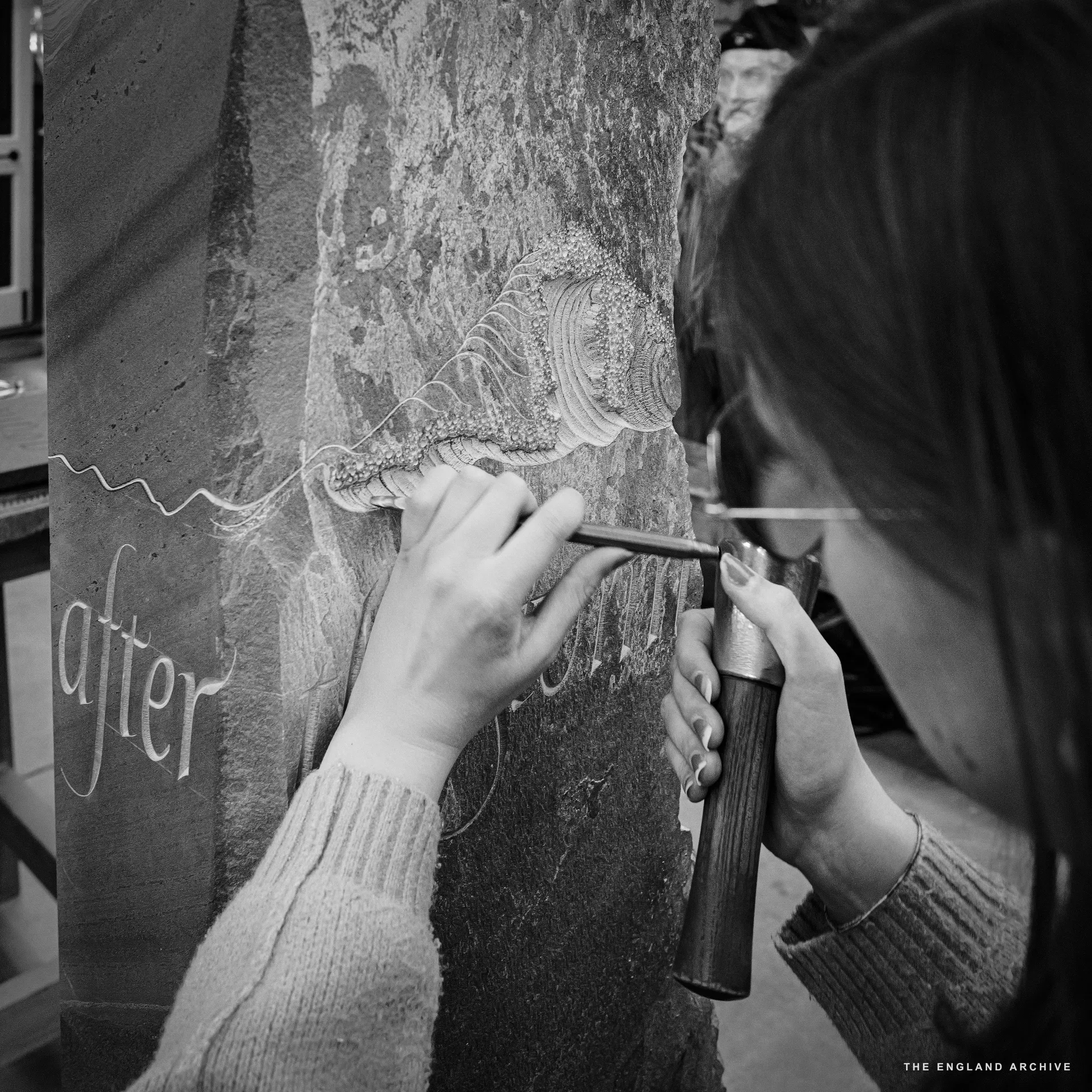
Stone letter-cutting is the discipline of forming letterforms directly into stone with a hand-held chisel and mallet. The cutter works with a hammer-and-cold-chisel logic: the chisel is held at a precise angle against the stone, the mallet strikes it, and the stone yields in a small, controlled lift. The shape of the letter emerges stroke by stroke, each one a different angle of the chisel, each one a small act of judgement about how much stone to remove. A line is not cut in one movement; it is composed, over dozens of strikes, into the curve the letter asks for.
This is not the same as carving. A carver works with a larger range of tools and removes stone across a broad surface to create three-dimensional form. A letter-cutter works with a small number of chisels on what is, dimensionally, a very shallow intervention: most cuts are only a few millimetres deep. The depth is not the point. The point is the edge: the meeting of the two angled faces of the cut where the light catches when the letter is read. The whole legibility of an inscription lives in those edges, and their crispness, their cleanness, their consistency across the full run of lettering is what distinguishes a master cutter from a competent one.
Nor is letter-cutting the same as sign-painting, hand-engraving, or machine-lettering, though all four work with related forms. A sign-painter lays colour onto a surface; a hand-engraver incises a line into metal with a burin; a machine-letterer uses a router or a laser to trace a digital file into a material. The letter-cutter works on stone, with percussion, by hand. The medium is ancient, the tools are essentially unchanged for two millennia, and the product is (in its finest form) indistinguishable from what a Roman cutter would have made in the first century.
The vocabulary of the craft is specific. A setting-out is the pencilled design that precedes the cutting, drawn directly onto the stone face after the stone has been dressed flat. A v-cut is the standard cross-section of an English inscribed letter: two angled faces meeting at a central point below the stone's surface. A rubbing is the paper record made of an inscription by laying paper over the stone and rubbing wax or graphite across its surface, producing a negative reproduction of the letterforms; most historical letter-cutting scholarship has been done through rubbings, because the stones themselves cannot be moved. The serifs are the fine cross-strokes at the terminals of letters; the bowls are the closed curves of letters like O and B and D; the counters are the enclosed white space inside those bowls. The cutter is trained in these parts before any practical work begins.
Stones vary. The classic English letter-cutting stones are Portland, Bath, York, Purbeck, and slate from Delabole and the Lakes. Each has a different hardness, a different grain, a different response to the chisel. Portland stone, the limestone quarried from the Dorset coast and used in a great many of England's public buildings, is the workhorse of English letter-cutting: soft enough to cut cleanly, hard enough to hold the letter sharp for centuries. Slate is the connoisseur's material; it takes the finest detail, holds the crispest edge, and produces the most durable inscription, but it is less forgiving of error. A letter-cutter trains on every major stone and learns each one's peculiarities.
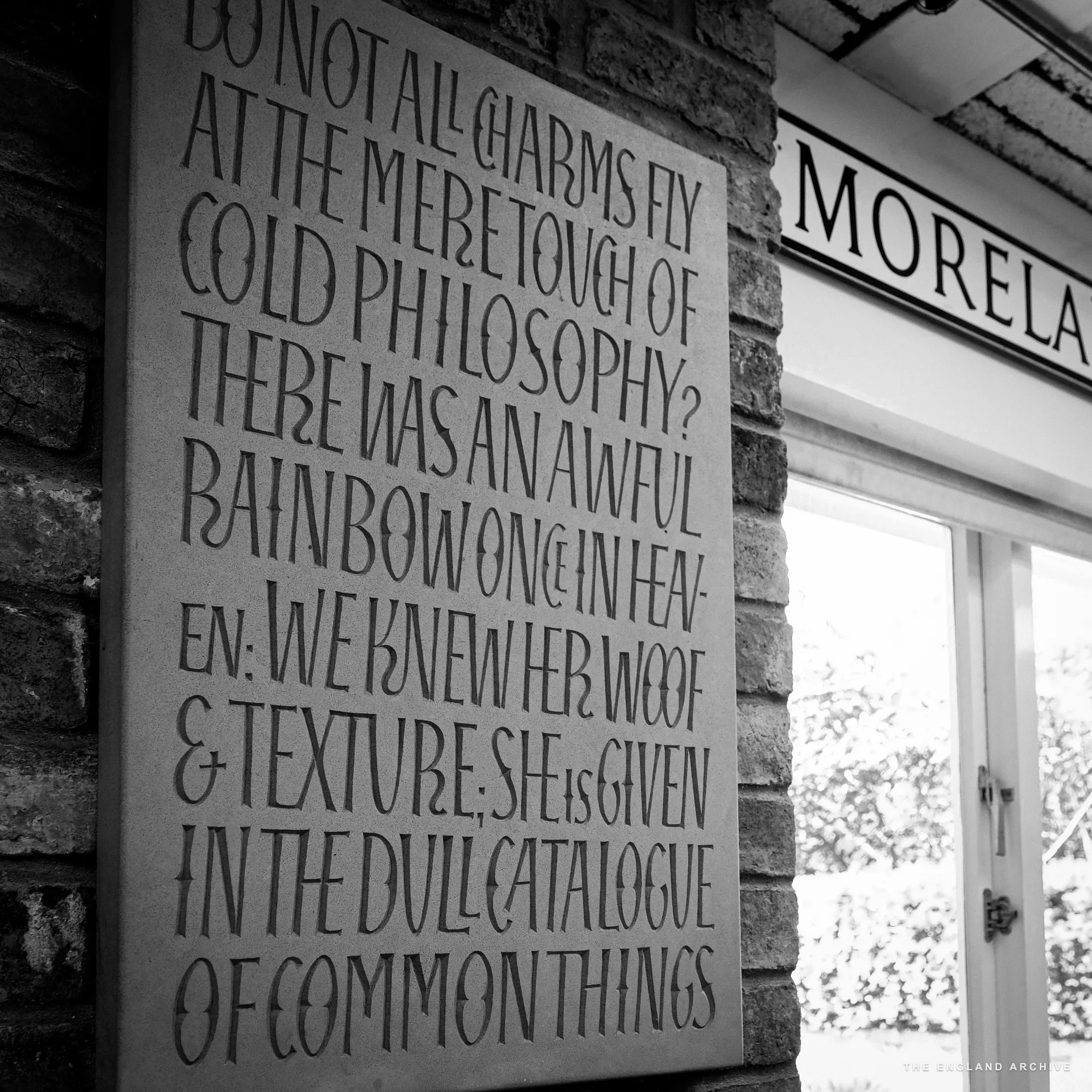
The output of the craft is not one thing. Memorial slabs for graveyards. Foundation stones for public buildings. Dedicatory inscriptions in churches, colleges, and libraries. Name plaques on doorways. War memorials. Sundial faces. Royal coats of arms. Lettering on ship launches. Public sculpture. Private commissions for gardens, gates, and walls. The market is small, thin, and specialist, but the range of applications is wide enough that the craft has never entirely disappeared from English public life. Almost every English village has letter-cut stone in it, most of it unsigned, much of it anonymous, all of it by someone's hand.
II. The long tradition
The canonical English letter-cutting tradition descends directly from Roman practice, and the single most influential letter-cut inscription in the tradition is on a column in Rome.
The inscription at the base of Trajan's Column, cut in AD 113 to commemorate the emperor's Dacian campaigns, is the piece that every subsequent Western letter-cutter has had to come to terms with. Its letterforms - the Roman capitals, in a specific proportion and stroke weight - became the reference specimen for monumental lettering throughout Europe for the next eighteen centuries. Edward Catich, the American priest and letter-cutter whose 1968 book The Origin of the Serif is the definitive study of the inscription, argued that the column's letters were laid out with a flat brush before cutting, and that the serifs and the stroke contrasts we associate with the Roman capital form are the direct record of the brush's movement transcribed into stone. Whether Catich was right in every detail remains debated; that the Trajan inscription defined the reference shape is not.
Roman Britain inherited the practice. Inscriptions on tombstones, altars, and civic dedications from the Romano-British period survive in considerable number, many of them now in the collections of the British Museum, the Yorkshire Museum, and the Great North Museum at Hancock. Their quality varies - some are provincial work, uneven and awkward; others are cut to standards that would not shame the imperial centre - but the tradition they belong to is the continuous Western one that the Trajan inscription anchors. When the Roman administration withdrew from Britain in the early fifth century, the stones were left in place; their letters endured; the cutters who made them and their apprentices continued in the craft, if not in its Roman register.
The Anglo-Saxon period produced letter-cutting of a different kind. The runic inscriptions of the early centuries and the later Insular lettering found on the great stone crosses of Northumbria - the Bewcastle Cross, the Ruthwell Cross, the Gosforth Cross - were cut in a regional tradition that combined Roman, Celtic, and Germanic elements. The surviving crosses are some of the most ambitious monumental letter-cutting England has ever produced; the Ruthwell Cross in particular carries a version of The Dream of the Rood in runic characters cut around its sides, linking the craft to the earliest English literature. These are worked in sandstone, mostly, and their survival into the twenty-first century is itself a testament to the durability of the medium.
After the Conquest, English letter-cutting settled into the medieval pattern that would dominate for the next four centuries. Incised letters were used for memorial slabs laid into church floors; for inscriptions on tombs; for dedicatory plaques; for the lettering on brasses (though the brass engraver and the stone-cutter were distinct trades). The lettering of the medieval period runs through several successive forms - Romanesque, early Gothic, Blackletter, humanist capitals in the fifteenth century - and English stones carry examples of all of them. The cutting is mostly anonymous. The masons who built the cathedrals and parish churches built the stones they letter-cut, and the workshops of the great medieval cathedrals employed letter-cutters whose names almost never reach us.
The Reformation was a hinge. The destruction of monasteries, the whitewashing of church interiors, and the removal of devotional inscriptions interrupted the continuity of the medieval letter-cutting workshop. But the craft re-emerged, differently, under the Elizabethan and Jacobean dispensation. The great tomb effigies of the late sixteenth and early seventeenth centuries carry inscribed letterforms of a specifically English Renaissance kind - inspired by the Italian humanist capital, influenced by the spread of printed books, rendered in local stone by local cutters. The tomb of the Earl of Leicester in Warwick, the Hatton tombs in Hatton Norris, the Shakespeare memorial in Stratford: these carry the letter-cutting of their period in a form that is recognisably continuous with the Trajan tradition.
The eighteenth century produced a letterform that was arguably the most influential in English public inscription history: the capitals used on headstones, memorial slabs, foundation stones, and dedicatory inscriptions in the Georgian era. These are the letters you read on the walls of the City of London churches, in the churchyards of English cathedral cities, and on the plaques that mark the foundation dates of eighteenth-century civic buildings. They are proportioned, balanced, legible at distance, and subtly distinct from the Roman capital that preceded them and the Victorian revival forms that followed. The cutters who made them were, for the most part, workshop masters whose names have not survived, but whose work carries an English vernacular authority that the twentieth-century revival would draw on.
The nineteenth century disrupted the craft in two ways. The industrial revolution introduced mechanical letter-cutting tools - sandblasting, pantograph routing, later the diamond saw - that could produce inscriptions faster and cheaper than the hand cutter. And the Victorian taste for elaborate memorial lettering, much of it cut by machine from pattern books rather than by hand from first principles, produced a century of monumental work that letter-cutters of the twentieth century would look at with something close to dismay. By 1900, the hand-cutting of letters in stone, as a practised, taught, transmitted craft with any connection to the Trajan line, had reduced to a handful of workshops in London, Oxford, and Cambridge. It was not dead; but it was thin enough that one person, entering the craft at the right moment, could rebuild it.
III. Gill and the twentieth-century line
The person who rebuilt English stone letter-cutting in the twentieth century was Eric Gill, and everything that happens in the craft after 1910 happens downstream of him.
Gill (1882-1940) trained as an architect but left the profession to apprentice with the lettering master Edward Johnston, under whom he learned the craft of the pen and the principles of the Roman capital. He turned from drawing letters to cutting them, set up as a stone-cutter in London in 1903, and by the end of the decade was producing inscriptional work of a quality that had not been seen in England for generations. His first major commissions were memorial tablets, headstones, and small inscriptions for churches and private clients. The lettering he cut in those years is recognisably the beginning of a twentieth-century English revival: Roman in its bones, carefully proportioned, cut with a crispness and uniformity that set a new standard for what could be expected of hand-cut work.
Gill's influence ran along two tracks. The first was the inscriptional work itself: the memorial stones, the war memorials (the First World War dead are cut into stone across the country in Gill's hand or in hands that learned from his), the foundation stones, the lettering on public buildings including the BBC's Broadcasting House at Portland Place. The second was the printed letterform: Gill designed several of the twentieth century's most-used English typefaces, including Perpetua (1925), Gill Sans (1928), and Joanna (1930), each of which carried the letter-cutter's understanding of the stroke into the domain of print. Perpetua in particular is a typeface by a stone-cutter for a reader: its proportions, its serifs, its relationships between thick and thin strokes were worked out at the bench and the chisel before they were drawn for the pantograph. When you read Perpetua in a book today, you are reading a stone-cutter's thinking about how a letter should hold itself.
From roughly 1907 Gill operated a workshop - first at Ditchling in Sussex, then at Capel-y-ffin in the Welsh Borders, then at Pigotts in Buckinghamshire - that took apprentices and passed the craft on. The list of letter-cutters who trained under Gill or were closely formed by his workshop is short but consequential: Laurie Cribb, Donald Potter, Ralph Beyer, Reynolds Stone, and - arriving at Pigotts in 1934 - a young Surrey-born apprentice named David Kindersley, of whom much more below. These cutters carried Gill's approach out of the single workshop and into independent practices of their own, each one shaping the craft in a slightly different direction while remaining recognisably of the same tradition.
Gill's personal life and documented abuses have properly complicated his reputation; the recent scholarship on this is substantial and should be read alongside any appreciation of the work. What is not in dispute is that the letter-cutting tradition as it exists in England today descends, almost without exception, from his workshop. Every working English letter-cutter in 2026 can trace their training, in one or two steps, back to Gill or to one of the people he taught. The genealogy is that specific. It is the craft's living spine.
By the late 1930s, Gill's workshop at Pigotts was the reference centre for English inscriptional lettering. The young cutters who came through it during that decade would, between them, carry the craft into the second half of the twentieth century. David Kindersley was the one whose workshop would, eventually, carry it into the twenty-first.
IV. David Kindersley
David Kindersley was born in 1915, the son of an architect, and came into letter-cutting by the accident of a family connection rather than by early vocation. As a teenager he was apprenticed in 1934 to Eric Gill at the Pigotts workshop in Buckinghamshire. He would spend the better part of three years there, among the last generation of apprentices Gill took on personally before the war and before Gill's death in 1940. The training was, by every account of it that has survived, total. Gill's workshop was a working practice in which the apprentices learned by cutting - by making the mistakes, by taking the correction, by spending thousands of hours at the bench until the proportions of the Roman capital were not a set of rules remembered but a set of movements known.
Kindersley left Gill in 1936 and worked briefly for Laurie Cribb, Gill's principal assistant, before establishing his own practice. The Second World War interrupted the pattern: like many of his generation, Kindersley served (in his case in the Royal Artillery and later as a war artist), and it was only after 1946 that he was able to set up a working workshop in his own name. He chose Cambridge as the base. The choice was significant. Cambridge - a university city with continuous commissioning demand from colleges, from the University itself, from the surrounding Cambridgeshire churches, and from private patrons in the East Anglian hinterland - offered a steadier workflow than London, a quieter life, and proximity to the English scholarly establishment whose inscriptional work would become one of his largest bodies of commission. The workshop at Barton Road, and later at Victoria Road where it remains today, became the centre of English letter-cutting for the second half of the twentieth century.
Kindersley's output from the late 1940s onward was substantial and various. Memorial stones, foundation stones, dedicatory tablets, college inscriptions, church work, war memorials for the Second World War dead, and a long line of private commissions for gardens, gates, sundials, and grave slabs. The King's College commission, the inscriptions for Churchill College, the lettering for the Trumpington war memorial, and a long sequence of memorials in Cambridgeshire parish churches belong to this period. The workshop's commissions extended nationally: college inscriptions in Oxford, memorial tablets in London churches, foundation stones for public buildings across the country. The commissioned work is the most visible part of Kindersley's legacy but it is not, in the end, the most consequential. Two broader projects from the 1950s and 1960s are the pieces of work the craft itself remembers him for.
The first was the Cambridge Street Signs project. In 1957 Cambridge City Council commissioned Kindersley to design a consistent visual identity for the street-name signs of the city. The project was, by any standard, one of the most ambitious civic-lettering commissions of the post-war period in England. Kindersley designed a letterform specifically for the signs - a cast-metal capital, slightly condensed, proportioned for legibility at walking distance, with an English restraint that matched the character of the city. The signs were produced in cast aluminium and installed across Cambridge over several years. They remain in place throughout the city centre in 2026 and are the single most frequently-seen piece of Kindersley's work by any visitor to Cambridge. The letters on the signs have instructed the reading eye of several generations of Cambridge residents, visitors, and students in what a well-proportioned English capital looks like, whether they noticed it or not. It is a reference piece of twentieth-century English public lettering.
The second project was Kindersley's theoretical work on letterspacing. Through the 1960s and 1970s he pursued a long inquiry into the geometry of the space between letters - the problem that every letter-cutter and typographer has to solve and that no machine, until very recently, solved well. His book Optical Letter Spacing for New Printing Systems, published in 1976, laid out a mathematical system for calculating the optical (rather than mechanical) spacing between letterforms, anticipating by decades the algorithmic approaches that digital typography would eventually adopt. The system is still cited in contemporary typographic scholarship. Kindersley was trying to write down, precisely, the thing that the apprentice in his workshop learned by eye over years. That he succeeded at all is remarkable; that he did it while running a working stone-cutting workshop, taking commissions, teaching apprentices, and raising a family is something close to extraordinary.
Kindersley's published writing runs to several books and many essays, most of them collected or reissued by his workshop's own imprint in the years after his death. Graphic Sayings, Mr Eric Gill: Further Thoughts by an Apprentice, the letterspacing book, and a variety of shorter pieces on lettering, memorial design, and the craft's place in English public life are the principal texts. The writing is precise, opinionated, and free of either sentimentality about the craft or defensiveness about its place in the twentieth century. Kindersley believed that letter-cutting was a practical discipline with a specific public function, and his prose on the subject reads like that of a craftsman who has spent fifty years thinking about his work and has no time to waste.
The workshop Kindersley built took apprentices throughout his working life. His training practice was inherited directly from Gill - the workshop as teaching body, the apprentice's first year spent on fundamentals before any independent work, the insistence that the eye be trained before the hand. A handful of cutters who passed through the Cardozo Kindersley Workshop have gone on to independent practice of their own across the country. The line continues.
In 1976 a young Dutch typographer named Lida Lopes Cardozo joined the workshop. She had come from Amsterdam, where she had trained in calligraphy and type design, and had arrived in Cambridge intending to learn stone letter-cutting for a short period before returning to the Netherlands. She did not return. She stayed, became David's partner in the work and in life, married him, and was the person at his side through the last two decades of his working practice. The workshop's output in that period bears the imprint of both hands; a great many of the commissions from roughly 1980 onward were collaborative.
David Kindersley died in 1995. The workshop, by that point, was the most visible English letter-cutting practice of its generation. It had commissioned work in cathedrals, colleges, and public buildings across the country; it had trained a generation of apprentices; it had published a body of theoretical work that would outlast any single commission; and it had, in Lida Lopes Cardozo Kindersley, someone capable of continuing it.
V. Lida Lopes Cardozo
Lida Lopes Cardozo Kindersley was born in Arnhem in 1954 and grew up in the Netherlands. Her training was Dutch: calligraphy and type design in Amsterdam, where the calligraphic tradition of the Low Countries - at that time the most active continental school of lettering - had produced a generation of designers whose work combined a strict sense of form with a painterly looseness. By the mid-1970s she had decided to extend her training into stone, and in 1976 she came to Cambridge with the intention of spending a period at the Cardozo Kindersley Workshop to learn the specific English inscriptional practice that David Kindersley had inherited from Gill.
She did not leave. Over the following two decades she became David's principal working partner, his wife, and the co-author of a great proportion of the workshop's commissioned output. The transition from apprentice to partner to co-principal was gradual and mostly invisible from outside; it reflects the way the workshop operated internally, with commissions taken by the workshop as a unit rather than signed individually by the cutter. By the 1980s the workshop's letters carried both hands; by the early 1990s Lida was running much of the day-to-day direction of the work; when David died in 1995, she was already, in practice, the principal.
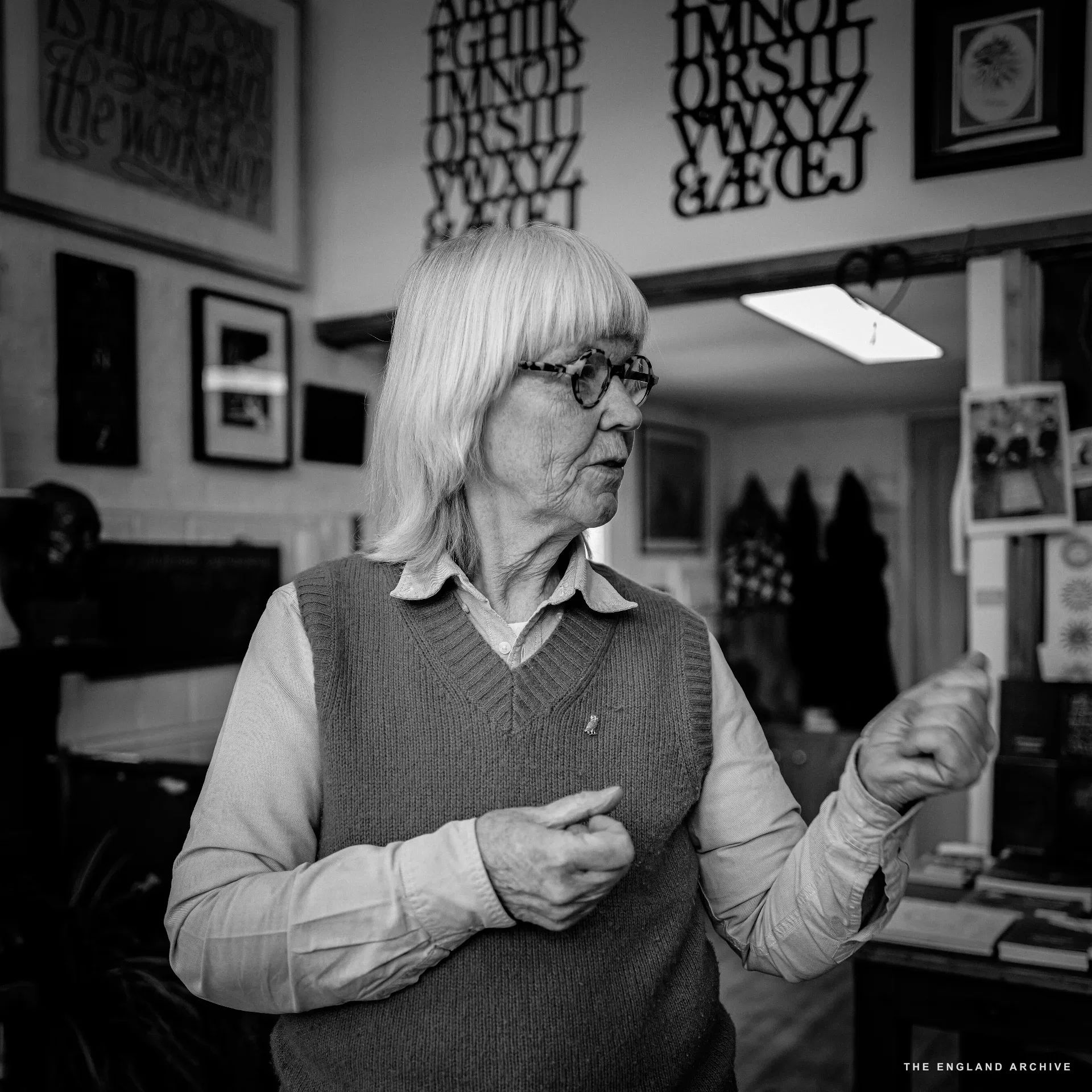
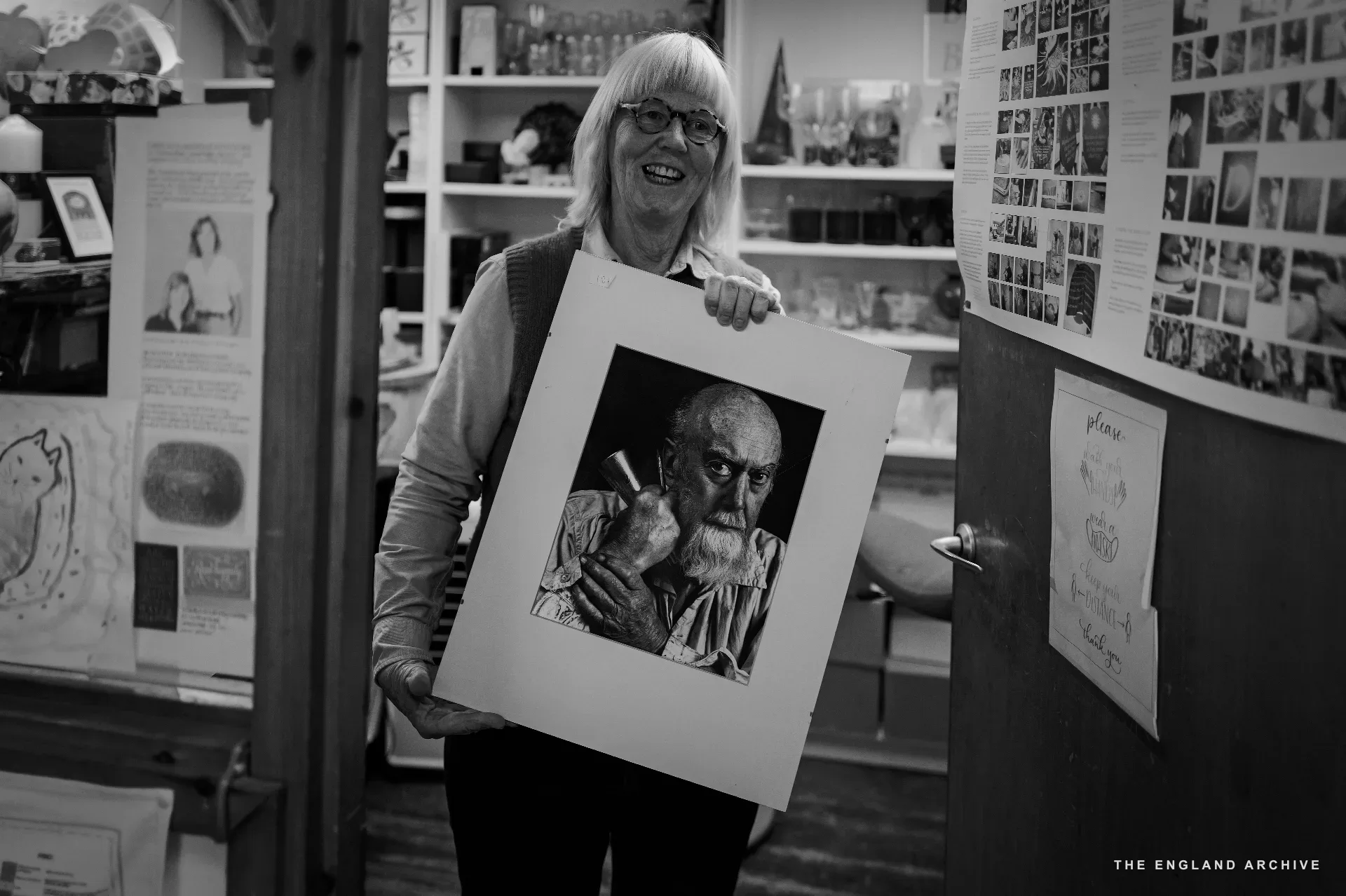
What Lida inherited in 1995 was not only a workshop but a responsibility. David Kindersley had been the central figure of English letter-cutting for forty-five years; his death left a commissioning gap, a training gap, and a public-face gap that no other practitioner of comparable standing existed to fill. The workshop was also not straightforwardly financially secure; like most English craft workshops at the end of the twentieth century, it operated on a narrow margin, with commissions coming in unpredictably and apprentices requiring years of investment before returning any productive value. Lida's decision to continue the workshop rather than wind it down was, in retrospect, one of the most consequential decisions made in English craft in that decade. The line could have ended in 1995. It did not, because she kept it going.
Her own work as a letter-cutter is substantial and distinct. Lida's inscriptional style carries her Dutch training in ways that make it possible, in many cases, to distinguish her hand from David's: a slightly different sense of the counter-space, a slightly cooler handling of the serifs, a cleaner rhythm. She has cut commissions across the country - memorial tablets, foundation stones, tomb slabs, dedicatory pieces for colleges and cathedrals, a substantial body of private commissions for gardens and houses - and her name is, in English letter-cutting circles, the one that means the workshop.
She is also a published author in her own right. Her books on the craft include Crafting in Stone, Variations on V, and several volumes on calligraphy and lettering collaboratively with other authors. Her writing is lucid, specific, and pedagogical - oriented toward apprentices and toward readers interested in understanding the craft's internal logic rather than toward general-audience flattery of English craft heritage. She has taught, lectured, and served on various bodies concerned with the lettering disciplines; within the trade she is a reference figure.
The period between 1995 and the present has also been the period in which Lida gradually prepared the workshop for the generation after her own. Her sons Hallam and Vincent both work at the workshop; Vincent's wife Roxanne came into the practice, learned it under Lida, and has been moving, year by year, into the running of the operation. That transition is, in 2026, materially complete in working terms, though Lida remains at the workshop every day and the formal public face of the practice is still shared between the two generations.
It is worth saying plainly what the thirty years from 1995 to 2025 represent for the craft. In that period, the number of working English letter-cutting workshops at the scale of Cardozo Kindersley could be counted on the fingers of one hand, and the workshop that Lida ran was the reference centre. She kept the apprenticeship tradition functional. She accepted commissions that sustained the practice financially. She maintained the archive of paper records, rubbings, and typographic material that the workshop had accumulated since David's time. She trained, in the most literal sense, the next generation. A reader a century from now who wants to understand why English stone letter-cutting is still being taught and practised in the early twenty-first century will find the answer substantially in Lida Lopes Cardozo Kindersley's thirty years of carrying the line.
VI. The Cardozo Kindersley Workshop in 2026
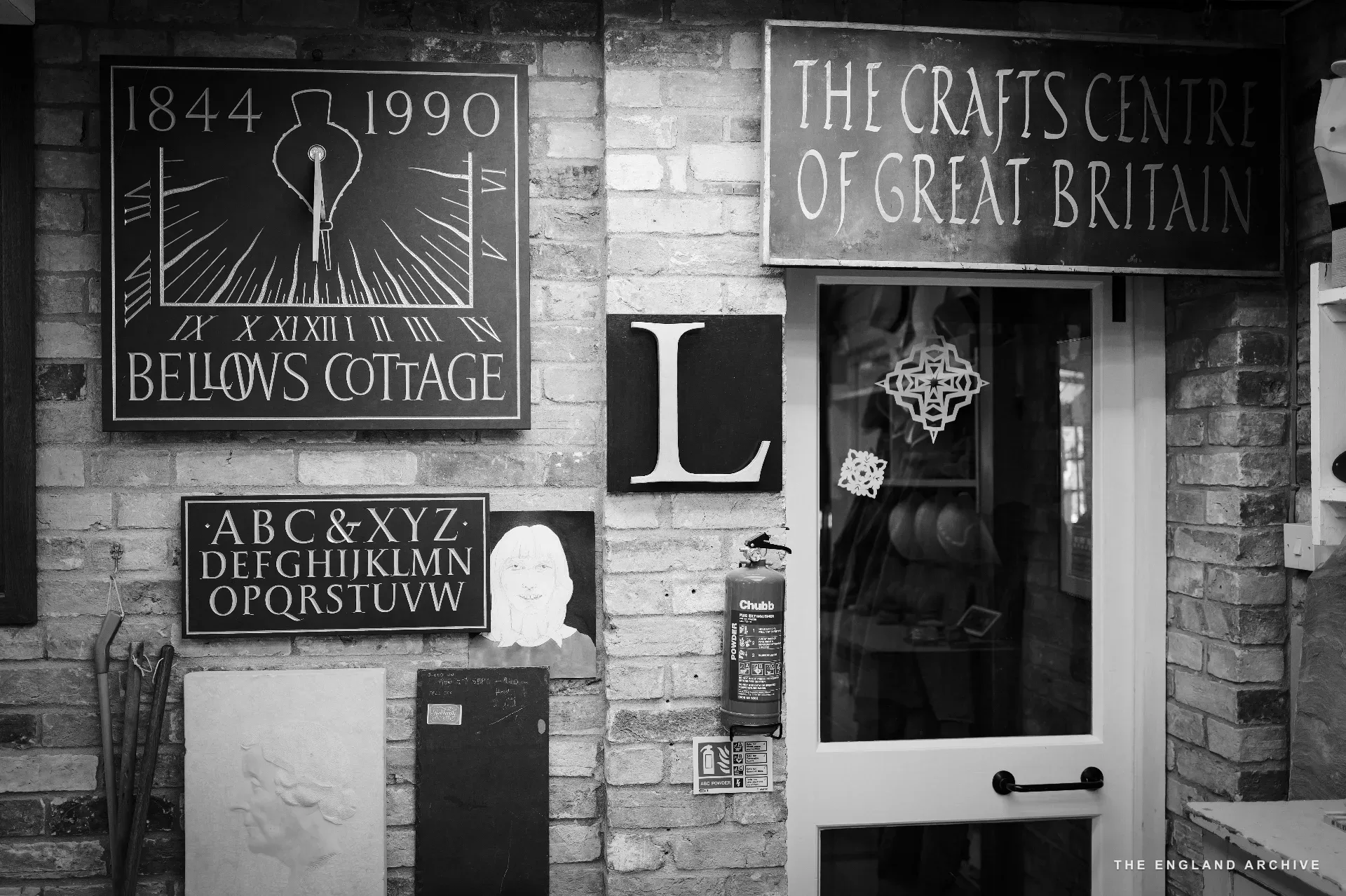
The Cardozo Kindersley Workshop occupies a building on a residential street in Cambridge. From the street it reads as a working house rather than a commercial premises; the only outward indication that a workshop of national significance is inside is the hand-cut sign above the door, which is an example of the work produced within. The archive visited the workshop on Wednesday 22 April 2026 at the invitation of the principals, and what follows is the record of the practice as it stood on that day.
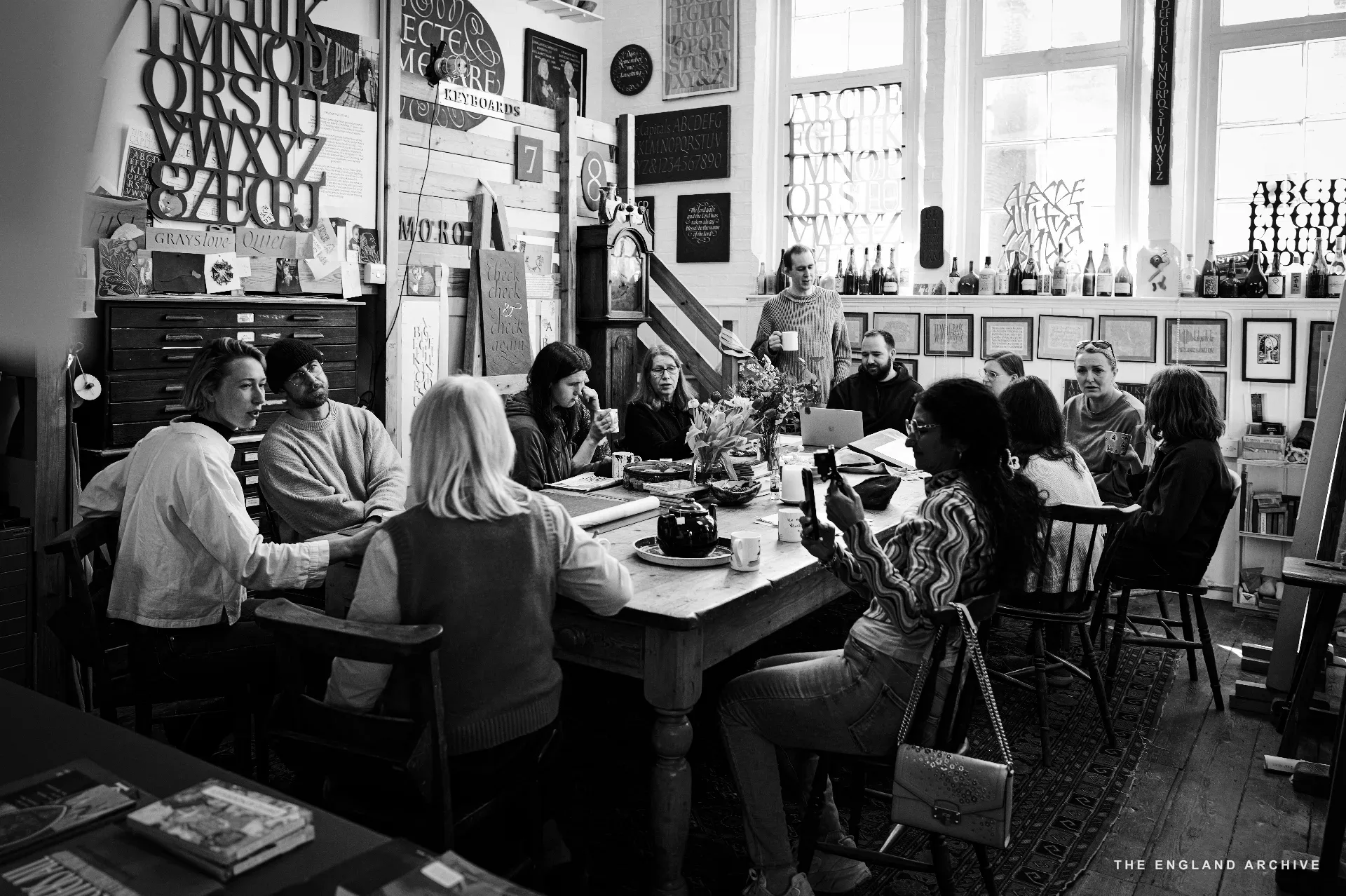
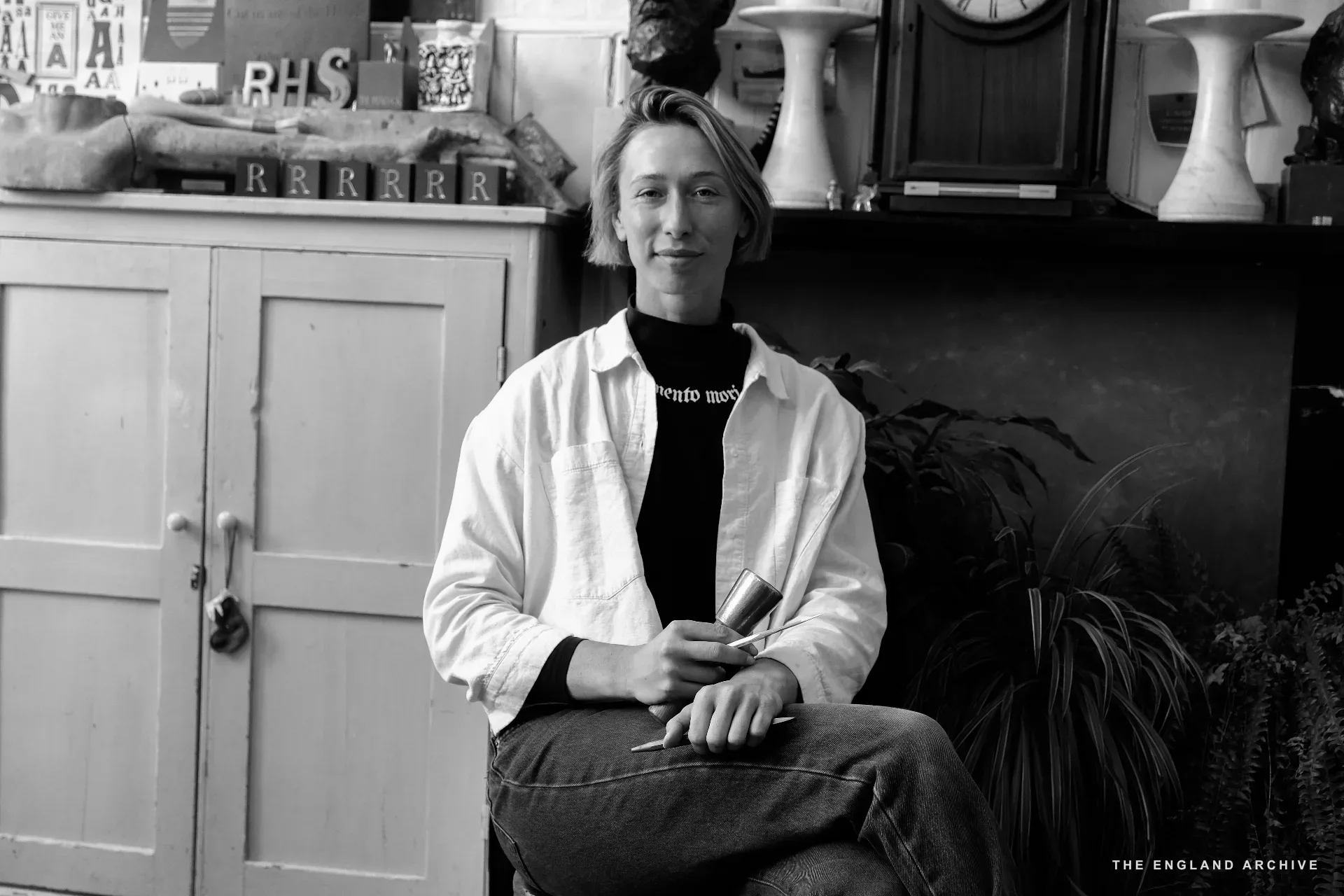
The working team on the morning of the visit was: Lida Kindersley, the matriarch; Roxanne Kindersley, the working head (Vincent's wife; daughter-in-law to Lida); Vincent Kindersley, designer and letter-cutter; Hallam Kindersley, letter-cutter, the elder of the two sons; Emily, a letterer of eight years' standing at the workshop; Harriet, who runs the office; and a first-day apprentice who had walked in off the street that morning without an appointment. The workshop generally carries a working complement of this kind: three to four letter-cutters, plus administrative support, plus apprentices at various stages of training. It is small by the standards of any industrial workshop; it is large by the standards of surviving English hand-cutting practices.
Roxanne has, over recent years, taken on the running of the workshop. The transition has been handled internally and gradually; there is no single date at which Lida ceased to be the principal and Roxanne became so, but in practical terms the commissions, the wages, the apprentice intake, and the direction of the day are now Roxanne's to manage. She learned the craft inside the workshop, alongside Lida, over a span of years; the apprenticeship was compressed but absolute. She cuts letters, teaches, directs commissions, manages clients, takes in new apprentices, and keeps the workshop running as a continuous working operation. The archive's subject-page treatment of her practice is at Roxanne Kindersley (MK-0003); the journal entry of the visit, A Morning at Cardozo Kindersley (JN-0011), gives the observational record of a morning in her company.
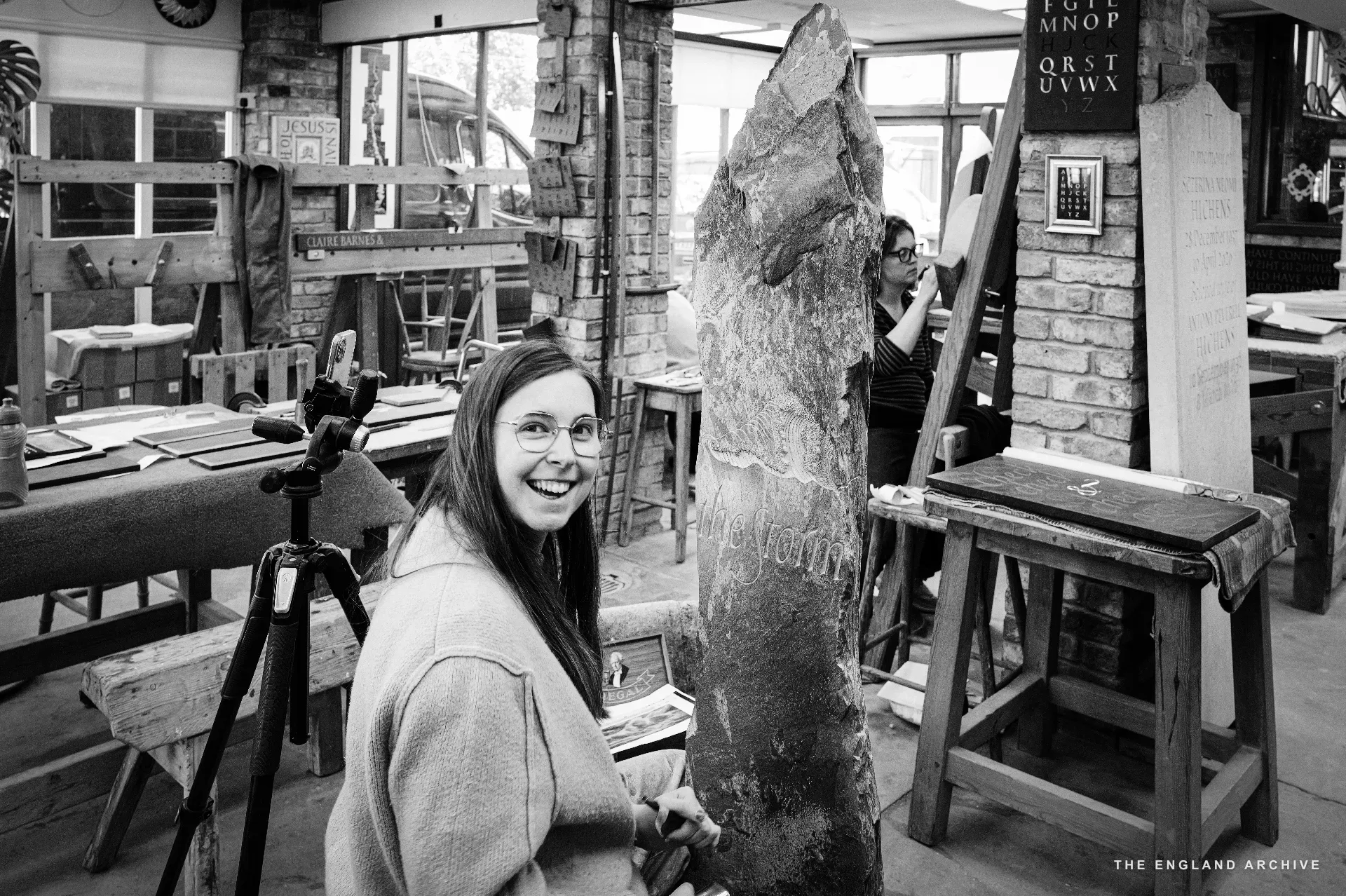
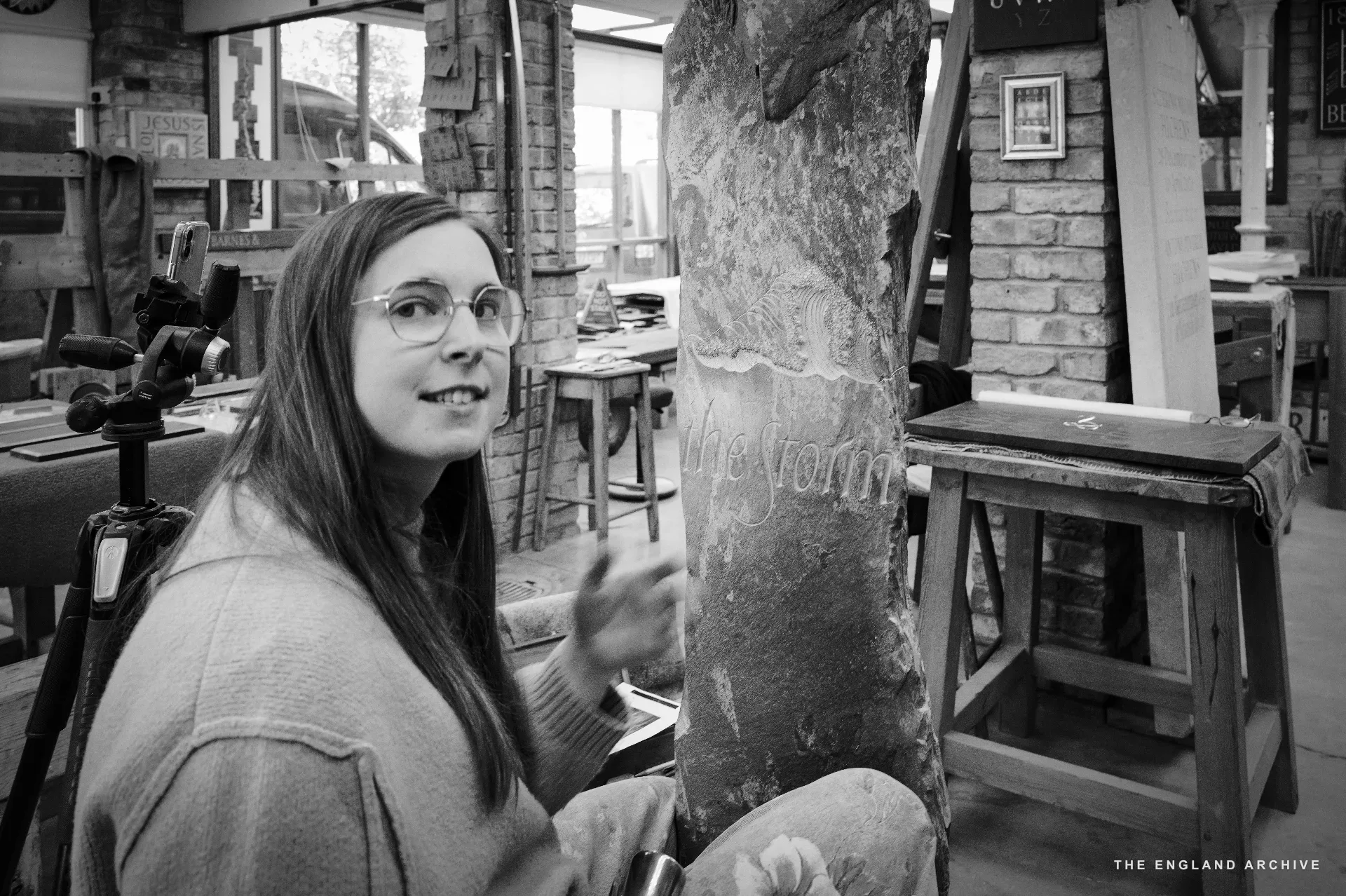
The commission slate in the period of the visit included memorial stones (the majority of the workshop's ongoing work), foundation dedications for two colleges, private garden pieces, and a memorial pillar being cut by Emily that is worth describing as representative of what the workshop produces. The pillar was being cut on two opposing faces. One face read The Storm. The other, The Calm After The Storm. The commission had come from someone who had come through an extended illness and wanted a piece for their home that commemorated the crossing. Emily had been working on the piece for some weeks. Roxanne described the logic of the setting-out - how the two phrases had to read as a single thought, how the tempo of the letters on each face had to answer the tempo on the other face - and Emily extended the account with the specifics of the execution: the choice of stone, the chisel angles for the two different textures of stroke, the places where she had corrected a line, the places where she had let a small unevenness stand because the piece was better for it.
Vincent was at his bench in a separate room, working on the design for a commission in progress. He had a sheet of paper, a pencil, and the setting-out drawing in front of him. He was working in the oldest tool-pair in the discipline - paper, a hand, a pencil - drawing out the letterforms at full size before any stone was touched. The setting-out is where the letter's proportions are decided; after the setting-out, the cutting is (in some sense) only the execution of a plan already made. Vincent spoke little while he worked. The drawing was what he was attending to.
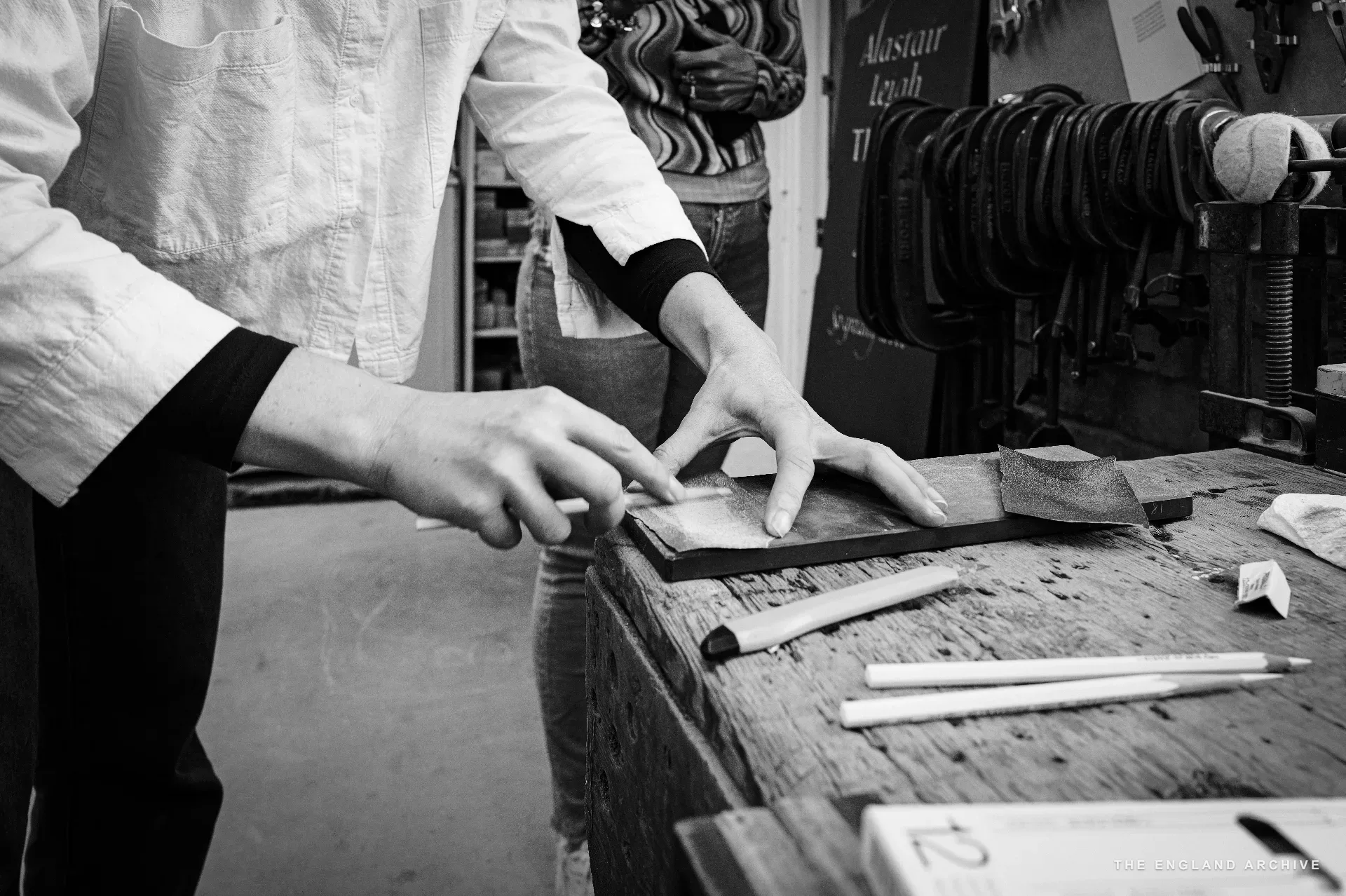
The apprentice was in another room, at her own bench, sharpening a pencil. She had arrived that morning uninvited; Roxanne had looked at her, said yes, come with me, and had set her up with a bench and a knife and the first task of any Cardozo Kindersley apprenticeship. This is a rare thing in 2026. Most craft training in England now runs through courses, certifications, and college programmes; the door-and-pencil method is anachronistic even by the standards of the trades that still accept apprentices. The workshop accepts it because Lida was trained in it, because David was trained in it, because Gill's workshop was run on it, and because the method still produces the apprentices it is designed to produce.
The workshop accepts commissions by letter, email, and personal enquiry. It takes apprentices as they present themselves, when the practice has capacity. It has a working relationship with Cambridgeshire churches, with the University, with a number of the Cambridge colleges, and with private patrons in East Anglia and beyond. Its commissions appear in public across the country, most of them unsigned, most of them identifiable only by the hand. An observer walking through Cambridge in 2026 is reading Cardozo Kindersley letters whenever they read a street sign; a visitor to a Cambridge college chapel is reading Cardozo Kindersley letters on many of the memorial plaques; a reader in a parish church in Cambridgeshire is often reading letters cut by Lida or by David or by one of the hands the workshop has trained. The letters are, in the specific sense the craft uses, there to be read.
VII. The state of the craft in 2026
How many working stone letter-cutters are there in England in 2026? The number is uncertain at the edges - letter-cutting overlaps with stone-masonry, memorial-masonry, and conservation work, and practitioners whose primary discipline is another stone craft will sometimes take on inscriptional work - but the number of people whose principal practice is the Gill-Kindersley line of hand-cut inscriptional lettering is small. Estimates given to the archive in conversation across the field vary, but the upper end of credible numbers is on the order of thirty working cutters nationally, and the lower end would bring the count below twenty. It is, in other words, a craft whose entire national workforce would fit comfortably in a small lecture theatre.
The workshops at this scale are few. Cardozo Kindersley in Cambridge is the largest and the most visible. A handful of smaller workshops - some independent practitioners, some in conservation settings, some attached to memorial-masonry firms that maintain a hand-cut capability alongside mechanised production - carry the rest of the working capacity. The training pipeline is thin. A handful of courses exist; the Prince's Foundation has run letter-carving programmes; the Cardozo Kindersley apprenticeship is the longest-running training pathway; and a small number of individual practitioners take apprentices directly. The total annual intake of new trainees into the discipline is measured in single digits.
The market for hand-cut inscriptional work has held at a small steady level for the last several decades rather than declining further. The demand for memorial stones, foundation dedications, and private commissions has not collapsed; there are enough clients, in England and among the English diaspora, who specifically want hand-cut lettering to sustain the existing workshops. What the market has not done is grow; the craft operates in a niche that is permanent but small. The work is more expensive than machine-cut alternatives by a factor that varies but is generally substantial. The clients who choose it do so knowing what they are choosing.
The heritage-status picture is mixed. The Heritage Crafts Association, the national advocate for endangered crafts, lists stone letter-cutting in its Red List of Endangered Crafts as a craft currently viable rather than critically or seriously endangered - which reflects the reality that the handful of workshops sustaining it are, individually, functional and commissionable. But "currently viable" is not "secure." The craft's entire continuity in the twenty-first century depends on a small number of working practitioners carrying the line into their own successors. If two or three of the current workshops were to close without trained replacements, the craft would move rapidly into the endangered tier of the Red List.
The threats are familiar: the aging demographic of existing practitioners, the economics of a small workshop in the English property market, the long training time required to produce a competent cutter (six to ten years, at minimum), the narrow pipeline of new apprentices, the competition from machine-cut and routed alternatives for the cheaper end of the commissioning market, and the general diffusion of attention away from crafts whose products are not consumed rapidly. Against those threats: the durability of the work itself, the continuing demand from specific classes of client, the theoretical and practical authority of the surviving workshops, the presence of living masters who remember the working practices of the twentieth-century revival, and the continued willingness of young people to present themselves at workshop doors asking to be trained.
What is lost if the line ends is considerable. The obvious loss is the production of new inscriptional work in the Gill-Kindersley tradition - the memorial stones, the foundation dedications, the private commissions that would otherwise have been machine-cut or not made at all. The less obvious loss is the maintenance of the historical record. A working letter-cutting workshop is also a custodian of the craft's accumulated knowledge: the rubbings, the paper archive, the specimens, the training exercises, the institutional memory of how particular problems were solved by particular cutters in particular decades. When a workshop closes, that accumulated material is at risk of dispersal. When the last workshop of a particular line closes, the line itself becomes something that can only be reconstructed from outside.
The stones already in place - the Trajan inscription, the medieval slabs, the Georgian memorials, the war memorials of the twentieth century, the Kindersley work in place across England - do not require letter-cutters to persist in order to keep existing. They will continue to be readable for as long as the stone holds, which, in the case of well-chosen stone in sheltered positions, is centuries. What requires living practitioners is the continuation of new work in the same line. Without cutters, the stones of 2050 will either be machine-cut or will not be cut at all. The record of English public lettering will develop a gap from roughly the year the last hand-cutter retires until whenever (if ever) a revival puts new hands at new benches.
Closing
The Cardozo Kindersley Workshop in April 2026 is not an endangered curiosity. It is a working practice, with commissions on the benches, apprentices at work, clients being spoken to on the telephone, and a matriarch still at the big table drinking green tea while a new apprentice learns to sharpen a pencil two rooms away. The craft it carries is the oldest continuously practised letter-working discipline in European culture, and the specific English line it carries was rebuilt by one man in Buckinghamshire in the 1930s and carried to Cambridge by another in the 1940s and kept alive by a Dutch typographer who came for a visit in 1976 and never left. Every letter cut on the workshop's benches today stands in that line.
The archive's record of the workshop is made of one long visit, a set of portraits on film, a set of frames on a small digital camera, an account of a pencil, and this essay. It is not a complete record and it is not meant to be. It is the record the archive is able to make, at the moment in the craft's history when we have made it, by the people whose hands are still at the benches. A reader a century from now who wants to know what English stone letter-cutting was in 2026, and what the Cardozo Kindersley Workshop was, and who the people inside it were on a Wednesday morning in April, will find here the honest answer that the archive was able to give.
What happens next to the craft is not something any single documentary record can influence. The workshop will take the apprentices it takes, or it will not. The commissions will come, or they will thin. The next generation - Roxanne's generation - will carry the line, or it will end. The stones that are already cut will continue to be there either way, and the best and oldest of them will still be legible in the year the last living practitioner's grandchildren are themselves old.
Stone letter-cutting is the craft's argument that some things are worth the long look. The argument survives, in 2026, because a small number of people have continued to make it with their hands. The archive's job is to name them, to photograph them, to place them in their line, and to leave a record that will be as durable as the medium permits.
Sources and notes
Primary sources. Observation and conversation at the Cardozo Kindersley Workshop, 22 April 2026, with Lida Kindersley, Roxanne Kindersley, Vincent Kindersley, Hallam Kindersley, Emily, and the workshop team. The narrative account of the visit is A Morning at Cardozo Kindersley (JN-0011).
Published sources consulted. David Kindersley, Optical Letter Spacing for New Printing Systems (1976); Mr Eric Gill: Further Thoughts by an Apprentice (1967); Graphic Sayings (1983). Lida Lopes Cardozo Kindersley, various publications including Crafting in Stone. Eric Gill, An Essay on Typography (1931) and the Autobiography (1940). Edward Catich, The Origin of the Serif (1968), the definitive scholarly work on the Trajan inscription. Nicolete Gray, A History of Lettering (1986), the standard English-language history of the discipline. The Heritage Crafts Association Red List of Endangered Crafts for the current craft status.
On the Kindersley workshop's archive. The workshop's paper archive - rubbings, setting-out drawings, commission records, photographs - is held at the workshop and is not publicly catalogued. A proper future treatment of the workshop's history will require access to that archive on research terms agreed with the workshop.
Photographs. Contemporary photographs in this essay are from the 22 April 2026 visit to the Cardozo Kindersley Workshop and are part of the canonical Cambridge image set (IM-0142 to IM-0213) shared across the journal entry, the subject pages, and the area page. The full visual record of the visit is in A Morning at Cardozo Kindersley (JN-0011). Public-domain plates for the Trajan inscription, Georgian English inscriptional work, and Gill specimens are referenced in prose only at this stage; they will be added when sourced from Wikimedia Commons and other PD repositories. Historical photographs of David Kindersley, the earlier workshop, and the Cambridge Street Signs project remain to be requested from the Cardozo Kindersley Workshop archive.
Corrections and revisions. This essay is an initial treatment and will be revised as research continues. Errors of fact, emphasis, or omission are the archive's. Readers who spot issues are invited to write: we would rather have the record right than right quickly.
Read alongside: A Morning at Cardozo Kindersley (JN-0011) - the narrative of the visit. Lida Kindersley (MK-0002). Roxanne Kindersley (MK-0003). Cambridge (AR-0027).