The Question of the Camera
Every camera is an argument about what the subject deserves.
I have been sitting with this sentence for weeks now, turning it over, testing it against what I actually believe. And I keep arriving at the same place. The choice of camera is not a technical decision. It is an editorial one. It tells the subject - whether they know it or not - how seriously you take them. Whether their work merits the slowness and cost and difficulty of doing things the harder way.
For this project, I believe it does.
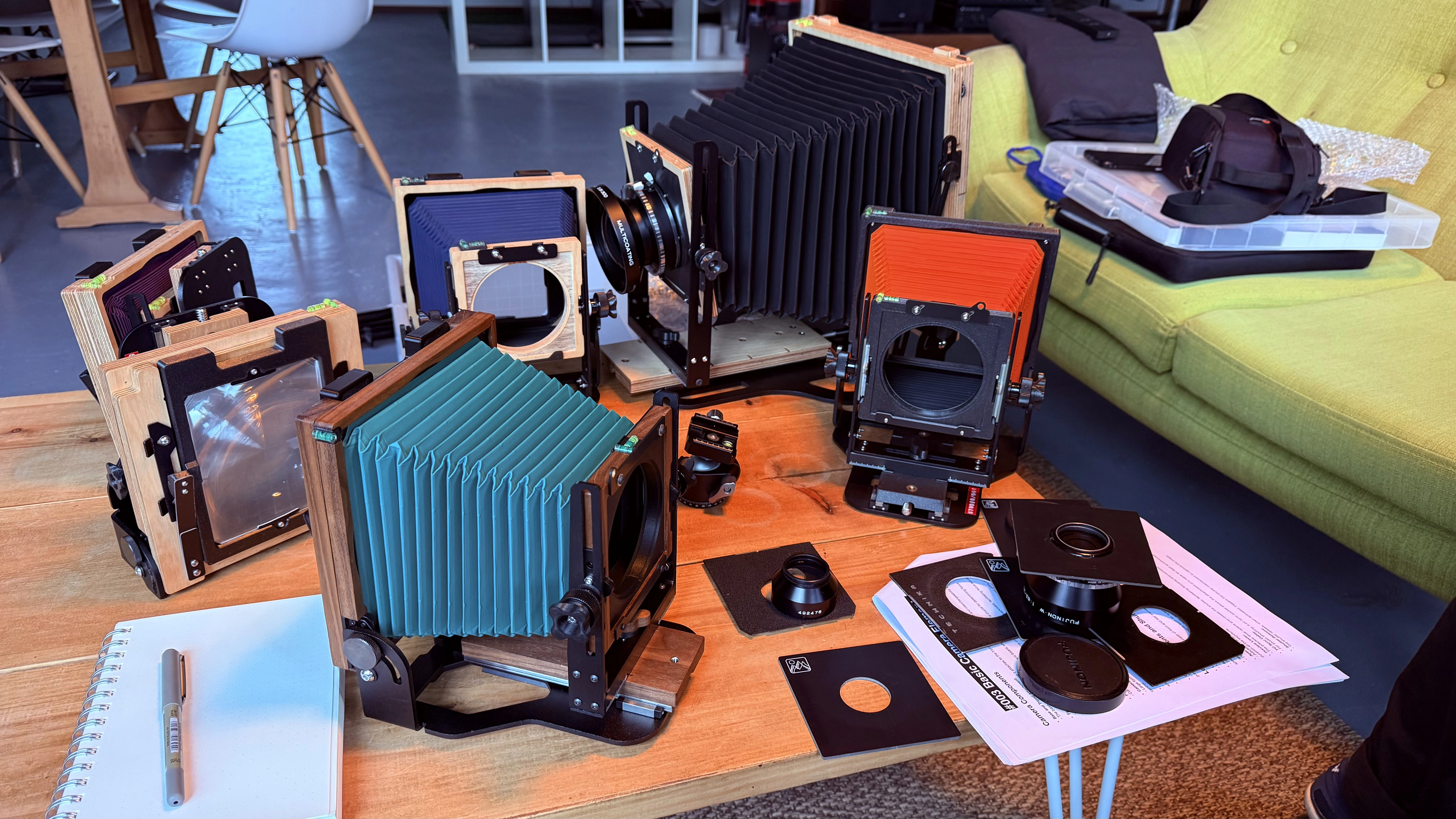
The England Archive will be shot on four systems. A Leica Q3 for the primary documentary work - the camera I love, the camera I reach for first and put away last. A Fujifilm X-S20 for behind-the-scenes video, b-roll, and the secondary documentary coverage that builds the visual diary around the main work. A Bronica SQ-A, medium format, square, fully mechanical, for the considered portraits and environmental work. And an Intrepid 4x5 large format camera for the most significant sittings, the portraits that will anchor the archive’s permanent collection.
Two of those cameras shoot film. In 2026, that requires some explaining. But first, the digital workhorses.
The Leica
The Q3 is the camera that never hesitates. The fixed 28mm Summilux lens forces you to be close, to be present, to commit to where you are standing rather than zooming from a safe distance. That constraint is a gift. When I am walking through a bonfire procession, or standing in a blacksmith’s workshop while sparks fly, or arriving at a village church at five in the morning to meet a churchwarden, the Q3 is the camera in my hand. It is fast enough that I never miss the moment and sharp enough that the images hold at any reproduction size. Sixty megapixels from a sensor that handles low light with a composure that still surprises me.
I love this camera. I do not say that about tools lightly. But there is something about the Q3 that makes the act of seeing feel frictionless - the viewfinder, the autofocus, the way the Summilux renders light - and for documentary work, frictionless is what you want. You want the camera to disappear so that the attention flows entirely to the subject. The Q3 does that better than anything I have used.
Most of the archive’s documentary images - the in-between moments, the hands at rest, the crowd gathering, the light across a churchyard - will be made with this camera. It is the workhorse. Everything else builds around it.
The Fujifilm
The X-S20 occupies a different role. It is the system camera - the one I build around when the day requires range. The X-mount lenses give me everything from wide environmental work to tight details without changing bodies, and the film simulations - particularly Classic Negative and Acros - give the in-camera output a character that sits naturally alongside the archive’s editorial tone. But the X-S20’s real value to this project is video. The behind-the-scenes footage, the b-roll of a craft process unfolding, the short documentary clips that will accompany the archive’s online presence - all of that comes from the Fujifilm. It is lighter than a full-frame video rig, which matters when you are shooting stills and video simultaneously over a twelve-hour field day, and the 6K output is more than sufficient for anything we need.
The Leica is for the images that define the archive. The Fujifilm is for the visual context that surrounds them - the process footage, the setting, the texture of a day spent in the field. Both are essential. They serve different kinds of seeing.
The Film Cameras
Film does something digital does not, and the thing it does matters for this project specifically. A medium format negative holds tonal information - the transition from light to shadow, the texture of skin and stone and cloth - in a way that even the best digital sensors approximate but do not replicate. When you are photographing a blacksmith’s hands, or the surface of a dry stone wall that has stood for two hundred years, or the face of someone who has spent forty years keeping a tradition alive that most of the country does not know exists, that tonal depth is not decorative. It is the difference between a photograph that describes the subject and one that honours it.
I am not a film purist. The Leica and the Fujifilm are digital, and much of the documentary work will be digital, and that is right. The event photography, the BTS coverage, the journal of a tradition unfolding in real time - digital is right for that. It is fast, forgiving, and allows me to work without drawing attention to the process. But when I ask someone to sit for a portrait - when I ask them to give me their time and their trust and the particular quality of attention that a formal sitting requires - the camera should match that ask. A mechanical Bronica on a tripod, with twelve frames on a roll, is a different proposition than a mirrorless digital body firing at ten frames per second. The subject can feel the difference. They sit differently. They understand, without being told, that something careful is happening.
Homer Sykes understood this. When I visited him and we talked about his work on Hunting With Hounds, the tonal quality of those square-format black and white prints was exactly what I had been chasing in my head for months. Rich, deep, unmanipulated. Not dramatic. Just honest and considered. His book confirmed something I had been circling around: the format is part of the meaning. A square negative from a waist-level finder puts you in a particular physical relationship with the subject. You are looking down into the ground glass, not squinting through a viewfinder with one eye. The subject sees your face, not a camera where your face should be. That changes everything about how a portrait feels - for both of you.
Daniel Meadows understood something adjacent. His colour work from the 1970s, the free portrait studio he set up in a double-decker bus and drove around England, has an intimacy that comes precisely from its refusal to aestheticise. The colour is just there, the way it was, and that ordinariness is what makes the photographs feel true fifty years later. He was not trying to make beautiful photographs. He was trying to make honest ones, and the beauty came from the honesty. That distinction matters more than most photographers are willing to admit.
Martin Parr understood something different again, and I want to be careful here because his work is extraordinary. The saturation, the ring flash, the way he finds the absurd in the ordinary - there is no one better at it. But his approach is fundamentally ironic, and irony is not what this project needs. The people I am photographing are not performing Englishness for an audience that finds it quaint or funny. They are doing serious work, often alone, often unrecognised, and the photographs need to meet that seriousness without flinching. I respect Parr’s eye enormously. I have spent hours with The Last Resort and The Cost of Living. But his camera is asking a different question than mine. His question is about what England looks like when you refuse to sentimentalise it. Mine is about what England loses when no one is paying attention. Both are valid. They are not the same.
The question of black and white versus colour has been more complicated than I expected.
My instinct, from the beginning, has been black and white for the formal portraits and colour for the documentary and environmental work. Black and white strips the image back to structure, to light, to the essential geometry of a face or a workshop or a landscape. It also, and this matters, places the image outside of a specific moment. A black and white portrait of a thatcher at work could have been made in 1975 or 2026. That temporal ambiguity is part of what I want the archive to carry - the sense that these people and practices belong to a continuity that is longer than any single decade.
Colour, on the other hand, is where the world lives. The rust on a forge. The green of a Somerset orchard in late spring. The specific, particular, unrepeatable light of a November bonfire in Lewes. You cannot photograph the Padstow Obby Oss in black and white and have anyone understand what it feels like to be there. The colour is the experience. To remove it would be to impose an aesthetic on the subject rather than letting the subject dictate the aesthetic.
So the answer is both, and the deciding factor is the subject, not the photographer. Some subjects demand black and white. Some demand colour. The discipline is knowing which is which and not letting your own preferences override what the work requires.
I should be honest about the practical reality of shooting film in 2026, because it is not romantic.
Labs are closing. The ones that remain are expensive and the turnaround times are getting longer. I have been doing the maths on this and it is sobering. Ilford is still making beautiful black and white stock and I am grateful for that, genuinely, because without them this project would be significantly harder. But Kodak’s pricing has become difficult to justify for anything other than the most important work. A single roll of Portra 400 in 120 format now costs what three rolls cost five years ago. A box of 4x5 sheet film is an investment that makes you think very carefully about whether you are ready to press the shutter.
There is a lab in south London I trust. There is another in Bristol. Between them they cover what I need. But every time one closes - and they are closing, quietly, one by one - the chain gets thinner. I am building an archive on infrastructure that is itself endangered. There is an irony in that which I do not find especially funny.
That expense, though, is part of why I am doing it this way. Not because I enjoy spending money, but because the cost imposes a discipline that changes how you work. Twelve frames on a roll of 120. Four sheets in a film holder. You do not spray and pray with a Bronica. You look. You wait. You make sure the frame is right before you commit. That slowness is not a limitation. It is a method. And the method shapes the result in ways that are visible in the final image, even to people who know nothing about cameras.
There is a tension in documentary photography between precision and emotional truth. The precise image records exactly what was there. The emotionally true image records what it felt like to be there. The best documentary work does both simultaneously, and the camera choice is part of how you get there.
A Bronica on a tripod, with its waist-level finder and its mirror slap and its twelve careful frames, puts you in a particular relationship with the subject. You are both present in the making of the image. It is collaborative in a way that a long lens from across the room never is. The subject knows they are being photographed. They know it matters. And that knowledge - that mutual understanding that something considered is happening - is visible in the result.
I keep coming back to the word “deserves.” The coppice worker in the Kent woodland, who learned the craft from his father, who learned it from his - what does that lineage deserve from a photographer? The woman who has been leading the Padstow May Day celebrations for fifteen years, who carries the weight of a community’s identity every spring - what does her commitment deserve?
I think it deserves the best I can offer. Not the most expensive, not the most technically impressive, but the most considered. A camera that slows me down. A format that holds detail. A process that treats the making of the photograph as an act of attention commensurate with the attention the subject has given their own work.
That is the argument. The camera is the argument. And the argument is that these people and their work deserve the slowest, most deliberate attention I can bring.
The first film goes in the camera next month.