England’s Calendar of Living Traditions
A month-by-month guide to the annual customs, ceremonies, and calendar traditions that survive because one person keeps showing up - where they happen, when they happen, and why the date itself is part of the meaning
England has a ritual calendar. Not the calendar of bank holidays and long weekends, but an older one - a calendar of obligations, performed by specific people in specific places on specific dates, year after year, for reasons that are older than anyone alive can explain.
On the first of May, a choir sings from the top of Magdalen Tower in Oxford at six in the morning. On the fifth of November, seven bonfire societies process through the streets of Lewes with flaming torches and burning crosses. On Twelfth Night, the Haxey Hood is contested in a mass scrum across the fields of North Lincolnshire. On Whit Friday, brass bands march through the villages of Saddleworth and Tameside, competing against each other in a tradition that has run since the 1880s. On the Saturday nearest Midsummer, the people of Warcop in Westmorland rush the church with armfuls of rushes, continuing a ceremony that predates the Reformation.
These events are not re-enactments. They are not heritage performances staged for tourists. They are living traditions, maintained by the people who carry them, and they survive for one reason only: someone shows up, every year, and does the work. The moment that person stops, the tradition does not wait. It ends.
This resource is the working calendar behind the Carriers strand of The England Archive. It maps what survives, when it happens, who carries it, and what the key pressures on each tradition are. It is updated as new fieldwork is completed and as traditions are added, revived, or lost.
This resource is a companion to our essay The People Who Carry England, which introduces the Carriers category and the nature of the obligation that sustains these traditions. For the question of how traditions actually end, see When the Ceremony Stops.
What a Living Tradition Is
The distinction matters, because England is full of events that look like traditions but are not, and full of traditions that do not look like much but are irreplaceable.
A living tradition, as The England Archive uses the term, has four characteristics:
Date-locked
The event happens on a specific date or within a fixed calendrical window. Moving it to a more convenient weekend would, in the eyes of the people who carry it, destroy its meaning. The date is non-negotiable.
Person-dependent
The tradition survives because a specific individual or small group of individuals organises it, performs it, or holds the knowledge required to carry it out. Without them, it stops.
Place-bound
The tradition belongs to a specific location. It cannot be relocated without ceasing to be itself. The Padstow Obby Oss is not a generic hobby horse dance. It is a Padstow event, and it makes no sense anywhere else.
Unbroken or restored
The tradition either has continuous history within living memory or was revived by people with a direct connection to the original practice. A newly invented event styled as a tradition does not qualify.
These criteria exclude a great deal. Medieval fairs restarted by town councils for tourism purposes are not living traditions. Morris dancing sides formed in the 1970s revival are part of the carrier ecology but are not themselves ancient customs. Heritage open days, craft fairs, and food festivals, however valuable, are events, not traditions. The distinction is not about quality or importance. It is about the specific fragility that comes from a practice being locked to a date, a place, and a person.
Ronald Hutton, in The Stations of the Sun: A History of the Ritual Year in Britain (1996), documented more than seventy distinct annual celebrations still practised across England when he researched the book in the early 1990s. His work remains the most rigorous scholarly account of the English ritual calendar, and it is the primary framework against which this resource is constructed. The number of active traditions has fluctuated since Hutton wrote - some have lapsed, some have been revived, a few new ones have established themselves - but the overall shape of the calendar he documented remains recognisable.
The Calendar Month by Month
What follows is a working list of surviving annual traditions in England, organised by the month in which they occur. It is not exhaustive. It prioritises traditions that meet the four criteria above and that fall within the geographical and thematic scope of the archive. Traditions marked with • are ones The England Archive has documented or plans to document.
January
The wassailing month. The oldest midwinter customs cluster here, tied to the old calendar’s Twelfth Night and to the orchard traditions of the cider counties.
- Haxey Hood - Haxey, North Lincolnshire. 6 January (Old Christmas Day). A mass scrum pushing a leather cylinder toward one of four pubs. The Boggins, the Lord, and the Fool lead a ceremony whose origins are medieval and whose rules are largely incomprehensible to outsiders.
- Wassail • - Various orchards across Somerset, Devon, Herefordshire, and Sussex. Mid-January. The blessing of the apple trees to ensure a good harvest. Involves toast soaked in cider hung in the branches, shotgun fire to wake the trees, and communal singing. Each orchard has its own variation, its own wassail king or queen, and its own songs.
- Plough Monday - Various locations across eastern England. First Monday after Epiphany. A decorated plough is dragged through the village, traditionally by ploughboys collecting money. The custom was widespread in the nineteenth century; a handful of revivals survive.
- Straw Bear Festival - Whittlesey, Cambridgeshire. Weekend nearest Plough Monday. A man clad entirely in straw dances through the town. Revived in 1980 after a gap of nearly eighty years, but based on photographic evidence and local memory of the original.
February
The quietest month in the calendar. Candlemas (2 February) was once widely observed but has few surviving secular customs. Shrovetide traditions cluster at the end of the month or early March.
- Shrovetide Football - Ashbourne, Derbyshire. Shrove Tuesday and Ash Wednesday. A mass football game played through the streets and fields between the Up’ards and the Down’ards, with goals three miles apart. Hundreds of players. No visible rules. Continuous since at least the seventeenth century.
- Scarborough Skipping - Scarborough, North Yorkshire. Shrove Tuesday. Hundreds of people skip with long ropes on the foreshore road. A pancake-day tradition of uncertain age but genuine communal participation.
- Hurling the Silver Ball - St Ives, Cornwall. Feast Monday (nearest Monday to 3 February). A silver ball is thrown from the churchyard wall and hurled through the streets. A Cornish tradition, included here because of its structural similarity to English carrier customs.
March
The equinox month. The boundary between winter and spring customs. Mothering Sunday traditions once brought servants home to their “mother church”; the custom has been largely absorbed into the commercial Mother’s Day.
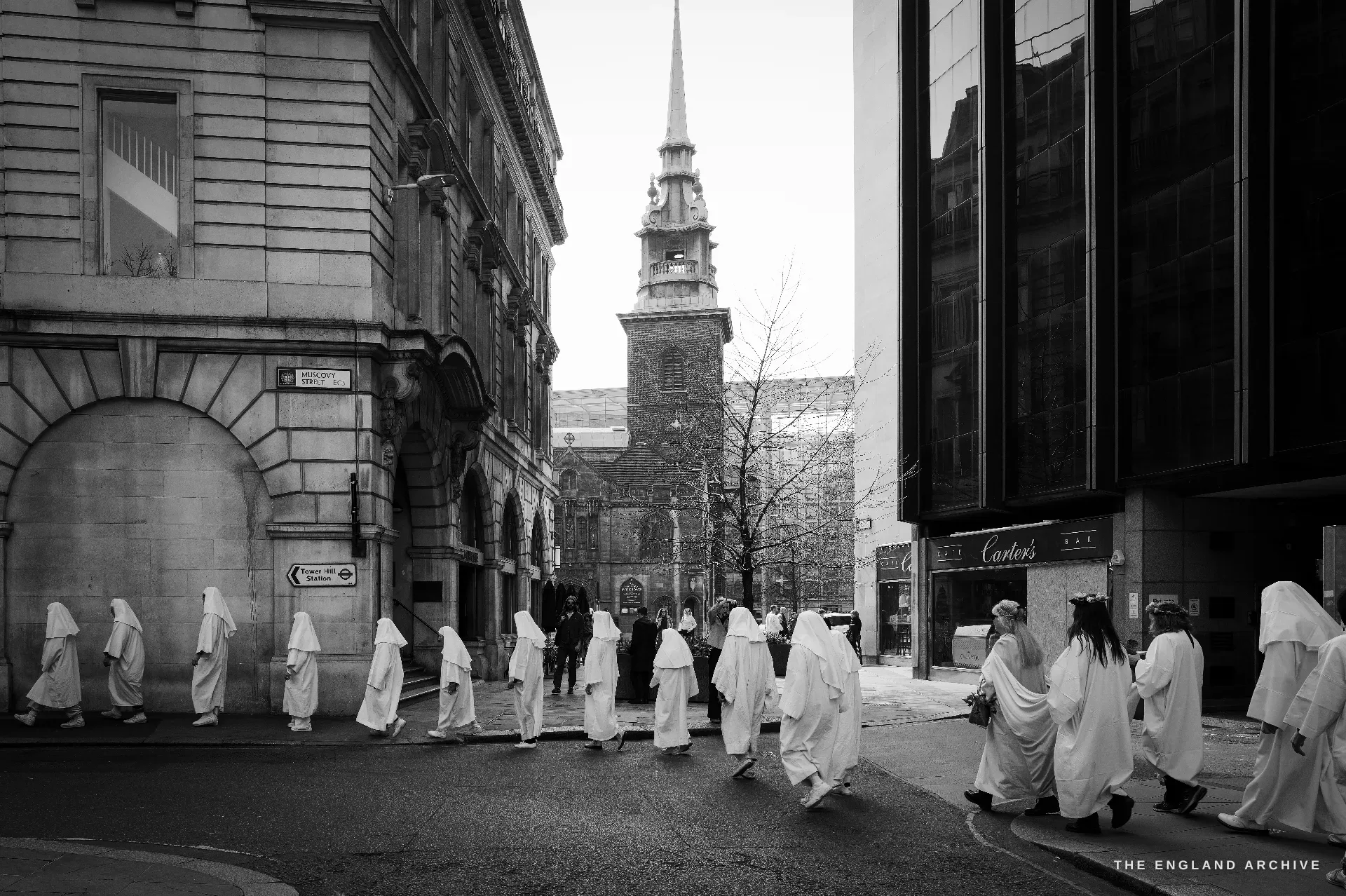
- Spring Equinox at Tower Hill • - Tower Hill, London. 20 or 21 March. The Druid Order’s spring equinox ceremony, held on Tower Hill since 1956. An open ceremony combining druidic ritual with seasonal observance.
- Tichborne Dole - Tichborne, Hampshire. 25 March (Lady Day). A distribution of flour to every household in the parish, maintained by the Tichborne family since the twelfth century. One of the oldest continuous charitable customs in England.
- Oranges and Lemons Service - St Clement Danes, London. Late March. Children from a local primary school receive oranges and lemons after a service at the church that gave the nursery rhyme its name.
April
Easter dominates. The moveable feast shifts the timing of many spring customs. Pace egg plays, hare pie scrambles, and hot cross bun ceremonies cluster around Good Friday and Easter Monday.
- Pace Egg Plays - Heptonstall, Midgley, and other locations in the Calder Valley, West Yorkshire. Good Friday. Mummers’ plays performed in the streets, featuring St George, Bold Slasher, and the Doctor. The Midgley version has run continuously; Heptonstall’s was revived in 1978.
- Hare Pie Scramble and Bottle Kicking - Hallaton, Leicestershire. Easter Monday. Hare pie is distributed at the church gate, then two teams contest a game with small wooden casks (the “bottles”) across open fields. No rules. No referee. No time limit.
- Biddenden Dole - Biddenden, Kent. Easter Monday. Distribution of bread, cheese, and tea to local residents, commemorating the Biddenden Maids, conjoined twins said to have lived in the twelfth century. Biscuits stamped with their image are distributed.
- The Widow’s Bun Ceremony - The Widow’s Son pub, Bow, London. Good Friday. A sailor adds a hot cross bun to a net hanging from the ceiling, continuing a tradition said to honour a widow who saved a bun each year for a son lost at sea.
May
The great month. More surviving traditions cluster in May than in any other month. May Day, the old start of summer, is the pivot around which the English ritual year turns.
- Padstow Obby Oss - Padstow, Cornwall. 1 May. Two hobby horses - the Old Oss and the Blue Ribbon Oss - dance through the town from dawn, accompanied by drummers and singers. The entire town participates. One of the most powerful surviving calendar customs in Europe.
- May Morning at Magdalen - Oxford. 1 May. At 6am, the choir of Magdalen College sings the Hymnus Eucharisticus from the top of Magdalen Tower. Thousands gather on the bridge below in silence. The tradition has been continuous since at least the sixteenth century.
- Jack in the Green • - Hastings, East Sussex. May Day Bank Holiday weekend. A figure encased in a tower of greenery is paraded through the Old Town and “slain” on the West Hill to release the spirit of summer. Revived in 1983 from a tradition associated with chimney sweeps’ May Day celebrations.
- Helston Furry Dance - Helston, Cornwall. 8 May (Flora Day). Couples dance through the streets and in and out of houses and shops in a series of formal dances beginning at 7am. The midday dance, led by the mayor, is the centrepiece. One of the oldest continuously observed spring festivals in England.
- ’Obby ’Oss - Minehead, Somerset. May Day eve, May Day, and 3 May. A hobby horse decorated with ribbons and a long tail dances through the town over three days. Less well known than Padstow but equally ancient and carried by a tight community of participants.
- Castleton Garland Day - Castleton, Derbyshire. 29 May (Oak Apple Day). A “king” on horseback carries a beehive-shaped garland of flowers through the village. The garland is hoisted to the top of the church tower, where it remains until the flowers decay. A rare survival of Oak Apple Day celebrations.
- Well Dressing - Tissington, Wirksworth, and other villages across the Derbyshire Peak District. Various dates, May–September. Springs and wells are decorated with elaborate pictures made from flower petals pressed into clay. Tissington’s Ascension Day dressing is considered the oldest continuous example.
- Cheese Rolling • - Cooper’s Hill, Brockworth, Gloucestershire. Spring Bank Holiday Monday. A wheel of Double Gloucester is rolled down a near-vertical hill and competitors chase it. Injuries are common. Official sanction has been withdrawn and restored multiple times; the tradition continues regardless.
June
Midsummer and the solstice. Club walks, fairs, and the old feast days of patron saints. Whit Friday brass band contests in the Pennine villages.
- Whit Friday Brass Band Contests - Saddleworth and Tameside, Greater Manchester / West Yorkshire border. Whit Friday (Friday after Whit Sunday). Brass bands march between villages, playing contest pieces at each stop. Dozens of bands, dozens of contests, from late afternoon into the night. A tradition since the 1880s rooted in the nonconformist chapel culture of the Pennine mill towns.
- Cotswold Olimpick Games • - Dover’s Hill, Chipping Campden, Gloucestershire. Friday after Spring Bank Holiday. Shin-kicking, tug-of-war, championship of the hill. Founded by Robert Dover in 1612, suppressed in 1852, revived in 1951. The oldest sporting event in England still held on its original ground.
- Midsummer Bonfires - Various locations, including Whalton, Northumberland. 24 June (St John’s Eve) or nearest Saturday. Bonfires lit on the longest night. Whalton’s Baal Fire is one of the few continuous survivals.
- Election of the Mayor of Ock Street - Abingdon, Oxfordshire. Saturday nearest 19 June. A mock mayor is elected and carried through the town. Buns are thrown from the roof of the County Hall. The tradition dates to at least the seventeenth century.
July
High summer. Rush-bearing ceremonies and the old hay harvest customs. The calendar thins as agricultural labour absorbed the community’s attention.
- Durham Miners’ Gala - Durham. Second Saturday in July. Colliery banners are paraded through the city to the racecourse, accompanied by brass bands. The Big Meeting has been held since 1871. No working deep mines remain in County Durham; the gala survives as an act of collective memory carried by the communities that once depended on coal.
- Rush-Bearing - Ambleside, Grasmere, and other Cumbrian villages. Various Saturdays in July. Children carry rushes and rush-bearings (rush crosses, rush sculptures) to the parish church, re-enacting the annual renewal of the rush-strewn church floor. Grasmere’s ceremony is the most elaborate.
- Swan Upping - River Thames, from Sunbury to Abingdon. Third week of July. The Royal Swan Marker and the swan uppers of the Vintners’ and Dyers’ Companies row upstream for five days, catching, ringing, and releasing swans. A census of the Crown’s swans that has been conducted since the twelfth century.
August
Lammas and the beginning of harvest. The old first-fruits celebrations have largely disappeared, but a few survivals persist alongside the agricultural shows that replaced them.
- Bampton Morris - Bampton, Oxfordshire. Late May Bank Holiday (traditionally Whit Monday; now danced in late May). One of the oldest documented morris sides in England, with records stretching to the seventeenth century. Included here for its calendrical discipline rather than its current date, which has shifted with the bank holiday.
- Plague Sunday - Eyam, Derbyshire. Last Sunday in August. An open-air service at Cucklett Delph commemorating the village’s self-imposed quarantine during the plague of 1665–66. Not a celebration but an act of remembrance carried by the village community.
- Burning Bartle - West Witton, North Yorkshire. Saturday nearest St Bartholomew’s Day (24 August). An effigy called Bartle is carried through the village and burned. The rhyme chanted during the procession is unique to this village and of unknown age.
- Harvest Festival - Nationwide. Various dates, late August through September. The most widespread surviving calendar custom in England, though now largely ecclesiastical. The first formal harvest festival service was held by the Rev. Robert Hawker at Morwenstow in Cornwall in 1843; the practice spread rapidly through the Victorian church.
September
The autumn pivot. Harvest suppers, horn dances, and the beginning of the bonfire season. The calendar accelerates from here toward the year’s climax in November.
- Abbots Bromley Horn Dance • - Abbots Bromley, Staffordshire. Wakes Monday (the Monday following the first Sunday after 4 September). Six dancers carry reindeer antlers - carbon-dated to the eleventh century - through the village and surrounding farms in a day-long circuit. The oldest ritual dance in Europe for which continuous documentation exists.
- Egremont Crab Fair - Egremont, Cumbria. Third Saturday in September. Crab apples are thrown from a cart, and the World Gurning Championship is held. The fair has been documented since 1267.
- Horseman’s Sunday - Hyde Park, London. Third or fourth Sunday in September. A mounted vicar blesses horses at the Church of St John, Hyde Park Crescent. A twentieth-century tradition, but one maintained by a small community of carriers with genuine calendrical discipline.
October
The old end of the agricultural year. Hiring fairs, mop fairs, and the remnants of Michaelmas customs. Punkie Night in Somerset preserves a rare calendar custom.
- Punkie Night - Hinton St George, Somerset. Last Thursday in October. Children carry “punkies” (hollowed-out mangel-wurzels with candles inside) through the village, singing the Punkie Night song. The tradition predates the American import of Halloween by centuries and is maintained by the village school and local families.
- Mop Fairs - Stratford-upon-Avon, Warwick, Cirencester, and other Midlands market towns. Various dates in October. Originally hiring fairs where servants and labourers stood with the tools of their trade to be hired for the coming year. Now funfairs, but the date and the name persist, and in some towns the opening ceremony retains elements of the original.
- Quit Rents Ceremony - Royal Courts of Justice, London. Late October. The Queen’s Remembrancer receives symbolic rents for two pieces of land: a blunt billhook and a sharp axe for cutting faggots in Shropshire, and six horseshoes and sixty-one nails for a forge in the Strand. The oldest surviving legal ceremony in England.
November
The fire month. Bonfire Night dominates, but the traditions surrounding it are far more complex and regionally specific than the nationwide event suggests. The Sussex bonfire societies carry the most elaborate and best-organised calendar customs in the country.
- Lewes Bonfire • - Lewes, East Sussex. 5 November. Seven bonfire societies process through the town with flaming torches, elaborate tableaux, burning crosses, and fireworks. Thirty thousand people in a town built for seventeen thousand. The most intense single-night calendar custom in England.
- Sussex Bonfire Season - Various towns across East and West Sussex. September–November. Rye, Hastings, Edenbridge, Robertsbridge, Battle, and others hold their own bonfire processions on different Saturdays, creating a season that runs from September through to late November. Each town has its own society, its own traditions, and its own character.
- Tar Barrels - Ottery St Mary, Devon. 5 November. Burning tar barrels are carried on the shoulders of runners through the streets of the town. Seventeen barrels, ranging from small ones carried by children to full-sized barrels that require adult strength. No safety barriers. No health and safety intervention. The tradition survives because the town refuses to stop it.
- Bridgwater Guy Fawkes Carnival - Bridgwater, Somerset. Nearest Saturday to 5 November. An illuminated carnival procession featuring enormous “squibbing” (firework) displays. The largest illuminated carnival in Europe, with floats that take a full year to build.
- Wroth Silver - Knightlow Hill, Warwickshire. 11 November (Martinmas). Before sunrise, representatives of local parishes pay a token rent (ranging from one penny to two shillings and threepence halfpenny) into a hollow stone on the hilltop. The Duke of Buccleuch’s agent presides. Documented since at least 1170. One of the simplest and most ancient surviving customs in England.
December
The midwinter cluster. Christmas customs are ubiquitous but most have been commercialised beyond recognition. A few specific, localised traditions survive with their carrier structure intact.
- Tin Can Band - Broughton, Northamptonshire. Second Sunday in December (Feast of St Andrew, old style). At midnight, villagers parade through the streets banging tin cans, kettles, and any available metal objects. A “rough music” tradition, possibly linked to an older custom of driving out undesirable elements before the Christmas season.
- Marshfield Paper Boys - Marshfield, South Gloucestershire. 26 December (Boxing Day). Mummers dressed in costumes made entirely of strips of newspaper perform a play in the Market Place at 11am. The tradition was revived in 1930 from local memory and has run continuously since.
- Tolling the Devil’s Knell - Dewsbury, West Yorkshire. Christmas Eve. The tenor bell of Dewsbury Minster is tolled once for every year since the birth of Christ, beginning in the late evening so that the final toll falls at midnight. A tradition maintained by the bell-ringers of the minster since at least the fifteenth century.
- Burning the Clocks - Brighton, East Sussex. 21 December (Winter Solstice). A procession of paper and willow lanterns through the streets to the beach, where the lanterns are burned in a communal bonfire. A modern tradition (founded 1994) but one that has established genuine carrier structures and calendrical discipline within a single generation.
The Carrier: Why One Person Matters
Behind every tradition listed above is a person. Not a committee, not an institution, not a funding body - a person. Sometimes two or three people, but rarely more than that at the operational core. The succession trap that threatens these traditions is structural: the person who carries the tradition is so consumed by the annual cycle of carrying it that they have no capacity to train a replacement or document what they know.
The carrier’s knowledge is almost entirely tacit. The bonfire society captain who knows the timing of the procession route down to the minute, who knows which supplier provides the tar barrels at cost, who knows how to negotiate the road closure with the council - none of this is written down. It lives in the carrier’s head, and it leaves when the carrier leaves.
The England Archive’s approach to the Carriers strand is shaped by this reality. We do not photograph traditions. We photograph carriers. The event is the visible surface. The person who makes it happen is the subject.
How Traditions End
The mechanics of how a calendar tradition actually ends are examined in detail in our essay When the Ceremony Stops. The summary version, relevant for anyone using this resource as a planning tool, is this:
Traditions do not end dramatically. They do not end with a final performance or a public announcement. They end with an absence. The person who always organised it does not organise it this year. Nobody else steps in, because nobody else knows how. The following year, the absence is normalised. The year after that, someone asks when the last time was, and nobody quite remembers. Within five years, a tradition that ran for centuries has become a memory. Within twenty years, it has become a rumour.
The traditions most vulnerable to this pattern are those carried by a single individual over the age of sixty-five with no identified successor. The COVID-19 pandemic accelerated the process for several traditions: a two-year gap in the calendar, during which the carrier aged, the volunteer base thinned, and the organisational momentum was broken. Some traditions came back at full strength after 2022. Others came back diminished. A few did not come back at all.
The England Archive maintains a confidential assessment of succession risk for each tradition it documents. This assessment is not published, because naming a tradition as “at risk” can itself cause harm - discouraging the existing carrier, attracting unwanted attention, or creating a self-fulfilling prophecy. The risk assessment informs our fieldwork priorities.
Who Is Recording What Survives
The England Archive is not working in isolation. Several organisations and individuals have documented English calendar customs, and their work forms the evidence base on which this resource is built.
Doc Rowe
The single most important individual documenter of English customs and traditions. Over five decades, Doc Rowe has filmed, photographed, and audio-recorded hundreds of calendar customs across England, building a personal archive of extraordinary depth. His collection, now being catalogued for deposit with a public institution, is the closest thing to a comprehensive visual record of the English ritual year. Much of what he documented no longer exists.
English Folk Dance and Song Society (EFDSS)
Based at Cecil Sharp House in London, the EFDSS maintains the Vaughan Williams Memorial Library, which holds one of the most significant collections of folk song, dance, and custom documentation in the world. Their records include field recordings, photographs, film, and written accounts of calendar customs dating back to the early twentieth century. The EFDSS also supports living traditions through grants, networking, and advocacy.
The Folklore Society
Founded in 1878, the Folklore Society publishes the journal Folklore and maintains an academic network of researchers working on British customs and traditions. Their library, housed at University College London, contains primary documentation of customs that have since lapsed, making it an essential resource for understanding what has been lost as well as what survives.
Ronald Hutton
Professor of History at the University of Bristol. His book The Stations of the Sun: A History of the Ritual Year in Britain (1996) is the definitive scholarly account of British calendar customs, tracing each tradition from its earliest documentation to its current state. No resource on English living traditions can be constructed without reference to Hutton’s work.
Local History and Folk Custom Groups
Across England, local history societies, folk custom groups, and individual researchers maintain records of their own regional traditions. The Sussex Bonfire Societies maintain their own archives. The Derbyshire Well Dressing committees hold records stretching back decades. The Saddleworth brass band community has its own institutional memory. These local records are often more detailed than anything held centrally, but they are also more vulnerable to loss when their custodians retire or die.
The Open and the Closed
Not all traditions welcome documentation. Understanding the spectrum of access in English carrier traditions is essential for anyone working with this calendar as a planning tool.
Open traditions actively benefit from being witnessed. The Lewes Bonfire, the Padstow Obby Oss, and the Durham Miners’ Gala are spectacles that draw their power partly from the size and energy of the crowd. Photographing them is a form of participation. The camera is welcome because the camera helps.
Semi-open traditions tolerate visitors but do not seek them. The Abbots Bromley Horn Dance processes through the village and surrounding farms; spectators are welcome but the event is not staged for them. The rush-bearing ceremonies of Cumbria are church services with a processional element; you may attend, but you are a guest in someone else’s observance.
Closed traditions are not accessible to outsiders except by invitation. Some customs are performed within a single family, a single street, or a single community group, and the participants have made a deliberate choice to keep them private. The England Archive does not document closed traditions without explicit, informed consent from the carrier community, and some traditions are better served by being left alone than by being recorded.
The calendar above notes which traditions The England Archive has documented or plans to document (marked with •). Traditions not marked may be open but fall outside the archive’s current scope, or may be semi-open traditions where the relationship has not yet been established.
Traditions We Are Documenting
The England Archive is documenting the following traditions as part of the Carriers strand. Each entry combines documentary photography, recorded conversation with the carrier, and contextual research. The focus is not on the event as spectacle but on the person who makes it happen.
Spring Equinox at Tower Hill
The Druid Order’s spring equinox ceremony, held on Tower Hill, London since 1956. Documented March 2026. An open ceremony combining druidic ritual with seasonal observance on the hill the Order calls Bryn Gwyn, the White Mount.
The Lewes Bonfire
The seven bonfire societies of Lewes and the Sussex bonfire season. Fieldwork planned for November 2026. The focus will be on the organisational carriers - the captains, secretaries, and committee members who hold the institutional knowledge of how each society operates.
Jack in the Green, Hastings
The May Day celebration in Hastings Old Town. Fieldwork planned for May 2027. A revived tradition (1983) that has developed genuine carrier structures and a committed community of participants within a single generation.
The Abbots Bromley Horn Dance
The oldest documented ritual dance in Europe. Fieldwork planned for September 2026. The dance is carried by a single family and a small group of dancers who have performed it for generations.
The Wassail
Orchard wassails in Somerset and the cider counties. Fieldwork planned for January 2027. The focus will be on the wassail leaders - the individuals who light the fire, lead the singing, and hold the community together around the annual observance.
The Cheese Rolling at Cooper’s Hill
The annual cheese rolling in Brockworth, Gloucestershire. Fieldwork planned for May 2027. A tradition that has survived despite official attempts to shut it down, carried by a community that refuses to let convenience or liability override continuity.