Open and Closed
The Spectrum of Access in English Carrier Traditions

Some traditions in England want to be seen. Others do not. The difference matters more than most documentarians are willing to admit, and getting it wrong can cost you the thing you came to record.
Cooper’s Hill cheese rolling, held every spring bank holiday on a near-vertical slope outside Brockworth in Gloucestershire, is as open as a tradition gets. Thousands line the hill. Television cameras from Japan, Brazil, and the United States jostle for position. The event has its own Wikipedia page, its own YouTube compilations, its own mythology of broken ankles and concussions. Nobody who organises it - to the extent that anybody organises it - objects to the attention. The attention is, at this point, part of the event itself. The cheese has always rolled down the hill; the cameras have simply joined the audience.
Now consider the Padstow ’Obby ’Oss. Every May Day, two hobby horses dance through the streets of this small Cornish town in a ceremony whose roots are genuinely uncertain and whose emotional intensity is difficult to convey to anyone who has not stood in it. Padstow does not hide its tradition. You can find it described in guidebooks and folklore collections. But there is a difference between a tradition being visible and a tradition being available, and anyone who has been to Padstow on the first of May understands the difference immediately. The town is doing something for itself, and you are there on sufferance, and the moment you forget that - the moment you push to the front with a tripod, or ask a dancer to repeat something for the camera, or treat the ceremony as content - you have crossed a line that the town will not explain to you but will enforce absolutely.
Between these two poles - the fully open spectacle and the essentially closed ceremony - lies the ground on which most English carrier traditions actually operate. Understanding where a tradition sits on this spectrum is not a matter of etiquette. It is a matter of ethics.
The Open Spectacle
England has no shortage of traditions that thrive on being watched. The Lewes Bonfire, held every fifth of November, is perhaps the most dramatic example. Seven bonfire societies process through the town with burning crosses, flaming tar barrels, and elaborate tableaux, and the whole thing is explicitly, deliberately, confrontationally public. The societies want you to see them. They want the fire to be witnessed. The tradition’s power comes partly from the sheer scale of communal attention it can command - thirty thousand people cramming into a town built for seventeen thousand, the streets so packed that movement becomes impossible and the crowd itself becomes part of the spectacle.
The Haxey Hood in North Lincolnshire operates similarly, if on a smaller scale. Every Twelfth Night, the Boggins and the Lord and the Fool enact a ceremony whose rules are barely comprehensible to outsiders and whose central event - a mass scrum pushing a leather tube toward one of four pubs - is open to anyone brave or foolish enough to join. The tradition does not merely tolerate participation from strangers; it absorbs them. You arrive as a spectator and leave as a participant, mud-covered and slightly dazed, because the Hood does not recognise a meaningful distinction between the two categories.
These traditions benefit from documentation. Photographs, films, and written accounts extend their reach, recruit new participants, and create the kind of cultural momentum that makes continuation easier. When a tradition is open, recording it is a form of support. The camera is welcome because the camera helps.
The Closed Door
Then there are the traditions that do not want the camera. Village wassails in Somerset and Devon are a useful case study because they exist on a sliding scale of openness that changes from village to village, sometimes from year to year. Some wassails - the Thatchers wassail in Sandford, for instance - are essentially public events, promoted on social media and attended by hundreds. Others are small gatherings in private orchards, announced only by word of mouth, attended only by people who live in the parish or who have a standing relationship with the orchard’s owner. These smaller wassails are not secret, exactly. But they are not for you, either, unless you have been invited.
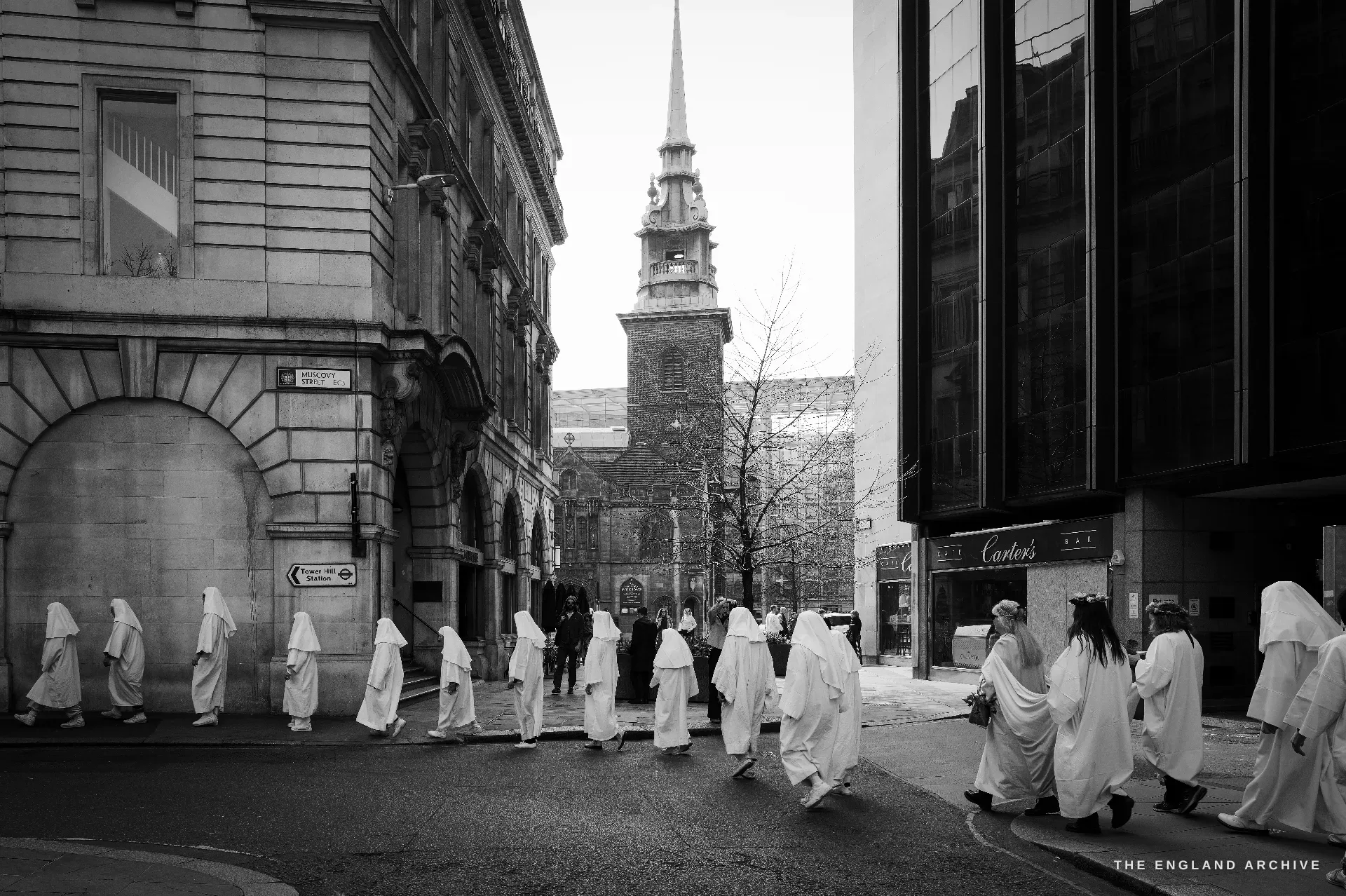
Certain Druid ceremonies at sites like Avebury operate under even stricter protocols. The Orders that conduct rituals at the stones do so according to calendars and liturgies that they consider sacred, and many of them regard uninvited observation as a form of intrusion no different from walking into a stranger’s church and filming the congregation without asking. That this happens to them regularly - that tourists routinely photograph ceremonies they have not been invited to witness - does not make it acceptable. It makes it a pattern of disrespect so normalised that the practitioners have largely stopped objecting, which is not the same thing as consenting.
The Burry Man of South Queensferry, though Scottish rather than English, illustrates a dynamic that recurs across the border: a tradition so visually extraordinary that it attracts cameras instinctively, carried by a community that regards the cameras with something between resignation and suspicion. The tradition survives not because of the attention but in spite of it. Every photograph taken without understanding is a small act of extraction - something taken from the event and given nothing in return.
What Attention Does
The relationship between outside attention and traditional survival is not simple, and anyone who claims otherwise is selling something. Attention can save a tradition. The revival of interest in English folk customs during the 1960s and 1970s, driven partly by academic work and partly by the folk revival in music, unquestionably preserved practices that were on the verge of disappearing. Morris dancing, which had declined to a handful of active sides by the mid-twentieth century, now has more practitioners than at any point in its documented history, and much of that recovery is attributable to people who saw it, documented it, and made others aware that it existed.
But attention can also destroy a tradition by changing its fundamental nature. When a village custom becomes a tourist attraction, the custom does not simply gain an audience. It gains an audience whose expectations reshape the event. The performers begin to perform for the visitors rather than for the community. The timing shifts to accommodate travel schedules. The rough edges - the long pauses, the in-jokes, the moments of genuine confusion where nobody is quite sure what happens next - get smoothed away because they do not photograph well. What remains may look like the tradition, but it has become a representation of the tradition, which is a different thing entirely.
The Abbots Bromley Horn Dance, performed every September in a Staffordshire village, navigates this tension with particular skill. The dance is public - it processes through the village and the surrounding countryside over the course of a full day - but the dancers have maintained a consistent boundary between accessibility and spectacle. You can watch, and you are welcome to watch, but the dance is not performed at you. It moves at its own pace, follows its own route, and does not pause for cameras. If you want to see it, you follow. If you cannot keep up, you wait for it to come back around. The tradition sets the terms, not the audience.
The Ethics of the Record
For an archive dedicated to documenting England’s living traditions, the question of access is not academic. It is the first question, and it determines everything that follows. Do you have permission to be here? Do you have permission to record? Does your recording serve the tradition or only your own interests? Would the people who carry this tradition want what you are making? These are not comfortable questions, and the honest answer is not always the one the documentarian wants to hear.
There is a meaningful difference between a tourist with a camera and a documentarian with a commitment, but the difference is not in the equipment. It is in the relationship. The tourist takes what they can see and leaves. The documentarian returns. They return the next year, and the year after that. They learn the names of the people involved. They understand the organisational burden, the cost, the logistics, the anxiety about whether enough people will show up this time. They earn, over years, the right to be trusted with something more than the surface of the event.
This is how archives of living tradition must work if they are to work honestly. Not by arriving, extracting, and publishing, but by building relationships slow enough and deep enough that the carriers themselves come to see the record as something that belongs to them as much as to the archive. The wassail king who has never spoken to a journalist may, after three or four years of seeing the same face at the same fire in January, decide that this particular person can be trusted with the fuller story - the one about how it nearly stopped in 2014, about who kept it going and why, about what it actually means to stand in a frozen orchard at midnight and shout at trees. That story is worth more than any amount of footage shot from a distance by a stranger.
Navigating the Spectrum
The England Archive does not treat all traditions alike, because all traditions are not alike. Some are open doors. Some are closed. Most are somewhere in between, and the position shifts depending on who is asking and how they ask and how long they have been showing up. The archive’s approach is not to force open the closed doors but to stand near them, consistently and respectfully, until the people on the other side decide whether to open them.
This means that some traditions documented here are covered in depth - with interviews, photographs, historical context, and the full weight of archival attention. Others are mentioned only in outline, their details left vague, their participants unnamed, because that is what the carriers of those traditions have asked for. The incompleteness is not a failure of the archive. It is a feature of it. An archive that documented everything regardless of consent would be comprehensive and also dishonest, because it would present as freely given what was actually taken.
Preservation requires recording. Authenticity sometimes requires privacy. These two imperatives do not always align, and when they conflict, the archive sides with the carriers. The tradition belongs to them. The record belongs to them. The decision about what to share, and with whom, and when, belongs to them. The documentarian’s role is not to decide what matters but to be present, with skill and patience and respect, when the carriers decide they are ready to be seen.
The cheese will keep rolling down Cooper’s Hill whether anyone films it or not. The private wassail will keep happening in the dark orchard whether anyone outside the village knows about it or not. Both are English traditions. Both are carried by people who show up, year after year, because the thing needs doing. The only question is how we attend to them - and whether our attention serves the tradition or only ourselves.