Learning the Darkroom
A day at POST in Hove with Josh Redfearn, developing and printing

POST is a new artist-led photography and film studio in Hove, a few minutes from the train station, founded last year by the photographers Simon Roberts and Nina Emett. The darkroom inside it is small, warm, and arranged like a working bench rather than a teaching room. The De Vere 504 enlarger stands waist-high under the dichromatic head, the trays sit in their proper sequence at the wet end, the negatives go up on a clip line over the sink. I had been here once, briefly, to look around. Today I was here to work.
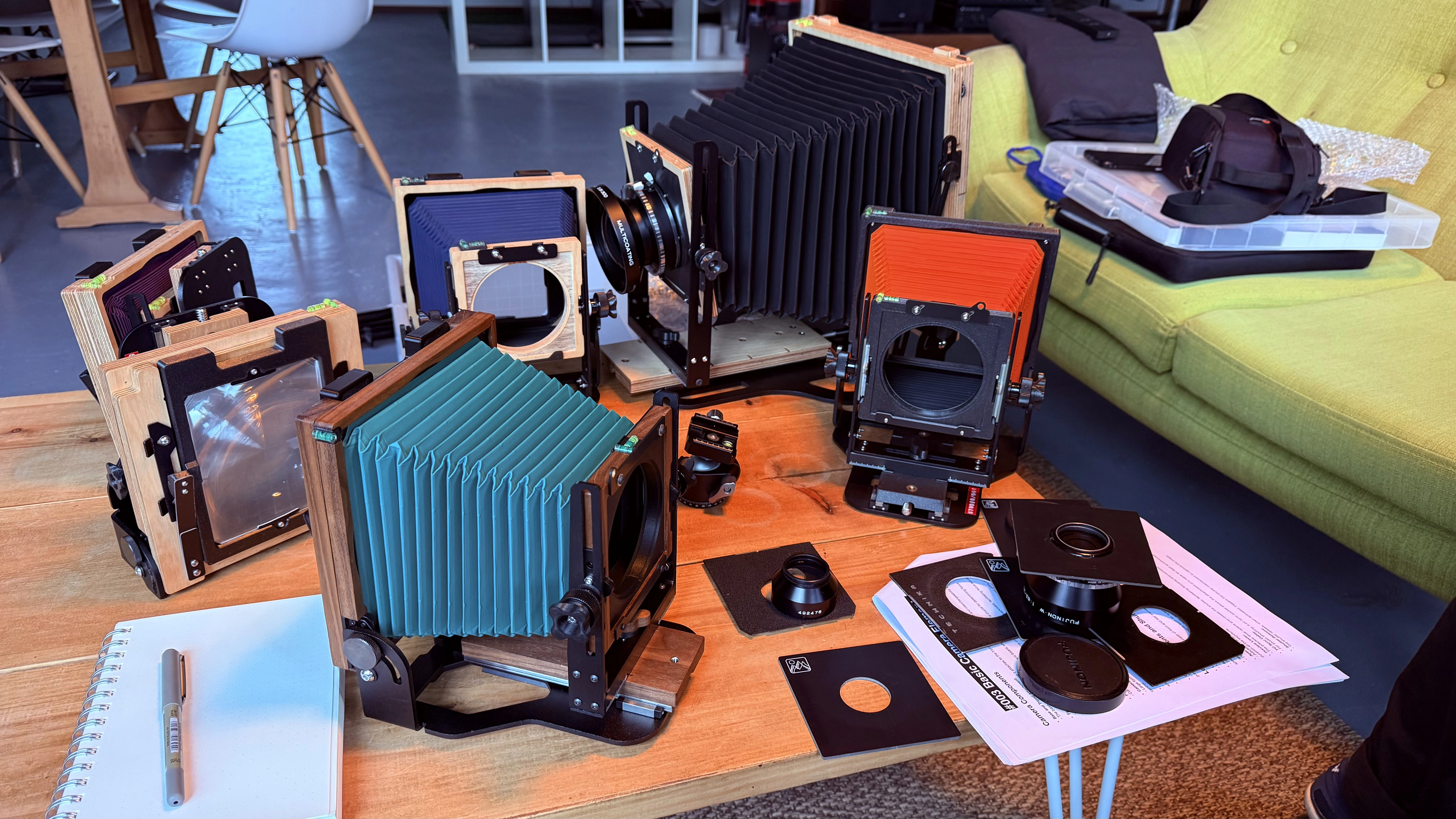
The day was the second part of an arc that began at Intrepid in Bristol with the same teacher, Josh Redfearn, on a 4x5 - written up as Learning the Camera That Changes Everything (JN-0009). The first day was about the camera. This day is about everything that happens to the negative after the shutter closes. There is a particular pleasure to the fact that this part of the education happened in a building owned and run by Simon Roberts - one of the photographers the archive’s homepage cites by name, alongside Benjamin Stone and Walker Evans, in the documentary lineage the project orients itself by. I had not arranged it that way. It just happened to be where Josh teaches the chemistry course.
I came up with two things in the bag. The first was a roll of Fomapan 400 shot on the Bronica SQ-A on a recent visit, exposed and rewound but not yet developed. The second was a folder of 6x6 negatives I had already had processed elsewhere, brought along to print. The plan for the day was simple: develop the unprocessed roll on the Paterson tank in the morning, then move to the De Vere in the afternoon and print whatever the negatives gave us. Two halves of one craft.
The Paterson tank
The Paterson tank is a small black-and-grey plastic cylinder with a light-tight funnel and a reel inside it that the film loads onto in total darkness. A 500ml tank holds one roll of 120 film. A litre tank holds either a single sheet of 4x5 or two rolls of 120 stacked. The geometry of the thing is the geometry of a small, contained promise: chemistry in, chemistry out, time-pressed, agitated on a known schedule.
Josh walked me through the chemistry while I loaded the reel by feel inside the changing bag. Ilfosol 3 as the developer at the dilution and time the data sheet specifies for Fomapan 400 - he noted in passing that for a home darkroom he would actually recommend Ilford DD-X over Ilfosol 3 (more forgiving, longer shelf life once opened, easier on the nerves of someone developing a roll a fortnight). Then Ilfostop to halt development cleanly, then Rapid Fixer to pull the unexposed silver halides off the emulsion and leave the negative permanent, then a final rinse with Ilfotol wetting agent so the water sheets off the film without leaving drying marks.
Before any of that, the pre-soak. Five minutes of plain water at temperature to bring the film up to processing speed and clear the antihalation backing. Josh poured the water out at the end of the pre-soak and a vivid sour green wash came out of the tank that looked like something had gone seriously wrong. He laughed and said he should have warned me - that is the antihalation layer dissolving off the back of the Fomapan, and it is famously, theatrically green. Without the warning it reads as a chemistry failure on the first roll you ever process. With the warning it is just the Fomapan clearing its throat. (Ilford films give a calmer, greyer wash; Foma is a Czech-made stock with its own particular signature.)
From there it is a sequence of pours, agitations, drains and replacements timed against a stopwatch. Inversions for the first thirty seconds, then four inversions a minute. The whole development takes about ten minutes; the fix takes another five; the wetting agent takes thirty seconds. The film comes out of the tank on the reel, glossy and limp, and goes straight onto the clip line in the drying cabinet at thirty-five degrees for half an hour. After that it is sleeved in clear archival sleeves - four strips of three frames each for 6x6 - and filed.
A blank roll
The film came out of the drying cabinet thirty minutes later. Josh held the strip up to the light and we both looked at the same thing.
Along the edges, the maker’s marks were perfectly clear - FOMAPAN 400, the frame numbers, the sprocket-hole equivalent for a roll-film system. The exposure registration along the rebate was crisp. The chemistry had worked. The film had been agitated correctly, fixed correctly, washed correctly. The lab side of the morning had done exactly what it was supposed to do.
In the middle of the strip, where the photographs should have been, there was nothing. Twelve frames of clear acetate. No latent image. No partial exposure. No light leak. Just blank.
This is the thing nobody tells you about analogue. You cannot see what went wrong until you process. With a digital camera a failed frame is visible the moment you press the shutter; the screen on the back is a kind of insurance against any mechanical problem you cannot see by eye. With film the gap between the act of photographing and the evidence of having photographed is sometimes weeks, and the news, when it arrives, can be that the morning never happened. Or that it happened but the camera did not record it. Or, in this case, that the camera fired the shutter and the back wound the film and everything looked correct in the hand, but no light reached the emulsion.
The diagnostic is straightforward, Josh said. The chemistry plainly worked. The fault is on the camera side - either a shutter that did not actually open at the moment of exposure, or a film back whose dark slide got engaged at the wrong moment, or a transport mechanism that wound past the gate without registering. The Bronica SQ-A is forty years old this year. Cameras of that age develop quiet faults that are invisible until a roll comes back blank. Get it serviced, he said, before you load another roll in the field.
I did not love hearing it. I had specifically liked some of the frames I thought I had made on that roll. None of them exist. But the lesson is the harder of the two lessons of the day: the analogue arm of the project depends on equipment that is older than the project itself, and that equipment will quietly fail without warning. The discipline is not to treat any frame as in the bag until the negative is in the sleeve.
The De Vere 504

After lunch we moved to the printing side of the room. The De Vere 504 is a heavy floor-standing enlarger of a kind you do not see in many darkrooms any more. The dichromatic head on top filters the printing light through a continuously variable yellow-magenta system; the Ilford Multigrade head we were using sits in the same slot and does the equivalent job through a fixed graded filtration. The negative carrier sat empty for the moment. We were working on Ilford Multigrade RC Deluxe Matt paper - resin coated, matte surface, the workhorse paper for this kind of teaching session. Eight by ten sheets, in a black light-proof box on the bench. Filtration grade 2 for now, the neutral starting point.
I brought up the first negative - a 6x6 frame from a recent walk - cleaned it with the air bulb, slid it into the carrier, locked it. The image projected down onto the easel and Josh adjusted the focus through the grain magnifier on the baseboard until the silver crystals on the emulsion were resolved. The act of putting the grain in focus is the act of putting the photograph in focus; the two are the same thing.
The first sheet is a test strip. A piece of paper exposed across its length in a series of stepped intervals - five seconds, ten, fifteen, twenty - so that when it goes through the developer you can read the right exposure off the strip the way you would read a histogram. The strip went into the dev tray. We watched the image come up through the surface. At the longer exposures the shadows fell into proper black. At the shorter exposures everything was a soft grey. Read off twelve seconds. That is the exposure for this print at this filtration on this paper.
Then the full sheet. Twelve seconds. Into the developer for the manufacturer’s time. Slide into the stop bath. Slide into the fix. Two minutes there, then the wash tray, then the screen above to dry. The whole sequence is choreography. Once it is in your hands it goes from one tray to the next without thinking; the only thinking happens at the easel, before the exposure, when you decide what the print is going to be.
Two prints, two photographers

I printed two of my own frames that afternoon. Josh, in parallel on his side of the bench, printed two for me from the day we had spent on the 4x5 in the earlier session. The portrait I had made of him on the camera he had taught me to use. The portrait he had made of me on his own 4x5, on the same morning, while I was setting up. Two large fibre-weight 4x5 prints came up under his enlarger while my smaller 6x6 prints came up under mine.
The picture at the top of this page is the moment, in the darkroom, when we both had a print of each other in our hands. He is holding the frame I made of him. I am holding the frame he made of me. The De Vere stands between and behind us. It is an exchange of objects more than of pictures - the print is heavier and more deliberate than its digital equivalent, and to give one to someone is to give them an artifact rather than a file. The whole afternoon collapses into that frame.
Print exchange is older than photography. Painters traded portraits; printmakers swapped editions; daguerrotypists did the same in the 1840s. There is something about the form that wants to be given. The print on resin-coated paper that I came home with that evening is a permanent object. It sits in a folder on my desk now. It will outlast both of us.
A chart, in digital terms
One of the things Josh sent me afterwards is a small reference table I have wanted, in some form, since the day the Bronica arrived. It is a chart of the 120 black-and-white and colour-negative films he would actually recommend to a working photographer, with their grain character set against the comparative megapixel value the negative produces at each of the 120 frame sizes - 645, 6x6, 6x7. It is a translation device. It tells someone whose calibration is digital roughly what they are looking at when they choose a stock and a frame size.
A 6x6 negative on Ilford Delta 100 lands in the same neighbourhood, in megapixel-equivalent terms, as a top-end medium-format digital sensor. A 6x7 frame on Kodak Ektar 100 is past 100 megapixels of effective resolution. It is information of a kind nobody puts on the side of the box, and it is the kind of information that lets a photographer make a sensible choice about what kind of project a stock is for.
I have set it up as a permanent resource on the archive, credited to Josh: 120 Film Comparison Chart (TL-0018). It will sit at that URL indefinitely as a reference for anyone moving from digital into 120 film and trying to work out what corresponds to what.
What two days have done
Two days with Josh Redfearn, six weeks apart, have done two specific things to this project. The first day at Intrepid in Bristol - the camera day, JN-0009 - put a working 4x5 in my hands and gave me the slow contemplation the format demands. This day at POST in Hove - the chemistry day - put the rest of the workflow behind it. I now know what happens to a roll between the moment the shutter closes and the moment a print comes out of the wash. I cannot do all of it on my own yet. But I know what every step is for, and I know which step in the sequence to look at when something fails.
The Bronica is going to a service. It will come back, and the next roll I run through it will be developed properly and the frames will exist. The willow-pond print on the drying screen at right of the wash-tray photograph above is a frame from the 4x5 day; it has now been printed twice, by two photographers, on two different enlargers. The first print sits in a folder at POST. The second one came home with me. That is the analogue version of the back-up rule.
The archive’s analogue arm now has a method. The method has a teacher - and Josh, by virtue of two days’ teaching, is the practitioner the project will continue to learn from for as long as the analogue side keeps growing. The next step is solo: a roll of Fomapan through the serviced Bronica on the next visit, processed at home on a Paterson tank that will arrive in a fortnight, printed at POST when the dry strip says there are images to print.
Two days. Two prints. One blank roll. A method, and a vivid green wash off the back of a Czech film stock that is the most surprising thing I have ever poured down a sink.