The Knowledge in Motion
What Carriers Know That Cannot Be Written Down, and Why It Matters That They Keep Moving

There is a moment in the Abbots Bromley Horn Dance - performed every year on Wakes Monday in a small Staffordshire village - when the six deer-men raise the antlers and begin to weave. They advance and retreat, cross and separate, turn and return. No caller directs them. No written choreography exists. The pattern lives in the bodies of the dancers themselves, transmitted from one generation of performers to the next across a span of time so long that its origins have been lost entirely. The dancers know the dance. But what they know is not information. It is motion.
This is the distinctive knowledge of the carrier: not the static craft knowledge of the maker, who understands materials and techniques, but the dynamic, performative, embodied knowledge of the person who keeps a tradition alive by doing it, year after year, in the right place and at the right time. The morris dancer who knows not just the steps but the weight of the bells on the shin, the angle of the handkerchief at the flick’s apex, the precise moment when the music shifts and the body must respond. The bonfire society captain who knows the route through town, the speed of the procession, the distance the crowd must be held back from the burning torches. The ceremony leader who knows the words of the charter, the pauses between the clauses, the gesture that accompanies the turning of the page.
This knowledge is real. It is precise. It is essential to the survival of the traditions it sustains. And it presents a fundamental problem for anyone who wants to record it, because it is knowledge that exists only in the doing.
The Body as Archive
Consider what a Cotswold morris dancer actually knows. There are the steps, certainly - the single step, the double step, the caper, the galley. These can be described in words and have been, in manuals dating back to Cecil Sharp’s collections of the early 1900s. There are the figures: the rounds, the gyps, the half-gyps, the hey. These too can be notated, diagrammed, filmed. But the knowledge that makes a dancer a carrier rather than a performer extends far beyond the steps and the figures into a territory that written language struggles to reach.
It includes the particular quality of a leap - how high, how heavy, how the landing should feel through the knees and into the ground. It includes the synchronisation with other dancers that comes not from counting beats but from a peripheral awareness of bodies moving in shared space: the sense of when the line is right that arrives through the corner of the eye rather than through instruction. It includes the feel of dancing on cobblestones versus tarmac versus grass, and the adjustments the body makes without being told. It includes the knowledge of how to dance in the rain, in the heat, after three pints, at the end of a long day’s tour when the legs are heavy and the bells are dragging.
None of this is trivial. It is the accumulated intelligence of a practice refined over decades of repetition in specific places under specific conditions. And it resides not in any document or recording but in the dancer’s muscles, joints, reflexes, and proprioceptive memory - the body’s own archive, written in movement and legible only through performance.
The Captain’s Walk
Every November, the bonfire societies of Sussex stage their processions. The largest, in Lewes, draws thousands of spectators and involves hundreds of participants carrying burning torches through narrow medieval streets. The safety of the event depends on knowledge that no risk assessment can fully capture: the captain’s knowledge of the route.
The captain knows where the street narrows and the crowd compresses. Knows which doorways people will press into and which junctions create bottlenecks. Knows that the turn by the War Memorial requires the procession to slow because the gradient changes and the torch-bearers at the rear cannot see the front. Knows that the wind at the top of School Hill comes from the east in November and will push the flames toward the spectators on the left side of the road. Knows the timing - how long each section of the route should take, where to pause for the tableaux, when to signal the fireworks, how to read the crowd’s density and adjust the pace accordingly.
This knowledge has been built through years of walking the route, first as a junior member carrying a banner, then as a torch-bearer, then as a marshal, and finally as a captain responsible for the whole procession. Each role teaches a different layer of the same knowledge. The banner-carrier learns the route. The torch-bearer learns the fire. The marshal learns the crowd. The captain synthesises all of it into a single continuous act of judgement that unfolds over several hours on a single night each year.
Write it down and you get a route map with timings. Useful, but insufficient. The route map does not contain the captain’s understanding of how a crowd behaves when fireworks explode overhead, or how the smell of gunpowder changes the energy of a procession, or how to tell from the sound of the crowd fifty yards ahead whether the pace needs to increase or decrease. The map is a skeleton. The captain’s knowledge is the living body.
Words, Pauses, Gestures
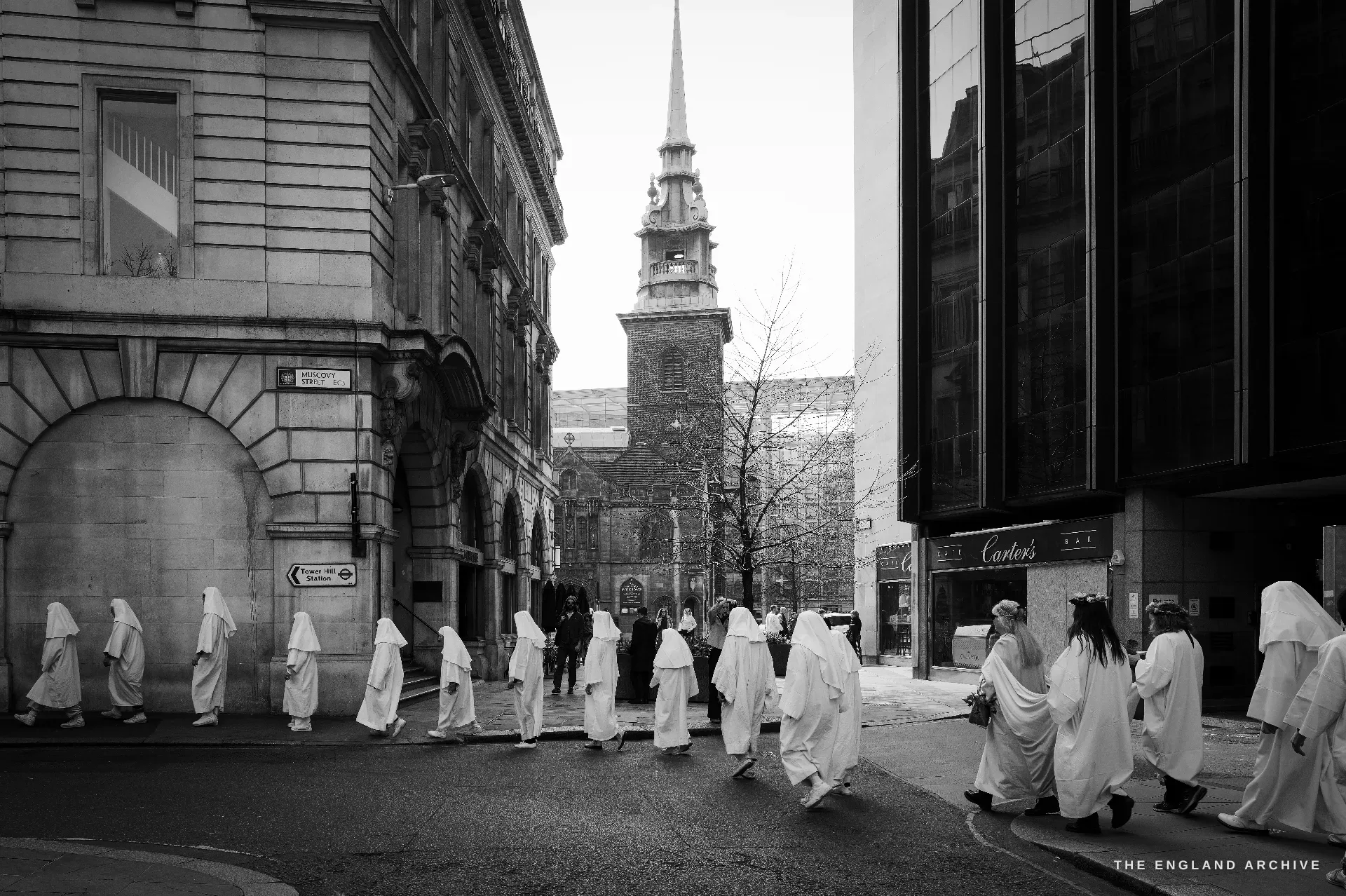
In the civic and ceremonial traditions of English towns, there are people who carry a different kind of knowledge: the knowledge of how to speak ritual words in a way that makes them ritual. The Town Crier of Lichfield who reads the charter. The Bailiff of the Royal Manor of Portland who walks the bounds. The Warden of the Cinque Ports who speaks the ancient oath. In each case, the words themselves are recorded. The knowledge that the carrier holds is not the words but the way of saying them.
This includes the pace of delivery - slower than ordinary speech, with pauses that are not hesitations but structural elements of the performance. It includes the volume and projection, calibrated to the specific acoustic properties of a guildhall or a market square or an open hillside. It includes the physical bearing: the way of standing, the angle of the head, the position of the hands, the direction of the gaze. These are not theatrical choices. They are inherited behaviours, learned from the previous holder of the role, who learned them from the holder before that, forming a chain of embodied transmission that can stretch back centuries.
The Beating of the Bounds in many English parishes provides a vivid example. The ceremony requires the participants to walk the parish boundary, stopping at specific points to mark the boundary stones. At each stop, the leader recites a phrase, strikes the stone, and in some parishes inverts a choirboy against the marker so the boy will “remember” the boundary. The ceremony is documented. But the documentation does not contain the leader’s knowledge of the ground - which stile is rotten, which field is planted and must be skirted, which farmer must be asked permission in advance, which section of the boundary follows a stream that floods in spring. The ceremony is a performance of spatial knowledge that cannot be separated from the space in which it is performed.
The Problem of Transmission
If the carrier’s knowledge lives in the body, then it can only be transmitted body to body. This is the fundamental constraint that distinguishes carrier traditions from craft traditions. A craft can be taught in a workshop, demonstrated on a bench, practised on a piece of material. The learner can work at their own pace, repeat the difficult sections, ask questions, make mistakes in private. The knowledge transfers through guided practice in controlled conditions.
Carrier knowledge transfers differently. It transfers through participation in the event itself, which happens once a year, in public, under the real conditions of weather and crowd and darkness and noise. The apprentice morris dancer does not learn the Lichfield Bower Dance in a rehearsal room and then perform it at the Bower. They learn it at the Bower, dancing it badly the first year, less badly the second year, competently the third year, and well the fifth year. The learning and the doing are the same act. There is no simulation. There is no dress rehearsal for a tradition that happens once annually in a specific place on a specific date.
This means that the transmission of carrier knowledge requires an overlap of generations: a period during which the experienced carrier and the learning carrier are both present, both active, both doing the thing together. The experienced dancer dances beside the novice. The retiring captain walks the route with the incoming captain. The old ceremony leader speaks the words while the new one listens, watches, absorbs the tempo and the tone that no written instruction can convey. If that overlap does not occur - if the experienced carrier leaves or dies before the transmission is complete - the knowledge is not diminished. It is gone.
The Archive’s Dilemma
How do you record knowledge that only exists in motion? This is the question that any serious attempt to document English carrier traditions must confront, and it does not have a comfortable answer.
Film captures the visible surface of the performance: the steps, the route, the gestures. It does not capture the proprioceptive dimension - the feel of the dance in the dancer’s body, the weight and momentum and balance that constitute the knowledge the carrier actually carries. Audio captures the words and the music. It does not capture the acoustic relationship between the voice and the space, the way the ceremony leader adjusts their projection to the wind or the crowd or the peculiar resonance of a fifteenth-century guildhall on a cold December morning.
Written description can analyse and contextualise. It can explain what is happening and why it matters. But it cannot transmit the knowledge itself, any more than a recipe can transmit the cook’s sense of when the bread dough has been kneaded enough - that moment of recognition that lives in the hands and nowhere else. The archive can document the tradition. It cannot preserve the knowledge. Only the next carrier can do that.
This is not a failure of archival method. It is a recognition of the nature of what carriers carry. Their knowledge is not information waiting to be extracted and stored. It is a living practice that exists only in its continuous performance, passed from body to body across time, surviving not because it is recorded but because someone stands up, every year, and does it again. The bells go on the shins. The torches are lit. The words are spoken. The knowledge moves, and in moving, endures.