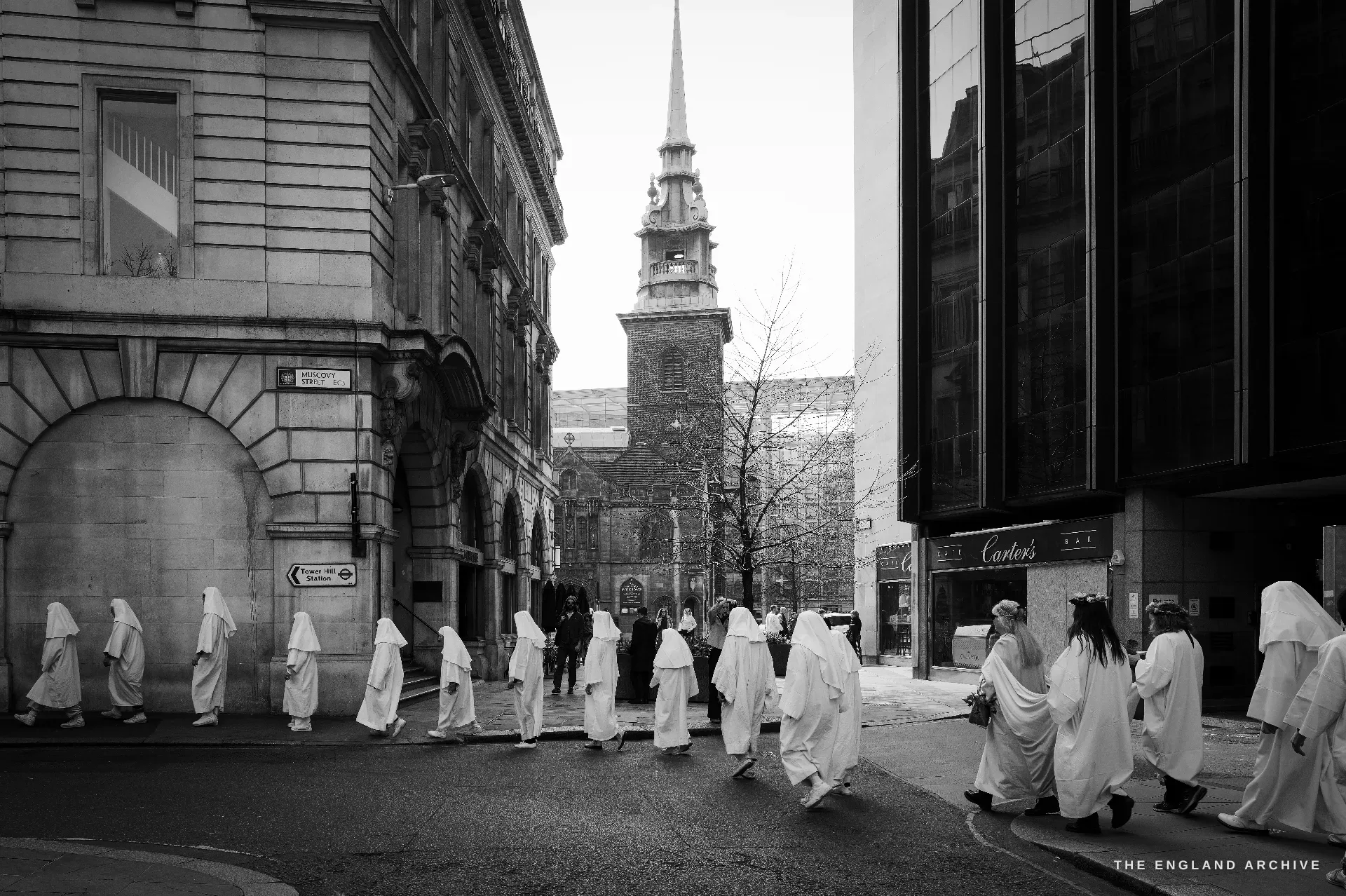
The People Who Carry England
The Calendar That Demands You Show Up
There is a particular kind of obligation that most modern life has quietly abolished, and England’s living traditions run entirely on it.
Not the obligation of contract, which is enforced by law and dissolved by lawyers. Not the obligation of employment, which is enforced by money and dissolved by resignation. The older kind. The kind where a thing needs doing and you are the person who does it, and if you do not do it, it does not get done, and the community that has done it together for as long as anyone can remember simply does not do it this year, and the year after becomes harder, and the year after that harder still, until one day someone asks when the last time was and nobody quite remembers.
The Carriers of The England Archive are the people this obligation lives in. The squire of a morris side who calls the practice sessions in February and makes sure there are twelve dancers ready for the first of May. The organiser of a bonfire society in Sussex who has been managing the paperwork and the permissions and the barrel procurement and the stewarding rotas since long before anyone thought to thank her for it. The wassail king of a Somerset orchard who lights the fire in the middle of January because if he does not light the fire, the ceremony does not happen, and if the ceremony does not happen, the orchard and the community that gathers around it lose something they cannot quite name but would feel the absence of immediately. The tower captain who has been running Thursday practice nights for twenty-three years because the bells need eight ringers and without her there would be six.
These people do not, by and large, think of themselves as heritage practitioners. They think of themselves as people who do a specific thing at a specific time of year, and have been doing it, and will keep doing it until they cannot, and hope someone else picks it up when they stop. The word “tradition” is not always how they would describe it. They would more likely say it is just what you do. This is how the deepest traditions survive: not by being elevated into heritage, but by being treated as simply, obstinately normal.
The Calendar as Obligation
The English ritual calendar is not like a diary. A diary is a record of what you are planning to do, subject to revision. The ritual calendar is a record of what the community has committed to doing, regardless of what else is happening, because it has committed to doing it every year since before living memory, and to break that commitment is to break the continuity that makes it meaningful.
This is the particular character of the Carriers’ obligation, and it is what separates them from every other subject category in this archive. The Maker works continuously, the craft always present. The Keeper tends the building year-round. The Rememberer holds memory that is always accessible, however fading. But the Carrier is only fully themselves at one specific moment in the year, and if that moment passes without them, the thing they carry is not deferred. It is absent. And an absence, repeated often enough, becomes a permanent one.
The Padstow Obby Oss happens on the first of May. It has happened on the first of May, in Padstow, for as long as records reach, and very likely longer. The date is not flexible. The occasion is not transferable to a more convenient weekend. The Lewes Bonfire societies process through the town on the fifth of November. Not near the fifth of November, not on the Saturday closest to the fifth of November, but on the fifth, because the fifth is the night, and moving it would be, in the language of the societies themselves, a concession to convenience that they have never made and do not intend to start making. The wassail in a Somerset cider orchard happens in mid-January, in the dark and the cold, because that is when it happens, and the fact that mid-January is cold and dark and inconvenient is precisely the point.
Ronald Hutton, whose book The Stations of the Sun is the most rigorous scholarly account of English seasonal customs in print, documented more than 70 distinct annual celebrations still being practised across England when he researched it in the mid-1990s. The number has fluctuated in the decades since - some events have been added, some have lapsed, some have been revived after periods of dormancy - but the scale of the English ritual calendar remains significant, and the seasonal logic that structures it runs deeper than most participants know.
The calendar is not arbitrary. The January wassail corresponds to the point in winter when the orchard needs to be thought about - the trees have been dormant for months, the growing season is still far enough away to feel abstract, and the ceremony functions partly as an act of communal attention, a declaration that the orchard is still watched and valued and tended. May Day’s urgency comes from its position at the exact turn of the agricultural year, the moment between the dead half and the living half, which is why it generates such concentrated tradition across so many European cultures simultaneously. Bonfire Night’s particular English character comes from the specific political history layered over the older autumn fire-festivals, producing a tradition that is simultaneously about Guy Fawkes and about something much older that Guy Fawkes happened to land on. These dates were not chosen carelessly. They accumulated meaning over centuries at the pressure points of the year.
The people who show up at those pressure points, year after year, are the Carriers.
What a Tradition Actually Is
Before going further, the question of authenticity deserves direct engagement, because it is the question that outsiders most reliably ask about English living traditions, and because the honest answer is more interesting than either the defensive answer or the dismissive one.
Many of England’s most visible living traditions are not as old as they look. The Abbots Bromley Horn Dance, which involves twelve performers carrying reindeer antlers through the village of Abbots Bromley in Staffordshire each September, is generally dated to its first firm documentary record in 1226, making it one of the genuinely ancient surviving English customs. The Padstow Obby Oss has documentary records from the early 19th century, though its character strongly suggests much older origins. The Lewes Bonfire celebrations in their current form are substantially Victorian, shaped by political Protestant identity in ways that have evolved further since. A significant proportion of English Morris dancing as currently practised owes more to the folk revival of the early 20th century - particularly to the work of Cecil Sharp, who notated and disseminated regional Morris styles beginning in 1899 - than to any unbroken local lineage.
Eric Hobsbawm and Terence Ranger’s concept of “invented tradition,” introduced in their 1983 collection, is the standard academic framework for this: many traditions presented as ancient and organic are in fact relatively recent constructions, created or substantially reformed at specific historical moments for specific social or political purposes. Hobsbawm’s examples included not just folk customs but state ceremonies - the Trooping of the Colour in its current form dates only to the late Victorian period.
The folklorists’ answer to this - the Folklore Society, founded in 1878 and still the primary scholarly body for the study of English custom and tradition, has debated the question for most of its existence - is that authenticity is not the right criterion for evaluating a living tradition. The right criterion is vitality. A tradition that people choose to practice, that serves real social functions in their community, that generates genuine belonging and meaning, is alive regardless of when its specific form was first codified. A tradition that exists only on a museum plaque is dead regardless of how old it is. The wassail in Somerset is not less meaningful because it was substantially shaped in its current form by 19th century romanticism. It is meaningful because the people who do it mean it, and have built real community around it, and would feel its absence.
Steve Roud, whose The English Year is the most comprehensive popular survey of English customs and whose earlier work cataloguing folk customs for the Vaughan Williams Memorial Library at Cecil Sharp House produced one of the most important databases of English traditional practice, makes a similar point differently. The longevity of a custom is evidence of the work that each generation has put into maintaining it, which is itself worth documenting and honouring. Whether the Abbots Bromley Horn Dance is 800 years old or 400 years old matters less than the fact that twelve people in Abbots Bromley choose, every September, to put on the antlers and walk the parish boundary and do the thing that the people before them did. That choice is the tradition. That is what the archive is trying to record.
The Transmission Problem
The craft extinction problem is immediate and legible: 72 critically endangered crafts, a body of knowledge that ceases to exist when the last practitioner stops. The tradition extinction problem is slower and harder to quantify, but it is real and in some cases acute.
A living tradition requires people willing to carry it in three distinct roles. It requires a core of dedicated participants who know the tradition from the inside, who have practised it long enough to understand its details and its variations and its history, who can teach it and answer the questions that newcomers bring. It requires a broader community of participants who may not hold the deep knowledge but who show up, reliably, when the day comes. And it requires an organisational layer: the people who handle the logistics, the permissions, the recruitment, the communication, the continuity between one year and the next. Lose any of these three layers and the tradition does not instantly die, but it begins to weaken in ways that compound.
The English Folk Dance and Song Society at Cecil Sharp House in London, which has been supporting folk music and dance since 1932 and runs the Vaughan Williams Memorial Library, has documented the succession challenges facing Morris sides, folk dance clubs, and seasonal custom groups across England. Many sides have aged significantly since the folk revival peaked in the 1970s and 1980s. Recruitment of younger dancers is genuinely difficult in areas where the tradition has no existing youth infrastructure - where there is no junior side, no school programme, no visible presence that introduces young people to the tradition before they are old enough to make an independent choice about participation.
The Morris Ring, the federation of traditional Morris sides founded in 1934, coordinates over 150 affiliated sides across England, and its annual figures for side membership track the demographic challenge clearly. The average age of a Morris dancer in England is significantly older than it was thirty years ago. Some sides have folded. Others are functioning but fragile - dependent on a small core group whose departure would end the side’s practical ability to perform. The Morris Federation, which represents women’s and mixed-gender sides, and Open Morris, which represents sides outside the traditional federations, together complete a picture of a tradition that is widespread, still active in hundreds of communities, and carrying a genuine succession risk in enough of them to warrant serious attention.
The bell ringing tradition, managed through the Central Council of Church Bell Ringers which links every ringing tower in England, faces an almost identical demographic profile: active in thousands of towers, carried by people who are on average older than they were a generation ago, with recruitment concentrated in towers that have active outreach programmes and thinning in towers that do not. The CCCBR’s Ringing 2030 programme is specifically designed to address this, targeting a doubling of active ringers by 2030 through structured recruitment and teaching. That target is ambitious, and whether it is achieved will determine the condition of the tradition in several hundred towers across England over the next decade.
These are not abstract institutional concerns. A morris side that folds ends the specific local expression of a regional dance tradition in a specific community. A ringing tower that goes silent ends the particular music of that tower’s bells in that town’s soundscape, and once the local knowledge of how those bells should be rung together is lost, it is very hard to recover. The tradition can survive somewhere else in another form. But the local version, the version that belonged to that place, is gone.
The Closed Traditions
There is a category of English living tradition that presents a particular challenge, and it is worth addressing directly because how the archive approaches it matters.
Some traditions are genuinely open. Cooper’s Hill Cheese Rolling in Gloucestershire is one of the most accessible events on the English ritual calendar: anyone can watch, the event is publicly announced, and the combination of genuine danger and complete absurdity makes it one of the most photographed traditions in the country. Well dressing in Derbyshire, the extraordinary craft of pressing flowers, seeds, bark, and moss into clay panels to create elaborate pictures that are then blessed and displayed at village wells through the summer, welcomes visitors explicitly and the artists who spend weeks preparing each panel are generally delighted to talk about the process. The Swan Upping on the Thames, the annual census of mute swans conducted each July by the Royal Swan Marker and the Swan Wardens of the Vintners’ and Dyers’ Companies, is a public spectacle that the participants are proud to have observed.
But others are not open in the same way, and the ones that are not open are often the most significant, the most deeply community-rooted, and the most visually extraordinary. Padstow on May Day is the most important example in the archive. The Obby Oss - the great black-cloaked figure that processes through the town from before dawn accompanied by hundreds of townspeople singing the same May Song that has been sung in Padstow for as long as anyone can trace - is not a performance for outsiders. It is not a spectacle mounted for an audience. It is a ceremony that the town does for itself, and the presence of outsiders with cameras and the apparatus of documentation is something that Padstow has an entirely understandable and long-standing ambivalence about.
The same is true of the Lewes Bonfire societies. The seven societies - Cliffe, Lewes Borough, Commercial Square, Waterloo, South Street, Southover, and Nevill Juvenile - run the most spectacular bonfire celebrations in England, drawing tens of thousands of visitors on the fifth of November, and they manage that visitor presence with careful organisation and long experience. But the inner workings of each society, the preparation that goes on through the year, the particular character of each society’s history and culture and internal traditions, are matters for the members. Being allowed to photograph the public procession is very different from being given access to the torch-bearer’s preparations, the effigy construction, the society’s meetings.
The archive’s approach to these traditions follows a single principle: relationship before access. Not press accreditation. Not a formal request in advance of a visit. A relationship, built over months, with the people who organise and carry the tradition, rooted in genuine interest in and understanding of what they do. The Padstow section of this archive will not happen in Year 1, because Year 1 is not enough time to build the relationship that would make genuine access appropriate. It will happen when someone in Padstow has known about this project long enough to trust that it approaches the Oss with the seriousness and care it deserves. The Lewes societies will be approached through multiple conversations with members before any camera appears on the fifth of November, and the depth of the resulting work will be proportional to the depth of those relationships.
This is not a constraint on the archive. It is the archive operating as it should. The most significant English traditions are not available on demand. They are available to people who have taken the time to understand them and earn the right to witness them from close enough to matter.
Four Traditions, the Bodies That Bear Them, and What Gets Lost When They Stop
Morris Dancing
The image most English people carry of Morris dancing is not accurate, and it gets in the way of understanding what Morris actually is. The image is this: men in white, with handkerchiefs and bells and sticks, performing a dance that looks vaguely medieval and is associated in the cultural imagination with either charming rural quaintness or a particularly intense species of English eccentricity. It is the image of a performance put on for the benefit of onlookers, watched with benign amusement, belonging to a category of heritage that people are glad exists without quite being sure why.
The reality is considerably more various, considerably more strange, and considerably more alive.
Morris dancing is not one thing. It is a family of related dance traditions, each rooted in a distinct regional geography, each with its own character, style, music, and history. The Cotswold Morris of Oxfordshire and Gloucestershire, notated by Cecil Sharp at the turn of the 20th century from dancers in villages including Headington, Adderbury, and Ilmington, is probably the most widely known form, characterised by small-group dances with handkerchiefs or sticks, performed in the street, outdoor spaces, or pub forecourts at seasonal occasions. The Border Morris of the Welsh Marches, with its blacked faces and ragged costumes, is a starker, more percussive form, associated with Herefordshire and Shropshire, whose current practice owes much to revival and reconstruction but whose regional character is distinct and specific. The North West Morris, associated with Lancashire and Cheshire, is performed in formation with clogs, a tradition rooted in the cotton mill communities of the industrial north rather than in rural agricultural life, and carrying a completely different social history from either of the above.
The Molly dancing of East Anglia, the Longsword of Yorkshire, the Rapper Sword of the northeast, the Garland dances of the South Downs - each of these is a different tradition with different steps, different music, different costumes, different occasions, and a different relationship between the dance and the community that carries it. Treating “Morris” as a single monolithic entity is like treating “English cooking” as a single monolithic entity: technically a useful shorthand but misleading in almost every specific that matters.
The people who carry these traditions are, in many cases, doing something more complicated than simply repeating an old dance. They are making ongoing decisions about authenticity, about adaptation, about what it means to continue something that was already in a state of change when it was first documented, in communities whose relationship to their own heritage is itself changing. A Cotswold Morris side performing the Fieldtown tradition today is drawing on Cecil Sharp’s notation from 1914, which was itself a snapshot of a practice that was already in decline when Sharp found it, which had itself evolved over the previous centuries. The squire of that side, managing recruitment and performance decisions and the relationship with the local pub that hosts the Boxing Day outing, is making active choices about which elements of the notated tradition to hold and which to develop, and those choices matter.
The Vaughan Williams Memorial Library at Cecil Sharp House, which holds the largest collection of English folk music and dance documentation in the world, provides the archival substrate for these decisions: the notation, the recordings, the correspondence of the collectors, the photographs and films from the revival period. But the library cannot make the decisions. Those are made by the people in the sides, in the fields and the pub forecourts on May mornings, year after year, with mud on their shoes and bells on their shins and a genuine seriousness underneath the smiles.
The squire of a Morris side is one of the Carriers this archive is most interested in. Not the dancing itself, which has been photographed extensively, but the person who makes the dancing happen: who runs the practices, who keeps the kit in order, who manages the relationships with other sides and with the pubs that host the events, who decides the repertoire, who recruits the next generation of dancers, and who knows, better than anyone outside the side, what it takes to keep the thing alive in a specific community in a specific year. That knowledge is not in the Morris Ring’s handbook or the Morris Federation’s guidelines. It lives in the squire. And when the squire changes, it has to be transmitted, person to person, in the same way craft knowledge is transmitted: imperfectly, inevitably transformed, and only possible if both people are present and paying attention at the same time.
Wassailing
In mid-January, in orchards across Somerset, Devon, Herefordshire, and parts of Kent, people gather after dark around apple trees and make noise.
They bang pots and pans. They fire shotguns into the upper branches. They pour cider on the roots. They hang toast soaked in cider in the branches for the robins, who in some tellings of the tradition represent the good spirits of the orchard. They sing a song at the trees, sometimes the same song at every orchard in a county, sometimes a local version with local verses that exist nowhere else. The person designated the wassail king or queen raises a cup, the assembled crowd responds, and the thing is done for another year.
The intention, in the oldest understanding of it, was agricultural: to wake the trees from winter dormancy, to drive off the evil spirits that bring blight and frost, to encourage a good harvest in the year to come. The trees needed to know they were noticed, that the community still cared about them, that they were not forgotten. Whether anyone currently performing a wassail believes this in any literal sense is a separate question from whether the ceremony serves real functions, and most people who have been to a wassail will tell you it does. It serves the function of gathering a community in the dark in January, around fire and cider, in a shared act of attention directed at something that feeds them and that they depend on. It serves the function of marking the year’s turning with something more meaningful than a calendar notation. It serves the function of making the orchard feel like it belongs to the people who gather in it, in a way that the orchard does not feel in July when the trees are just trees in a field.
Julian Temperley, of Burrow Hill Cider in Somerset, is one of the most significant Carrier subjects in this archive’s West Country section. His wassailing event at Burrow Hill is among the most authentic and most attended in Somerset, drawing people from across the county and beyond to a ceremony rooted in the orchard itself rather than in heritage tourism. What makes Temperley a Carrier rather than simply a host is his relationship to the ceremony: the understanding he has built over decades of cider making and orchard management about why the wassail matters, what it connects, what would be different about the orchard and the community around it if it stopped. His knowledge of cider making runs through the Three Counties Cider and Perry Association and the wider Somerset cider network, but his knowledge of the ceremony as ceremony is his own, accumulated and refined through years of organising it.
The wassail is also a useful example of the transmission question because the ceremony has been revived, lapsed, and revived again in different orchards at different times, and the revivals are not always the same ceremony. When an orchard that stopped wassailing in the 1960s begins again in the 2000s, it may draw on a local folk archive, on the accounts of older members of the community who remember attending as children, on neighbouring orchards’ current practice, or on a printed account in a folklore journal. The ceremony that results is real - the people who do it mean it - but it is a reconstruction, and the reconstruction carries the marks of the moment in which it was reconstructed. This is not a criticism. It is a description of how living traditions actually work: not as unbroken chains but as renewed commitments, made by specific people in specific circumstances, to do a thing again that was worth doing.
The archive wants to record both the ceremony and the person behind it. The fire in the orchard, yes, and also the person who has been building it for twenty years. The song at the trees, yes, and also the person who taught the words to everyone who now sings them. These are not separable. The ceremony is what it is because of who carries it.
Bell Ringing
Change ringing - the English system of ringing a set of church bells in continuously varying sequences - is one of the most technically demanding and most English of all the country’s living traditions, and one of the least understood by most of the people who live within earshot of it.
It is not carillon playing, where a single musician plays a melody on a keyboard connected to the bells. It is not simple tolling, the repetitive single-note call to worship. Change ringing requires a team, and the team works together according to a system of mathematical permutations, each ringer responsible for one bell, the sequence of bells shifting according to a series of methods - Grandsire, Plain Bob, Stedman, Cambridge Surprise - that can be learned and rehearsed but that require constant attention and mutual listening in the ring to execute correctly. A peal of bells rung in Plain Bob Minor produces 720 changes before returning to the original order. A full peal of 5,040 changes on seven bells takes approximately three hours to ring without stopping.
The Central Council of Church Bell Ringers, founded in 1891, estimates there are around 5,500 rings of bells in England, the great majority of the world's full-circle rings. England invented change ringing in the 17th century, and it remains the only country where the tradition has deep roots, which is to say: England’s church bell culture is globally unique, and it exists entirely because of the people who climb the tower steps every week to practice.
The tower captain is the Carrier in this tradition. She is responsible for the team, for the teaching of new ringers, for the management of the bells’ mechanical condition, for the coordination of ringing for services and weddings and funerals and the marking of significant civic occasions. She knows her bells the way a musician knows their instrument - their weight, their response, their idiosyncrasies, the way the number 4 bell has always pulled slightly to the left on the backstroke and the way you compensate for it without thinking. She knows the ringers under her captaincy, knows who is ready for what method, knows who can be trusted to ring the treble at a funeral when there is no room for mistakes, knows who is still learning and what they need to be told again this Thursday.
The Ringing World, the weekly publication that has been the official journal of English bell ringing since 1911, is the record of this community’s life: the peal records, the obituaries, the technical debates, the tower reports, the notices of towers in need of ringers or ringers in need of towers. It is, in miniature, the documentary record of a tradition that would otherwise be almost invisible to anyone who was not already part of it.
The succession challenge in bell ringing has a particular geography. Urban towers in university cities tend to have healthy ringing communities, partly because university ringing societies run active recruitment and teaching programmes. Rural towers are more varied: some thriving, many struggling, some silent because the last capable team dispersed through death and departure over a period of years without the recruitment that would have replaced them. A silent tower is not always empty. The bells may still be there, hung and functional. The absence is the people, and bringing a silent tower back into regular use requires both a mechanical assessment and a social one: finding the ringers, building the team, maintaining the commitment through the inevitable disruptions of any small volunteer group across the years.
The Ringing 2030 initiative is the most ambitious recruitment and development programme the bell ringing community has attempted, and it represents an honest acknowledgment of where the tradition stands: strong in aggregate, fragile in many individual towers, and dependent on the health of those individual towers to remain strong in aggregate. The archive’s interest is not in the initiative but in the tower captain: the person who, with or without a national programme behind her, has been climbing those stairs and calling the practice every week, and who represents, in her specific tower and her specific community, the entire weight of the tradition’s continuity.
The Lewes Bonfire
England’s Bonfire Night on the fifth of November is, in most places, a relatively modest affair: a local display, rockets and Catherine wheels, a crowd of cold people in a field, a bonfire if the venue allows it. In Lewes, East Sussex, it is something categorically different.
The Lewes Bonfire celebrations are organised by five separate bonfire societies, each with its own history, its own costume traditions, its own territory within the town, and its own effigies. On the fifth of November each society processes through the town - through thousands of visitors, down streets lit by the torches carried by hundreds of society members, past barrel fires and with the percussion of thunderflashes and the smell of smoke permeating everything - before splitting to its own bonfire site for a ceremony of fire and effigy-burning that can last until midnight or later. The whole event is simultaneously one of the largest and most spectacular public celebrations in England and one of the most fiercely locally owned.
The societies are primarily Protestant in historical identity, formed from the memory of the 17 Protestant martyrs burned in Lewes under Mary I in the 1550s, whose names are still read out in the annual ceremonies. The burning of effigies - which in recent decades has included a rotating cast of public figures alongside the traditional effigies of Guy Fawkes and the Pope - makes the societies a recurrent subject of controversy, which they weather with the equanimity of organisations that have been weathering controversy for a very long time. The South Street Bonfire Society, the Cliffe Bonfire Society, Borough Bonfire Society, Commercial Square Bonfire Society, and Waterloo Bonfire Society are each distinct organisations with their own membership, their own character, and their own internal culture that does not fully itself to outsiders.
The person this archive wants to spend time with is not the fire or the effigy or the procession, all of which have been photographed extensively in the way that dramatic spectacle always attracts photographers. The person is the society secretary who has been managing the logistics for fifteen years - the permissions, the stewarding, the torchbearer recruitment, the relationship with the council, the coordination between societies, the management of the media requests that arrive every October from photographers who have just discovered that Lewes does something remarkable on the fifth of November and would like to be in the middle of it. That person carries, in their working knowledge, the accumulated learning of how to make this thing happen safely and correctly in a specific town, and that knowledge is not in any document. It is in them.
The Guy Fawkes Night Archive and the Lewes Bonfire Council maintain records and coordinate between the societies, but the living intelligence of each society lives in its core members, and it is that intelligence - how long have you been part of this, what do you understand about it that a newcomer could not, what would you most want someone to know - that the archive is trying to record.
Why the Photograph Cannot Come First
There is a principle I hold to in the Carriers strand of this archive, and it needs stating plainly, because it cuts against the assumptions that usually drive documentary photography.
At a craft workshop, the photograph can come relatively early in the relationship, because the craftsperson’s work is continuous - it happens every day, and the visit can be arranged for a day when it is happening. At a church, the photograph can come quickly, because the building is there and the churchwarden is generally pleased that someone wants to record it. But at a seasonal tradition, the photograph cannot come before the relationship, because the tradition happens once a year at a fixed time, and arriving on that day as a stranger with a camera is not the same as arriving as someone known to the community.
The practical reason for this is access: a photographically interesting position at the Padstow Obby Oss procession, or in the preparation areas before the Lewes march, or at the inner circle of a wassail ceremony, requires the trust of the people who are allowing you to be there. A stranger with a camera on public ground produces photographs of a public spectacle. A person known to the community, invited into spaces that are not public, produces photographs of what the thing actually is.
The deeper reason is respect. These are communities doing something they care about, something they have built and maintained over years, something that belongs to them. My job is to witness that, not to extract it. Witnessing requires presence over time, not just presence on the day. The photographer who spends three years building a genuine relationship with a bonfire society, attending meetings, understanding the history, knowing the members as people - that photographer produces different work from the photographer who books a hotel room in Lewes in October and arrives on the fifth. Both photographers may make technically accomplished images. Only one of them is in the archive that this project is trying to build.
This is why the Carriers category requires more preparation time than any other strand of this archive, and why some of the most significant subjects in it will not be photographed until Year 2 or Year 3. The constraint is not logistical. It is relational. And the relational constraint is not an obstacle to be overcome. It is the thing that makes the work worth doing.
The Organisations Holding the Traditions
The infrastructure supporting England’s living traditions is more substantial than most outsiders know, and naming it serves both the article’s argument and the archive’s relationships with the organisations themselves.
The Folklore Society, founded in 1878, is the oldest and most academically rigorous body for the study of English custom, legend, and belief. Its journal and its members’ work provide the scholarly foundation for understanding what specific traditions actually are, where they come from, and what they mean. The English Folk Dance and Song Society at Cecil Sharp House is the primary practical organisation for folk music and dance, running teaching, events, and the Vaughan Williams Memorial Library. The Vaughan Williams Memorial Library itself is the most important archive of English folk tradition documentation in existence.
For Morris specifically: the Morris Ring, the Morris Federation, and Open Morris together represent hundreds of sides and provide coordination, resources, and community for the tradition nationally. For bell ringing: the Central Council of Church Bell Ringers is the governing body that connects every tower in the country and provides the framework for the tradition’s continuation. The Ringing World is its published record. For folk customs more broadly, the Calendar Customs website, maintained by practitioners who care about keeping an accurate national record of active events, is the most reliable planning and reference resource available.
Academic work on English traditions is concentrated in the Institute of Folklore Studies at the University of Durham and in the broader humanities departments of universities where folklorists work. The Traditional Arts and Culture Scotland organisation, while focused on Scotland, maintains relationships with English traditional arts bodies that inform best practice across both countries. Arts Council England funds living traditions through its grants programmes, as does Historic England where traditions connect to built heritage, and some of the most valuable transmission work happens at the intersection of these funding streams and the grassroots communities that deliver the traditions.
None of these organisations is the tradition. The tradition is the people who show up. But the organisations provide the conditions in which showing up remains possible, and the archive’s relationships with them will provide access, context, and community that cannot be built any other way.