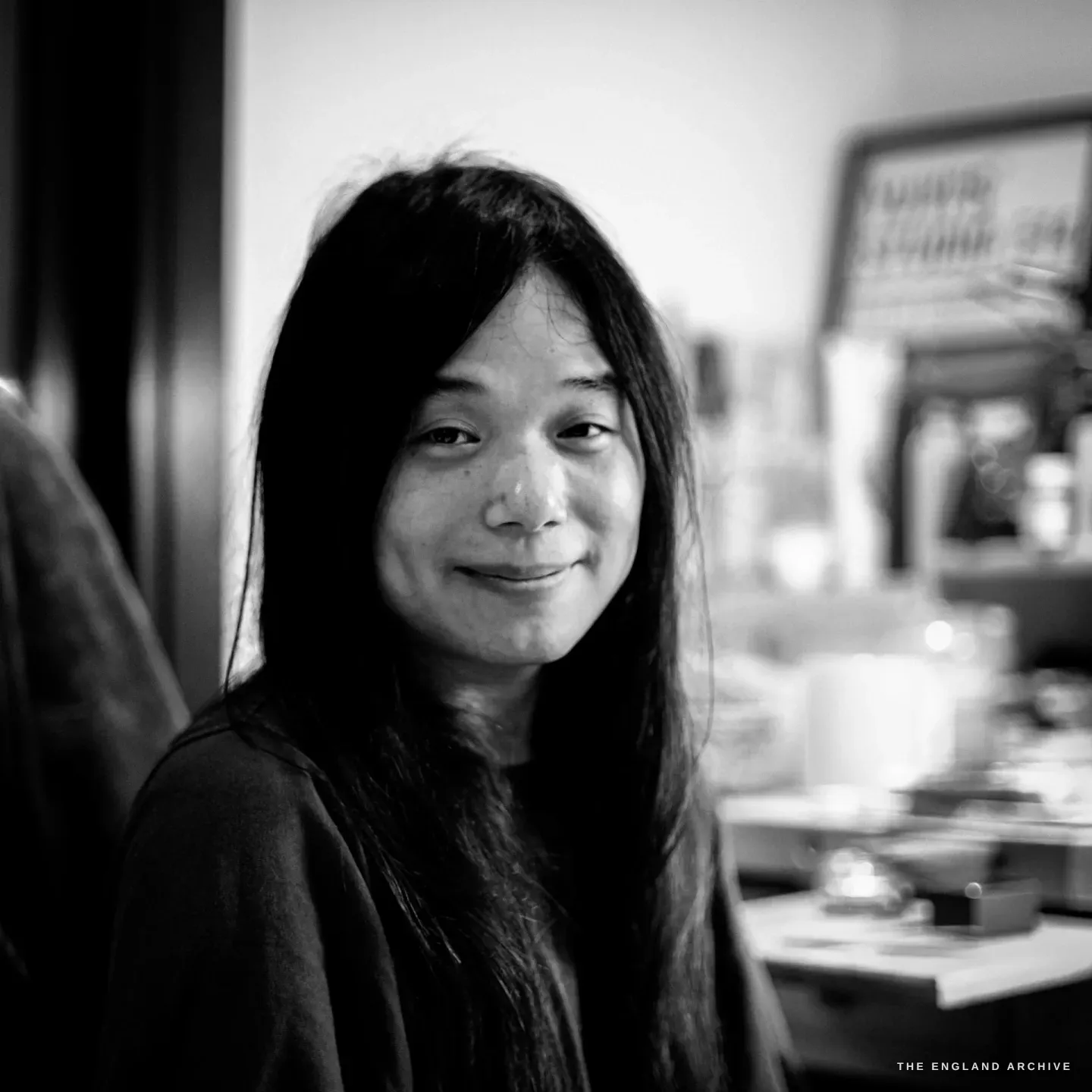
At midday on the Spring Equinox, on a terrace above the Thames in the shadow of the Tower of London, around fifteen people in white robes process through the City, form a circle, scatter seeds into the cold March air, and mark the turning of the year in a ceremony that has been performed on this spot since 1956.
The hill they gather on is Tower Hill - known in the older Welsh tradition as Bryn Gwyn, the White Mount. According to the mythology preserved in the Mabinogion, the head of Bran the Blessed, the Celtic god-king, was buried here, facing France, to protect the island from invasion. The ravens that still inhabit the Tower of London are said to be Bran’s birds. The legend persists that if the ravens ever leave, the kingdom will fall. It is, by any measure, one of London’s oldest sacred sites, and the Druid Order chose it deliberately.
The Event
Before the Procession
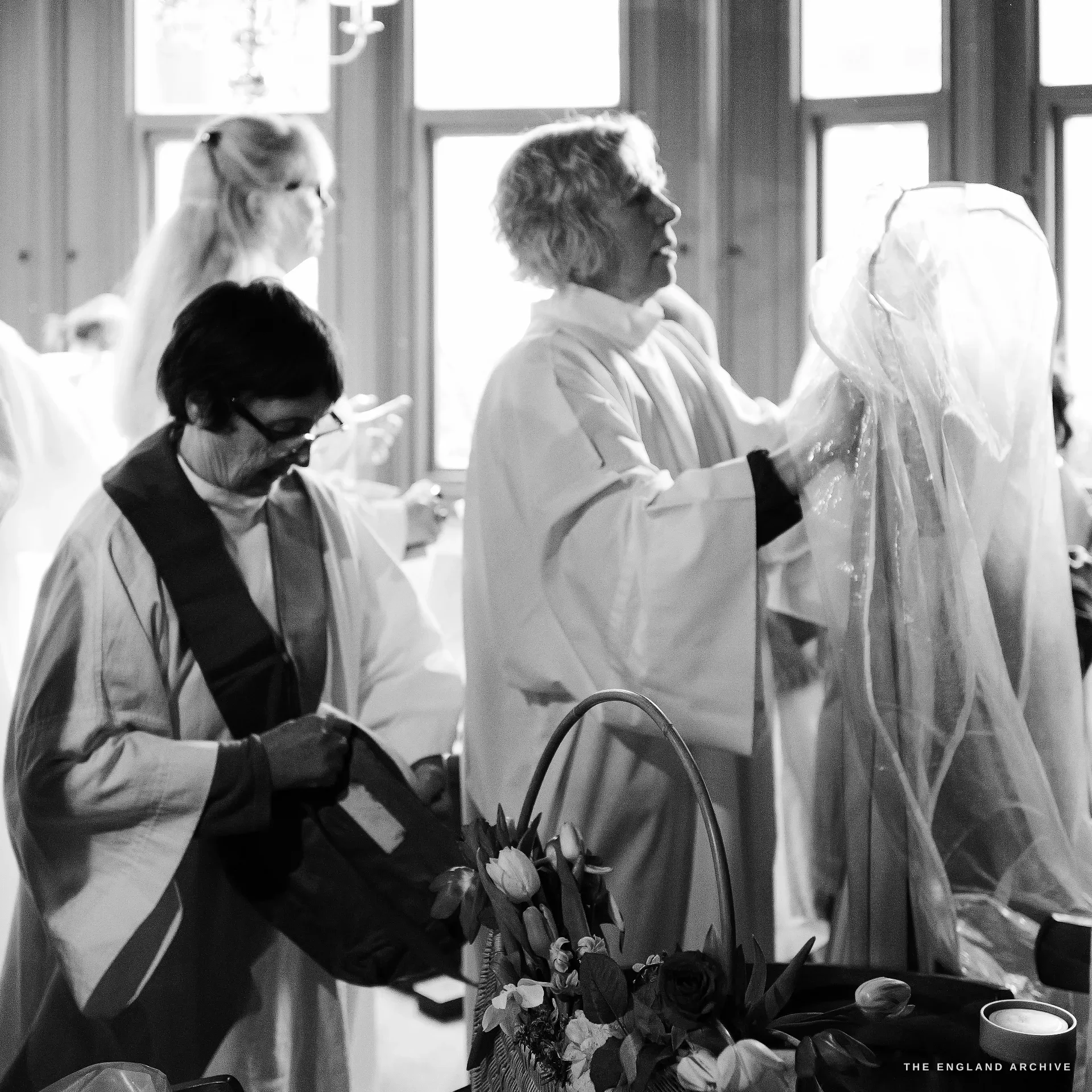
The day starts in a function room above a City pub - a high-windowed space with tulips in jars and a tall pillar candle on the table. Members arrive in ordinary clothes and dress one another. Robes pulled over heads. Veils tucked, adjusted. Floral crowns lifted onto hair. The conversation is quiet but not solemn. Everyone has done this before.
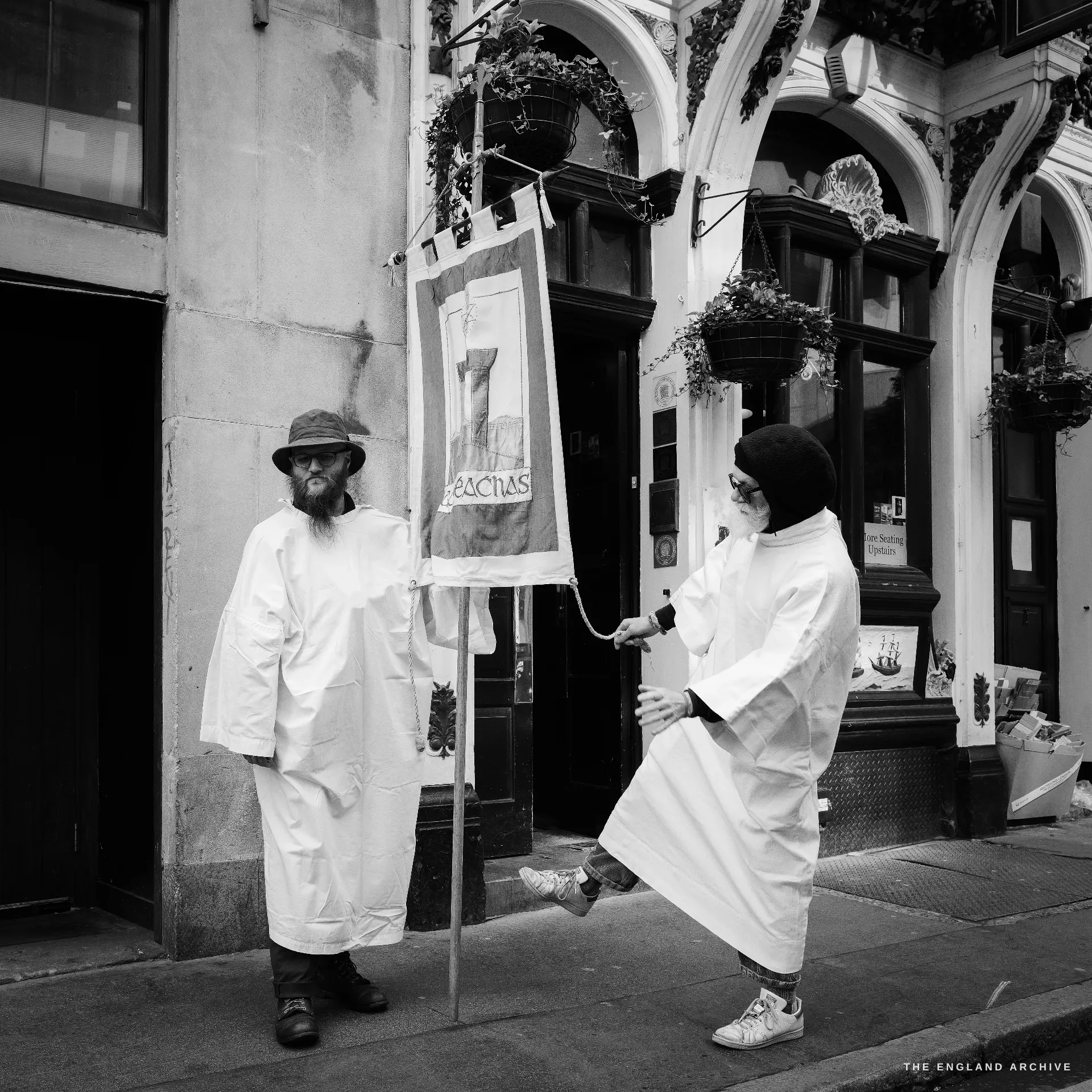
Outside the pub the banner of the Order is unfurled, and the day’s first cord is passed across it.
The Procession
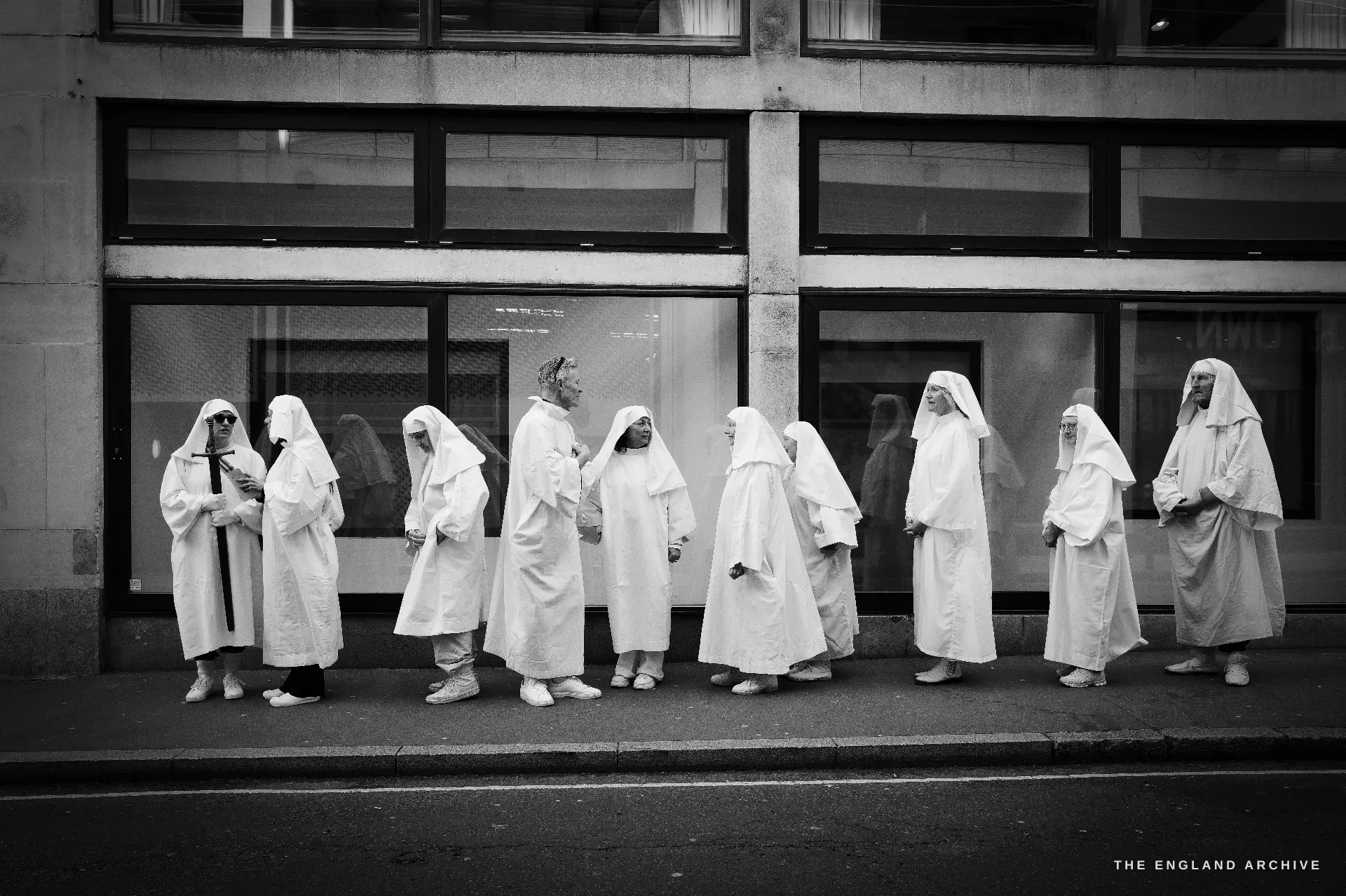
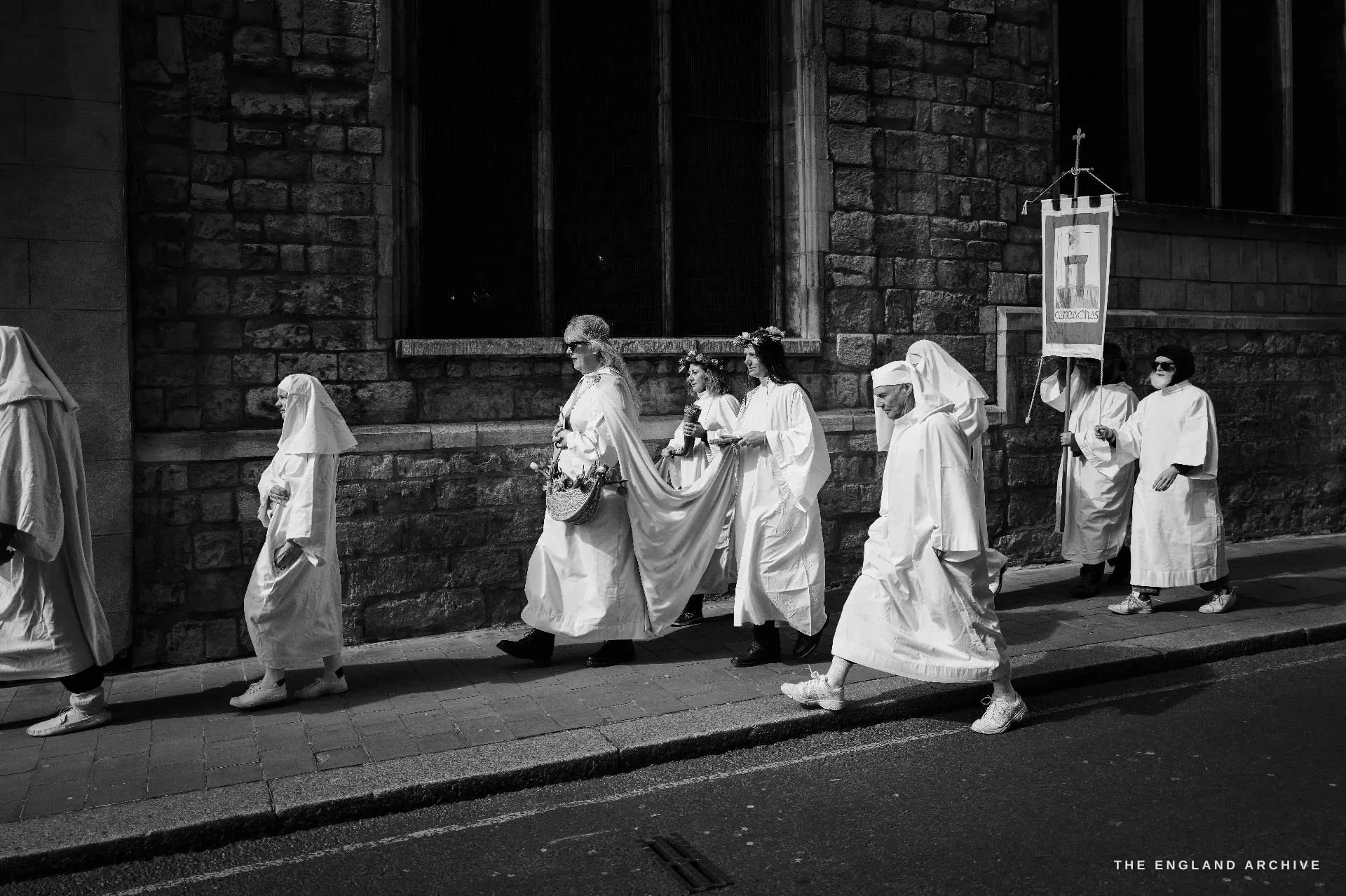
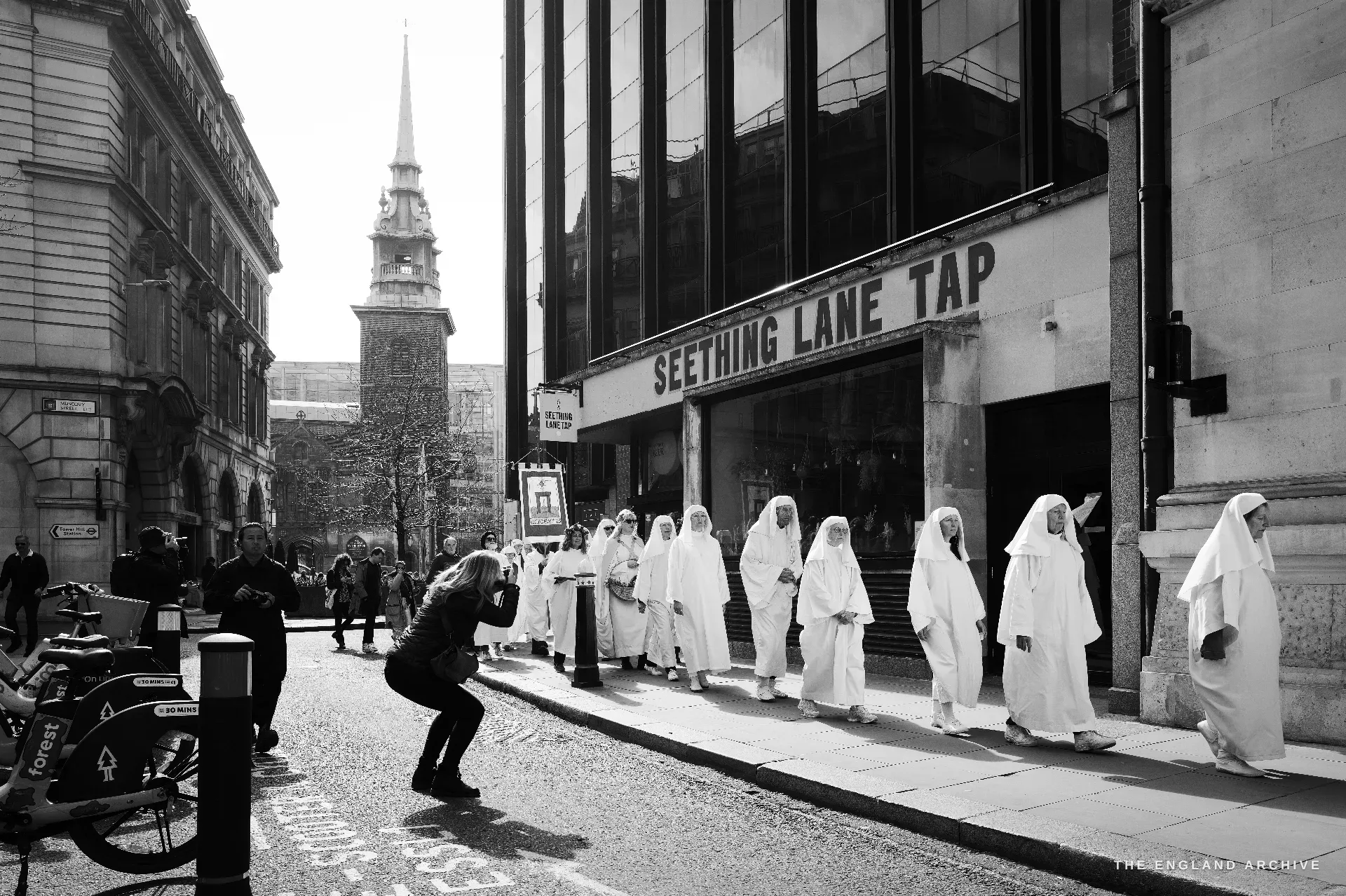
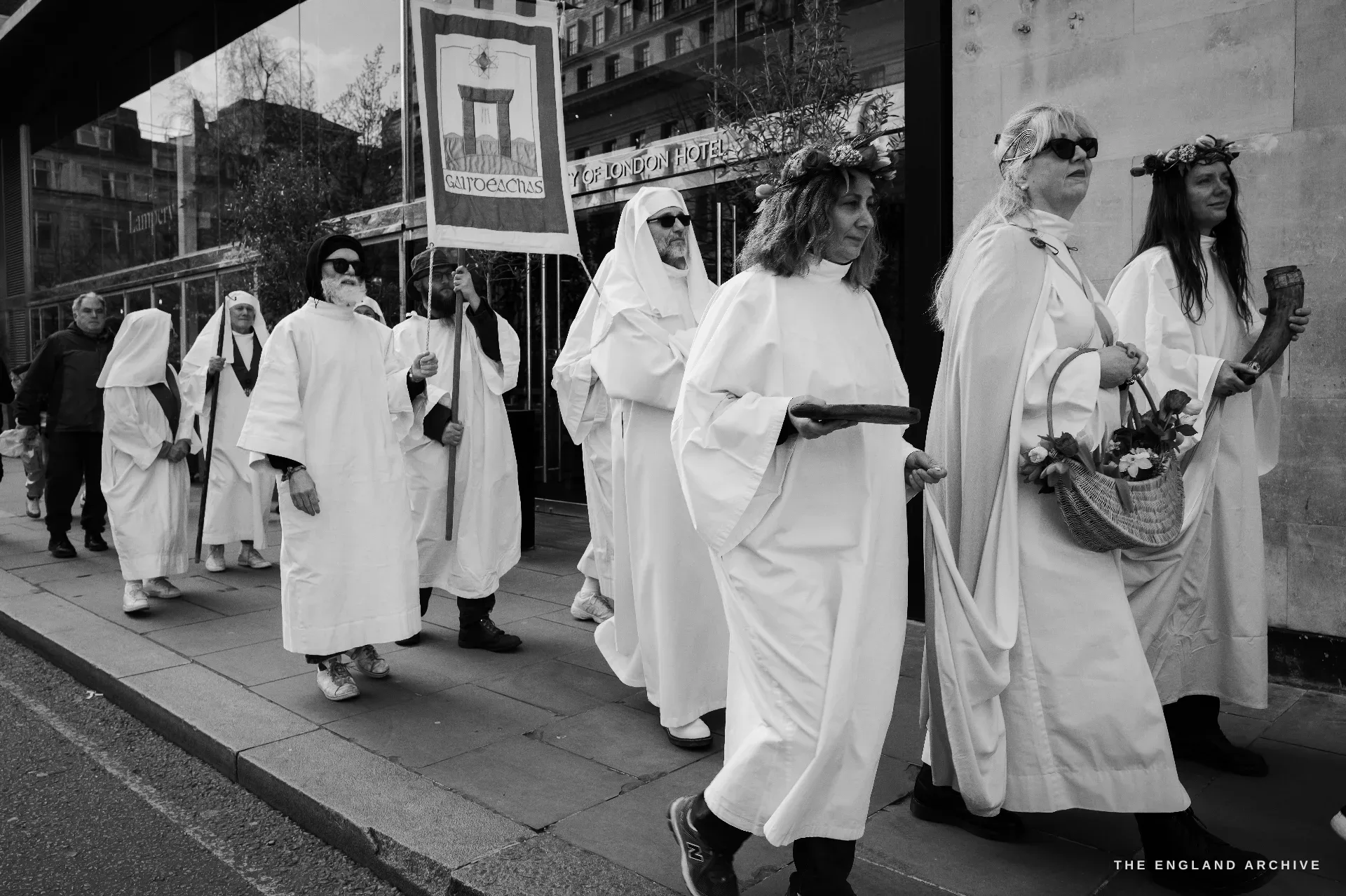
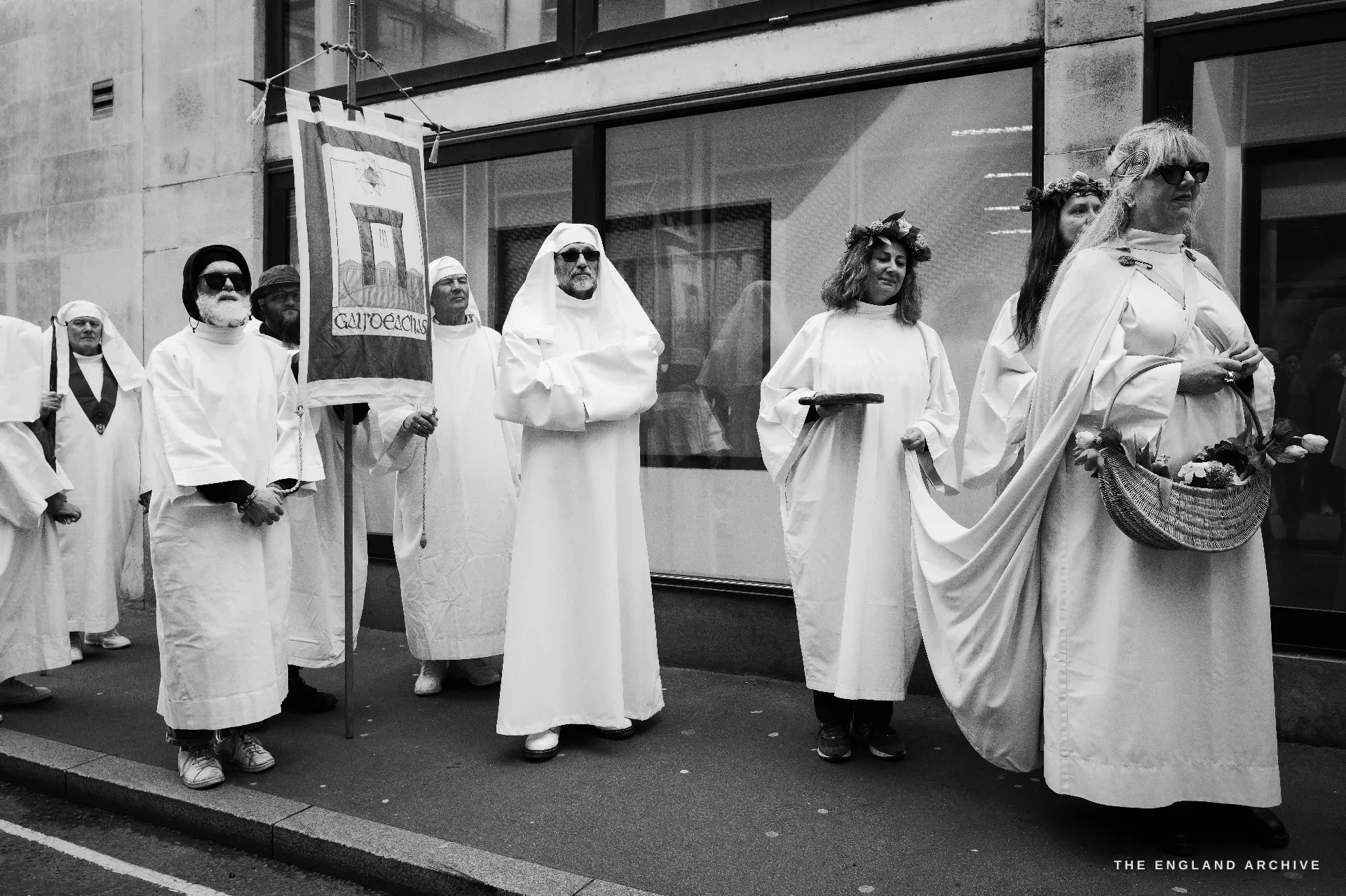
At midday they begin to walk. The members assemble in a loose line along the pavement, the embroidered banner at the centre, the wooden cross at the head, the senior Druids carrying their staffs. Around fifteen figures in all - smaller than I had expected, and more deliberate for it.
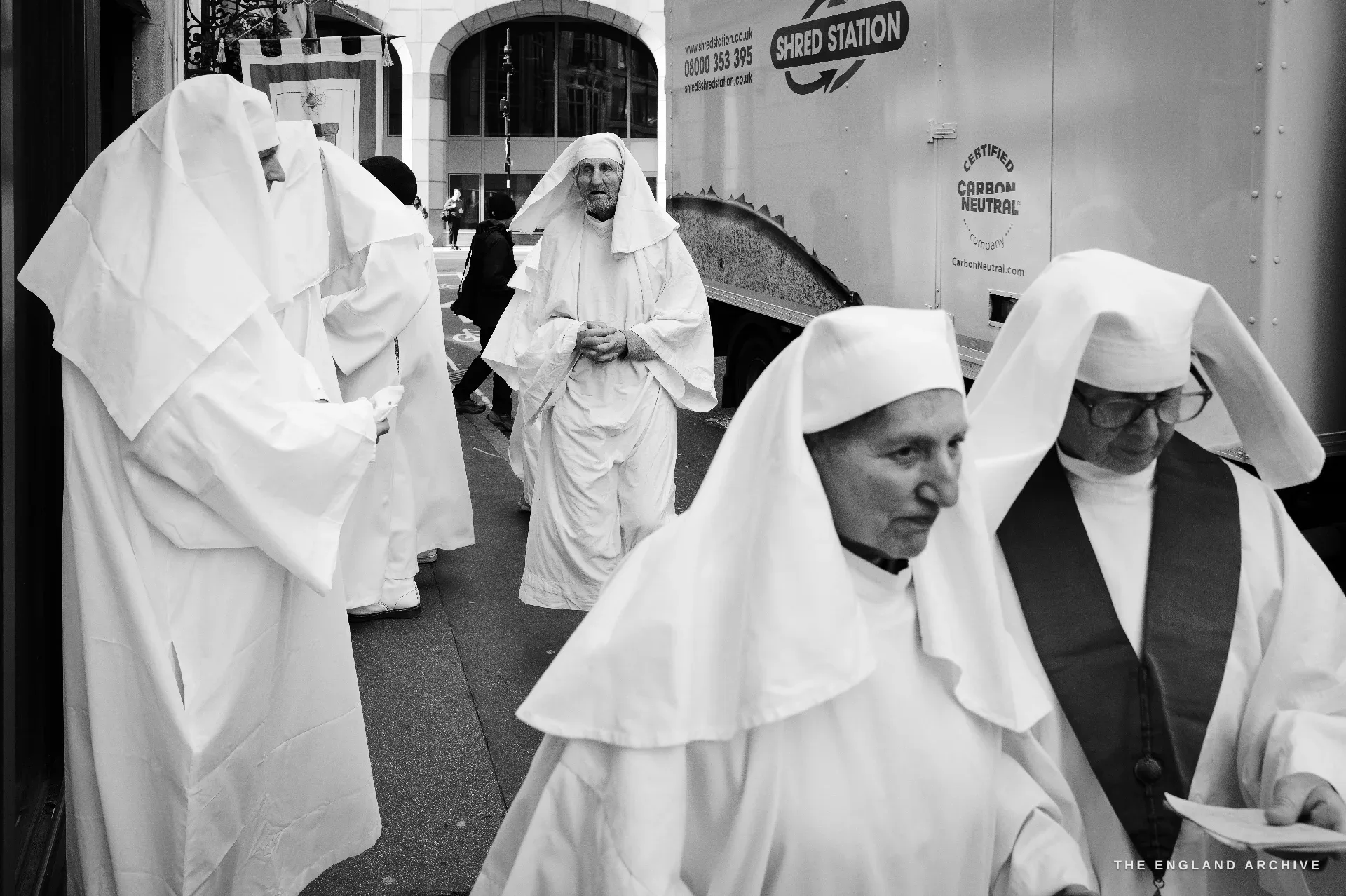
The City the Order walks through is not the City the Order was founded in. A SHRED STATION lorry rumbles past their gathering. A young woman in athletic shorts breaks into a run between two of them on the pavement. Behind their banner, a CENTRAL LONDON ALLIANCE / LONDON SPORTS FESTIVAL hoarding lines the route. The procession proceeds as though none of this is happening, which is itself a kind of statement about what the Order considers real.
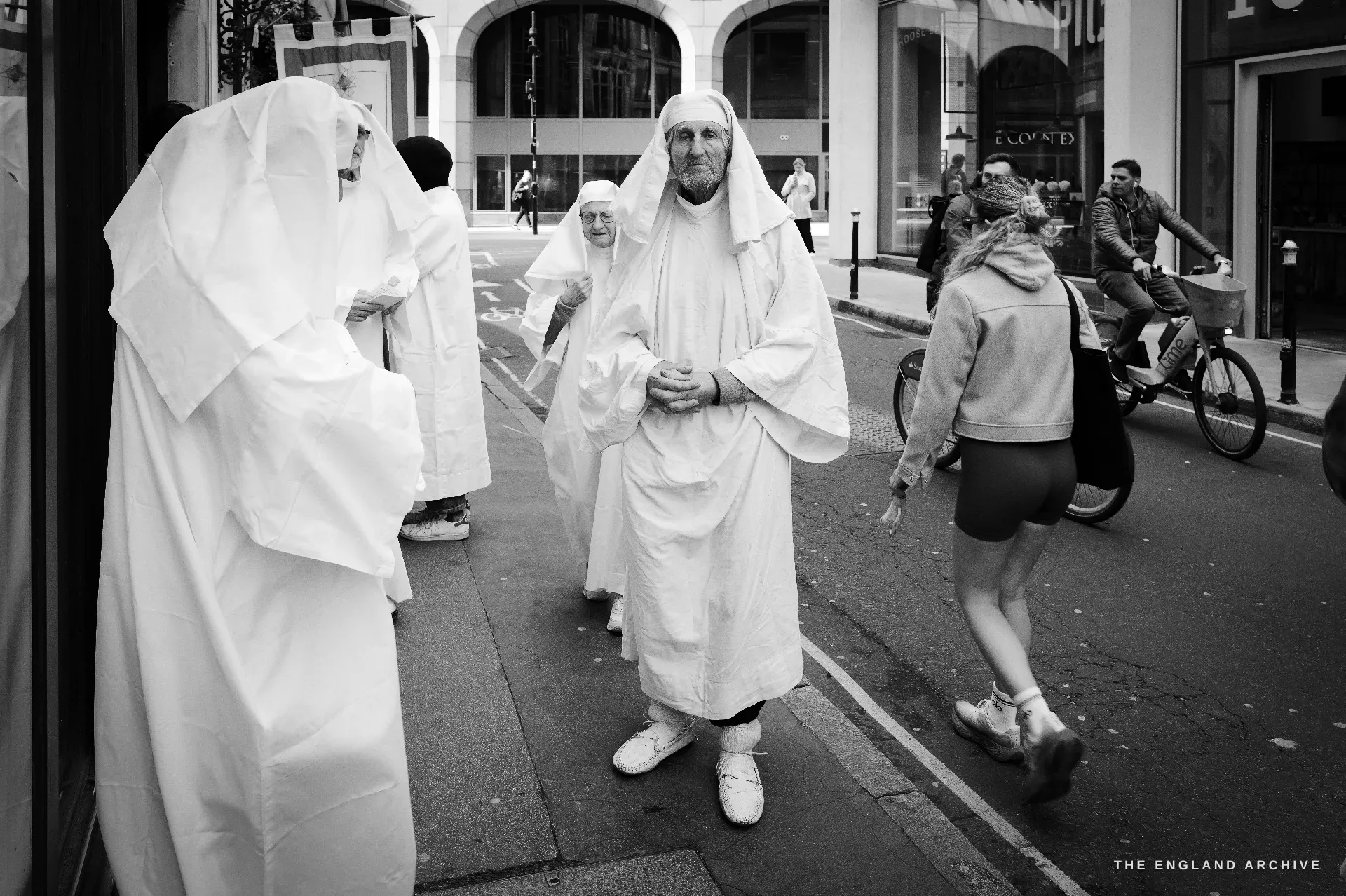
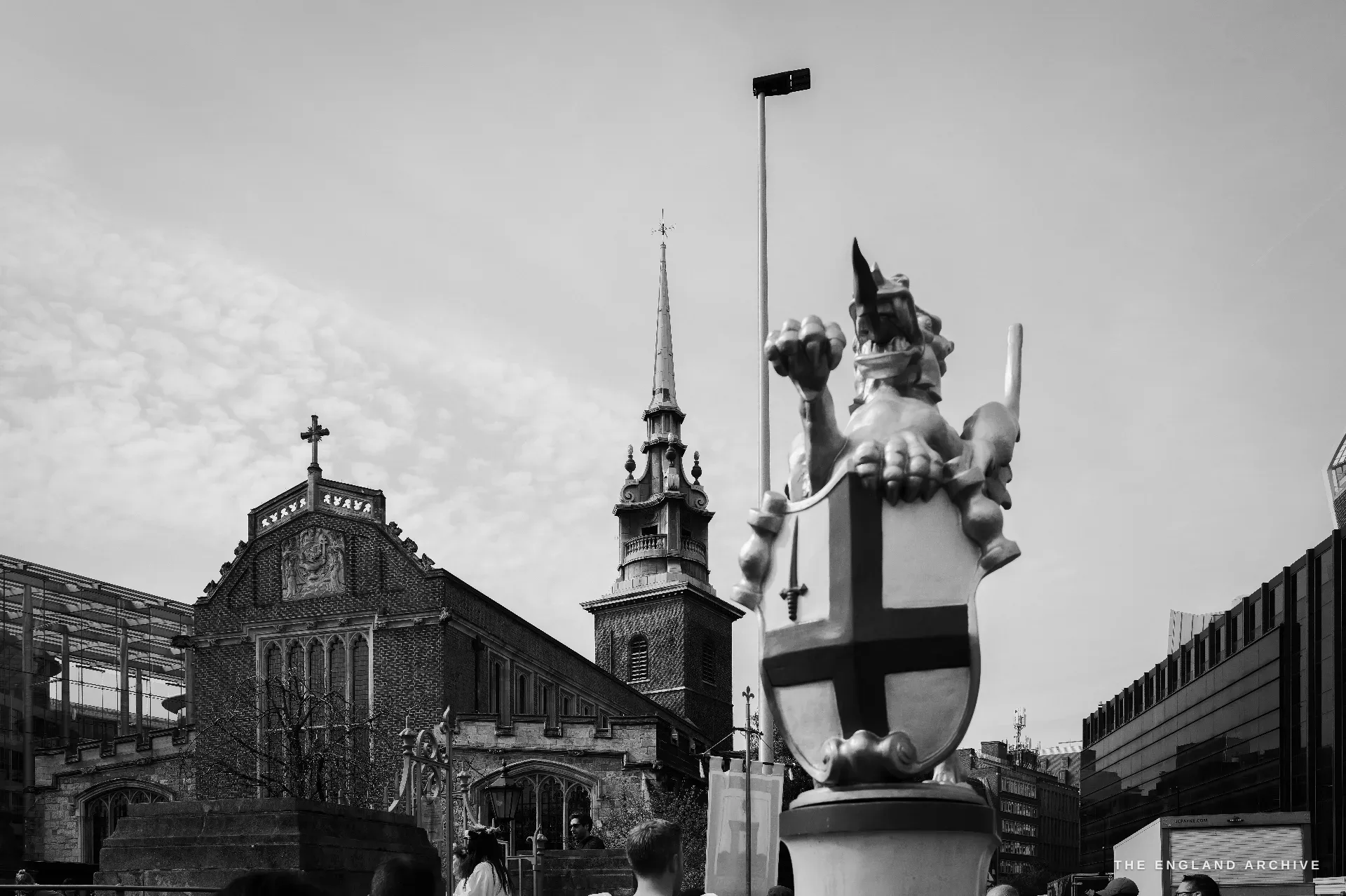
The route winds towards All Hallows-by-the-Tower - reputedly the oldest church in the City of London, founded around 675. The Order pre-dates Christianity in its references; All Hallows pre-dates almost everything else. The two things share a stretch of pavement once a year, on this day, and neither of them announces itself.
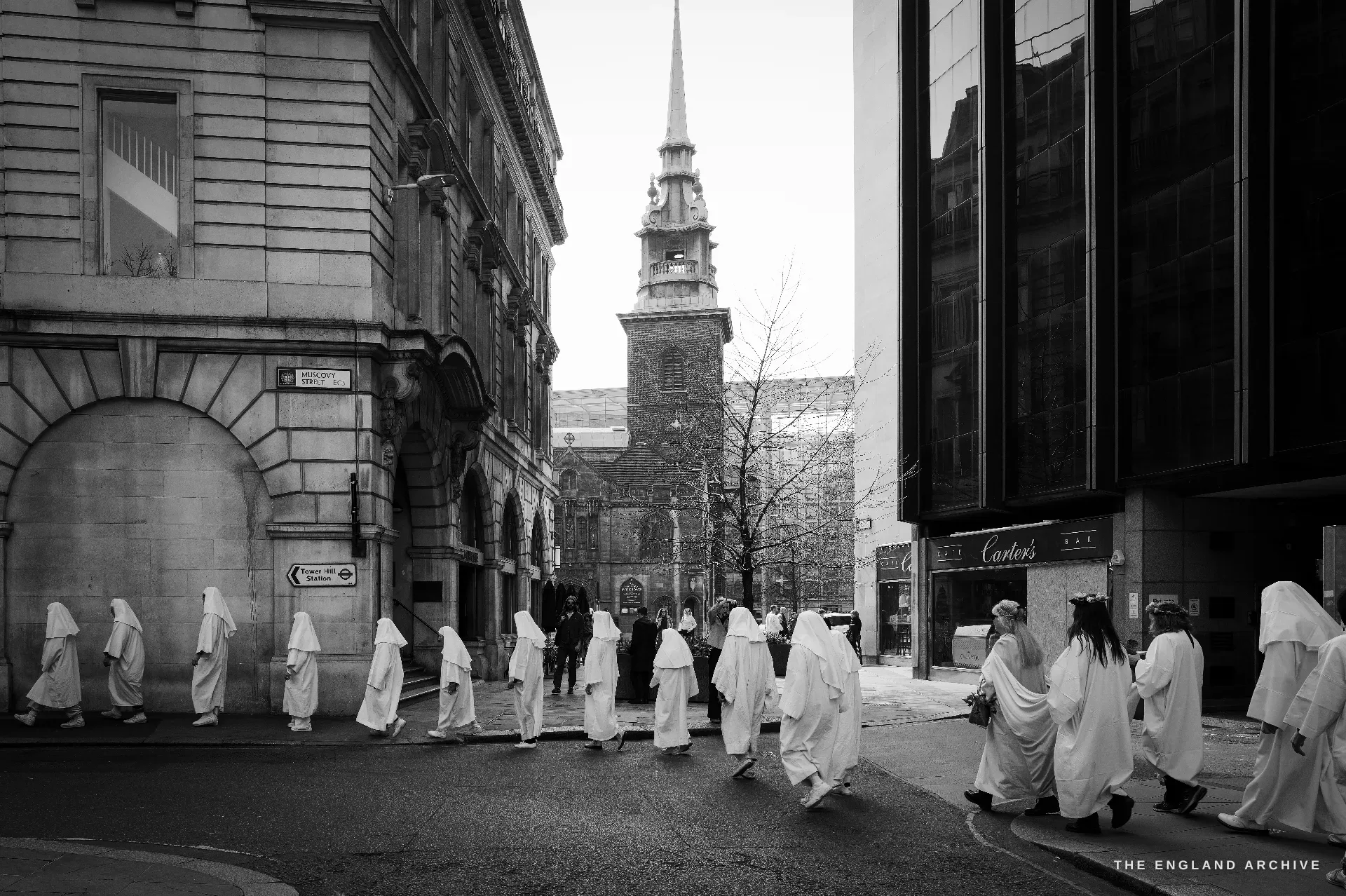
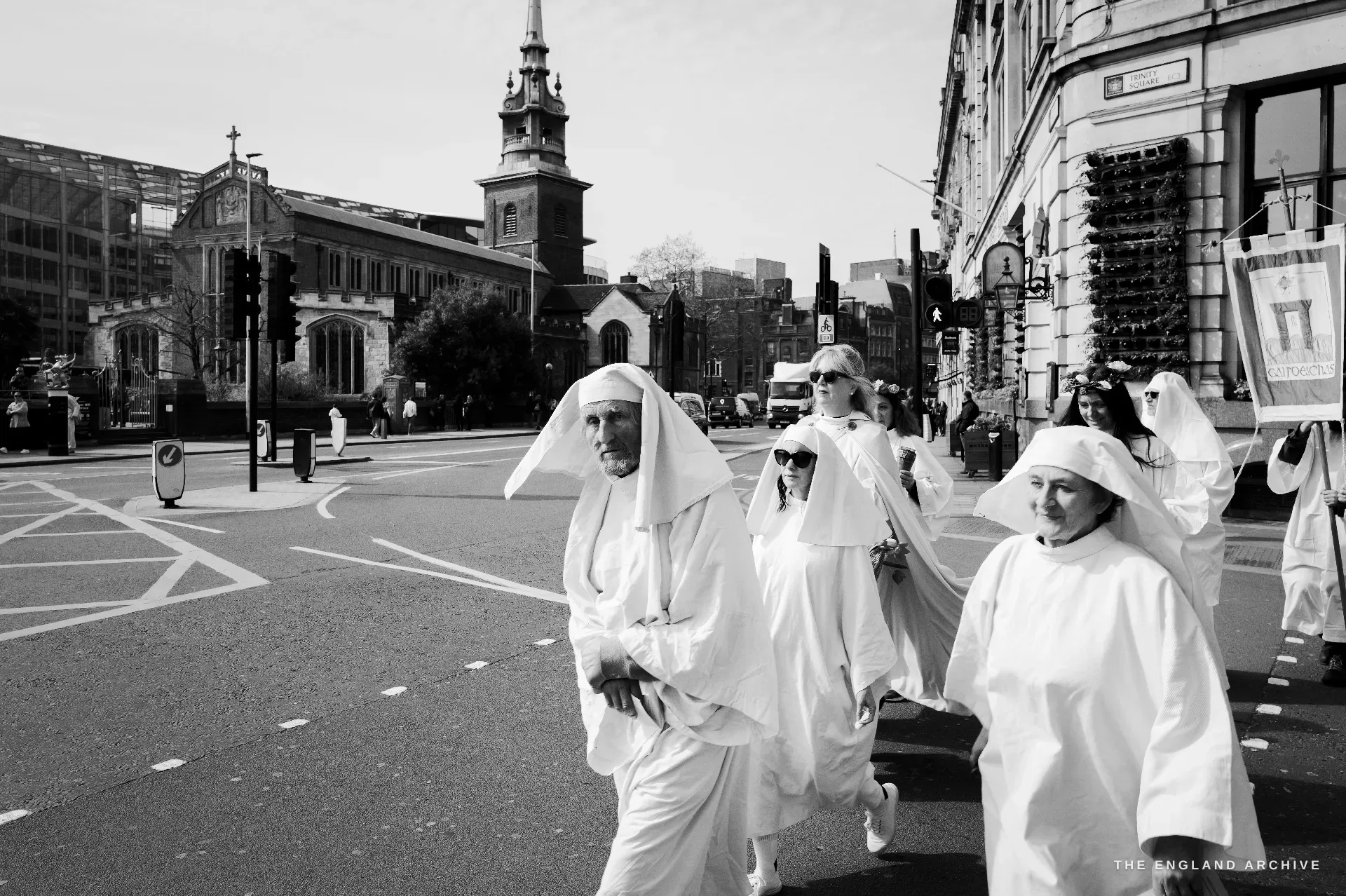
Tower Hill
And then the carved wall, with the four words deep-cut into the stone: TOWER OF LONDON. The line of robed figures passes a young woman stretching against it, headphones in, mid-warm-up. The Tower of London, the runner, the Order, the same wall.
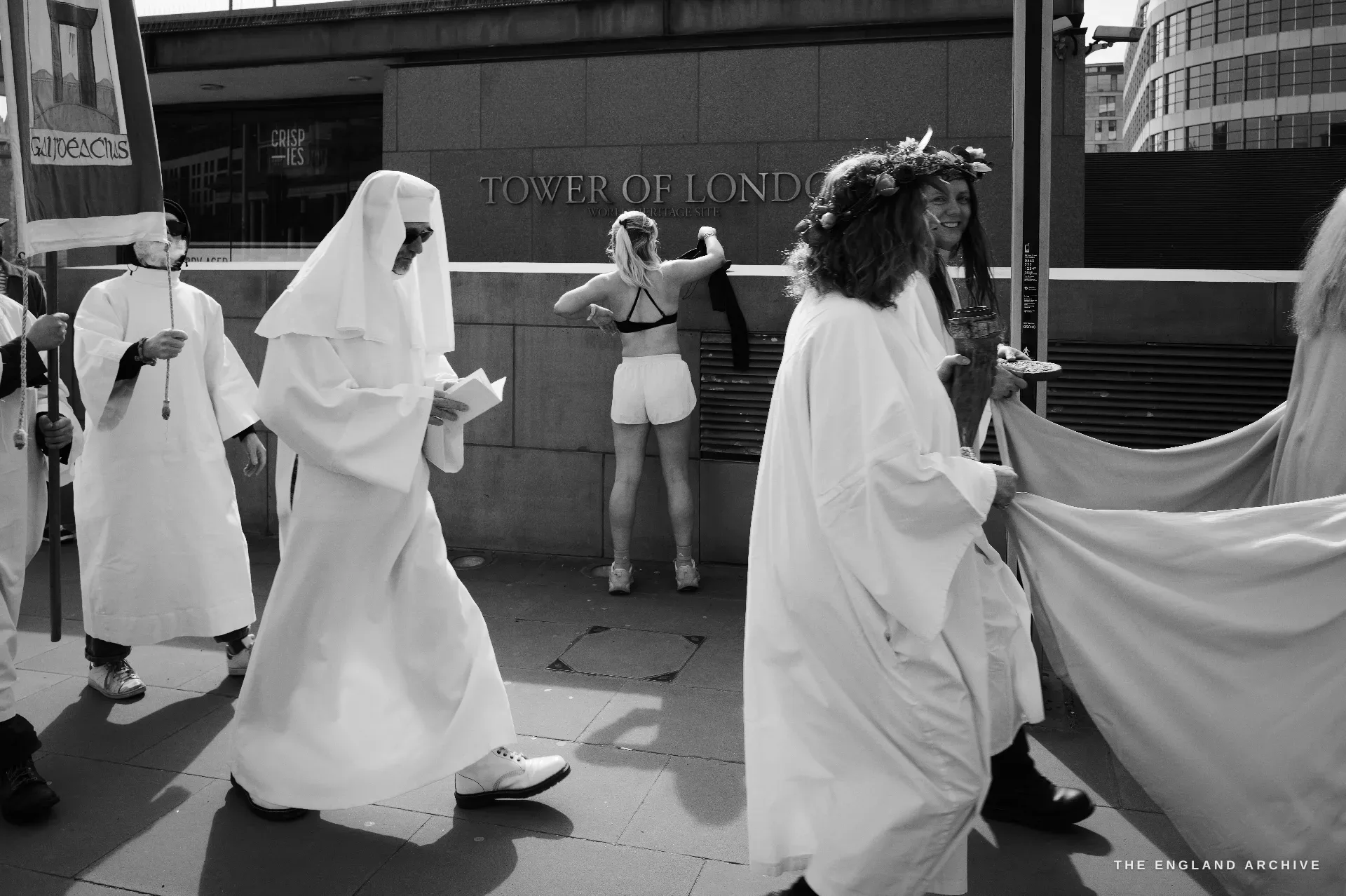
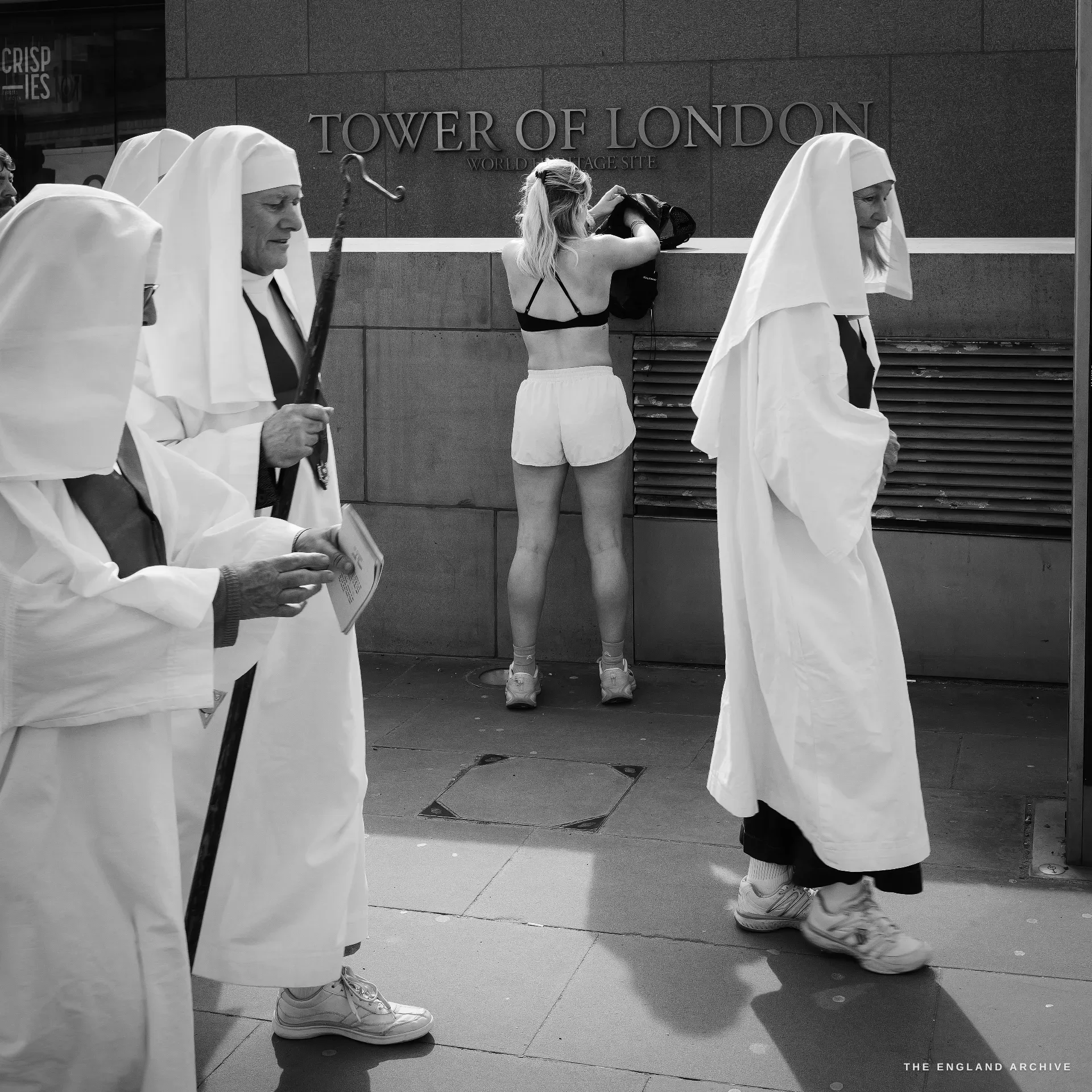
Beyond the wall the hill itself - Bryn Gwyn, the White Mount, the place the Mabinogion records as the burial site of the head of Bran the Blessed. A City dragon stands sentry at one end of the square. All Hallows’ spire rises at the other.
The Circle
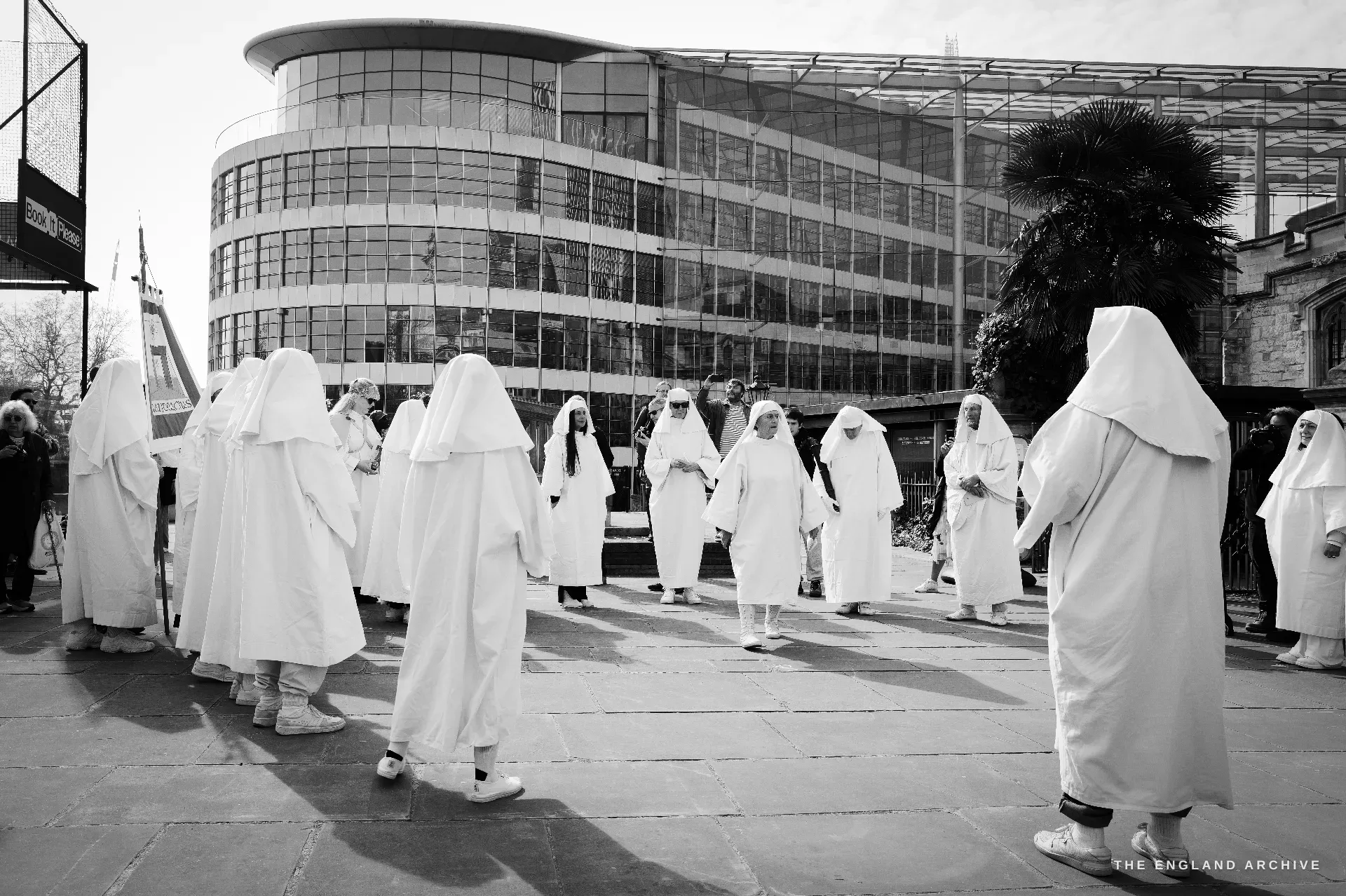
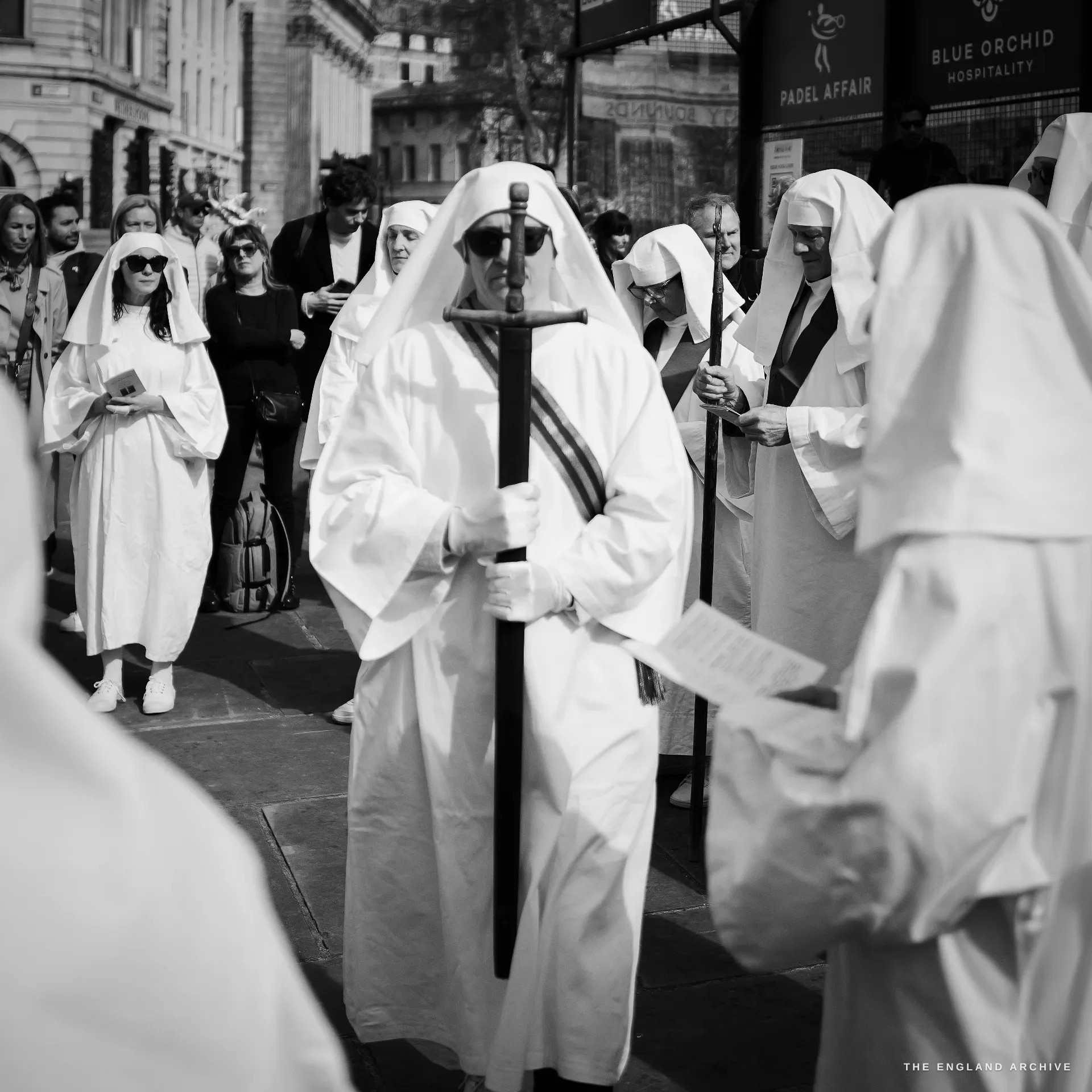
The Order forms a loose circle on the paved square. The senior figures take their cardinal points. The flag is raised vertical. The sword is brought up to the shoulder. The chief invocations begin.
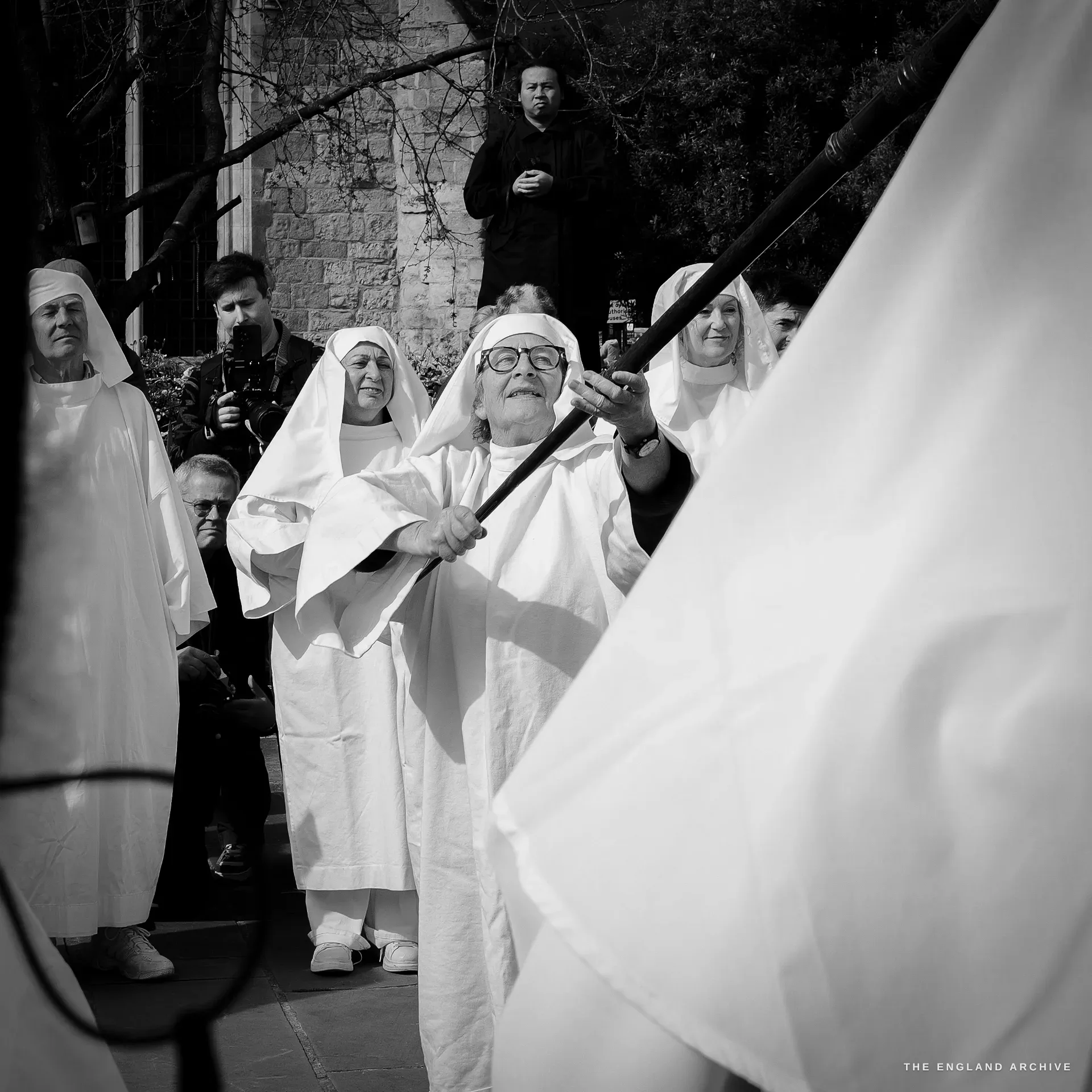
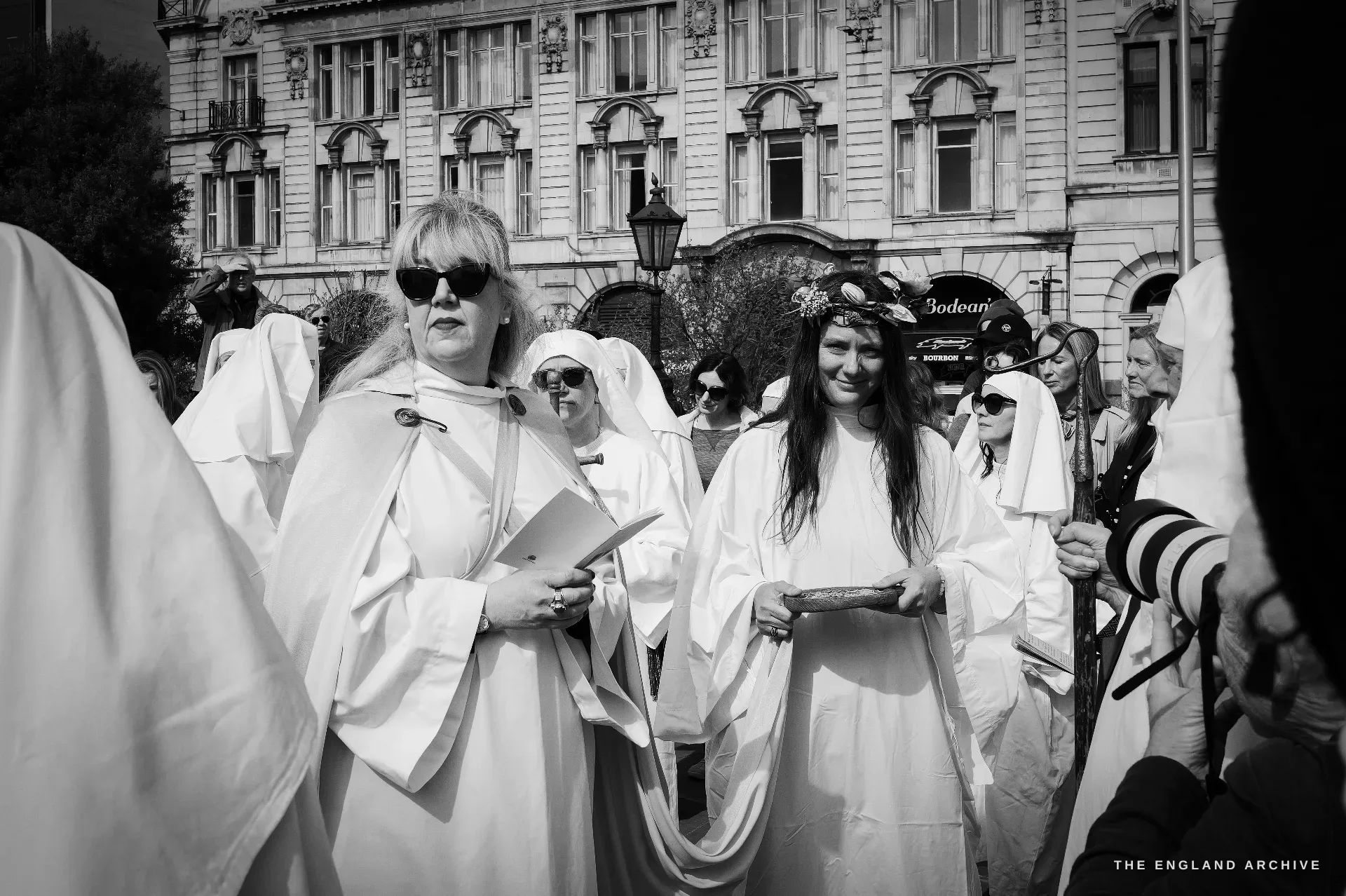
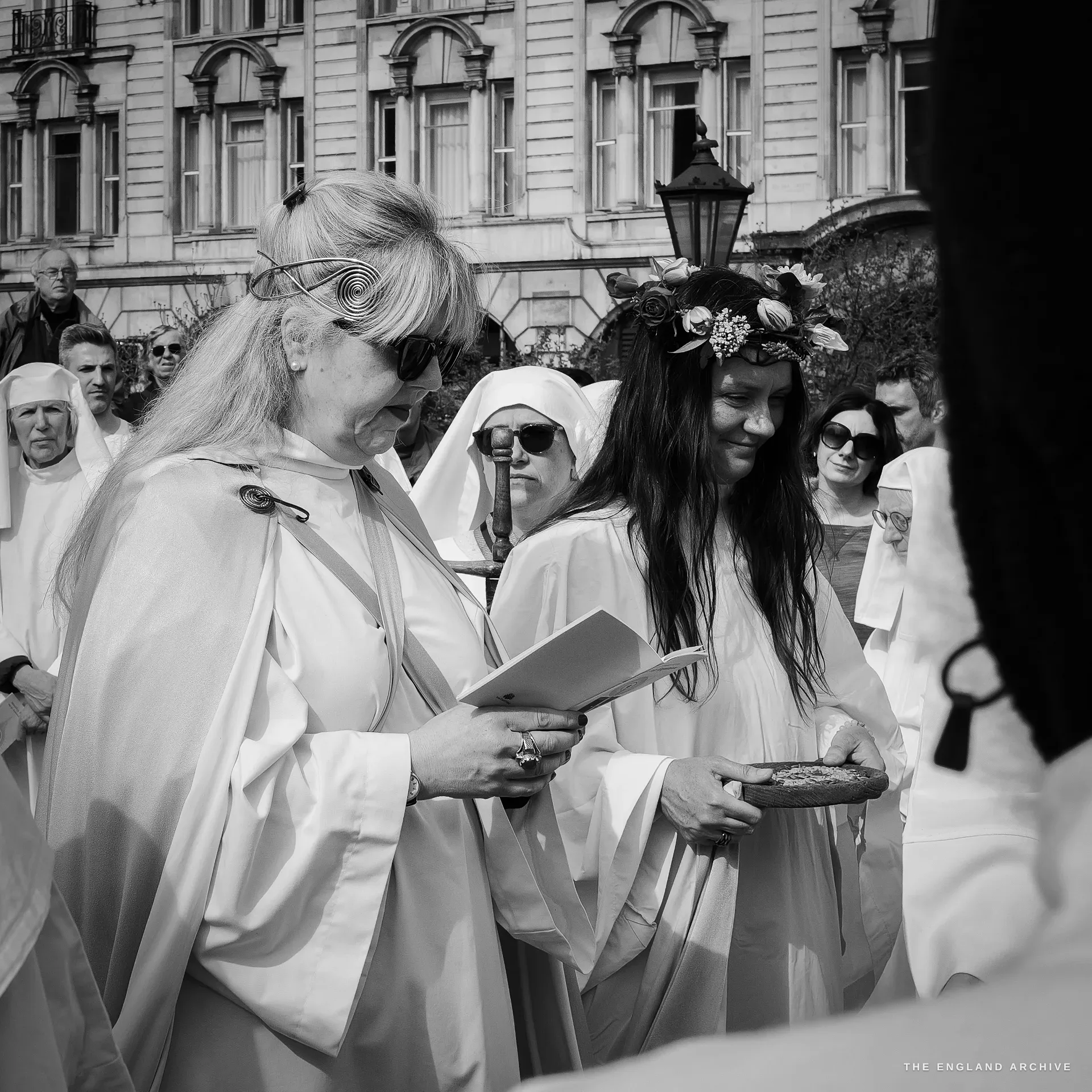
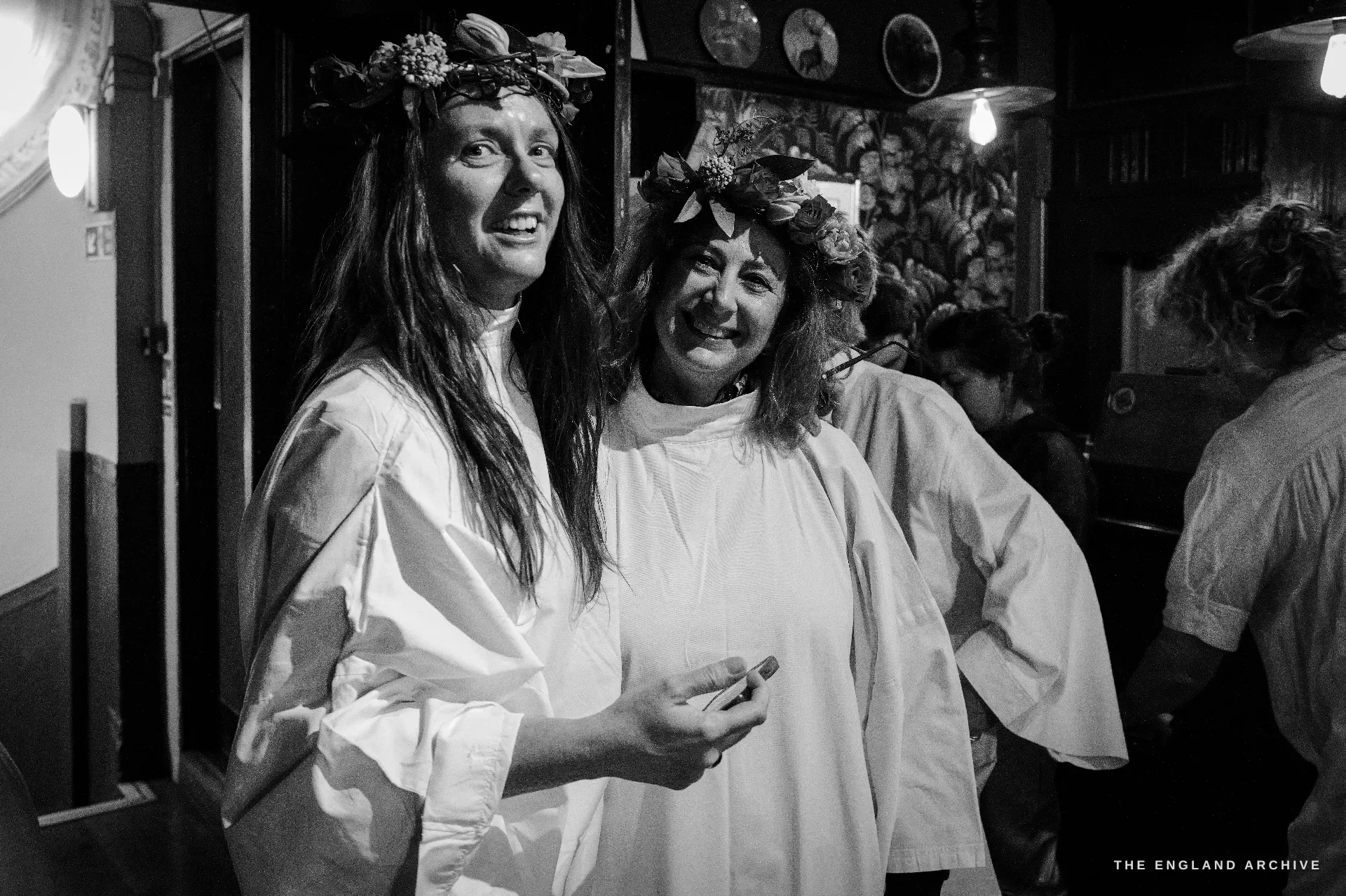
Two women in floral crowns stand close at the edge of the circle. One holds a flat oat cake in both hands - the spring offering carried into the rite. The other holds a thin folder of papers - the words the circle will say.
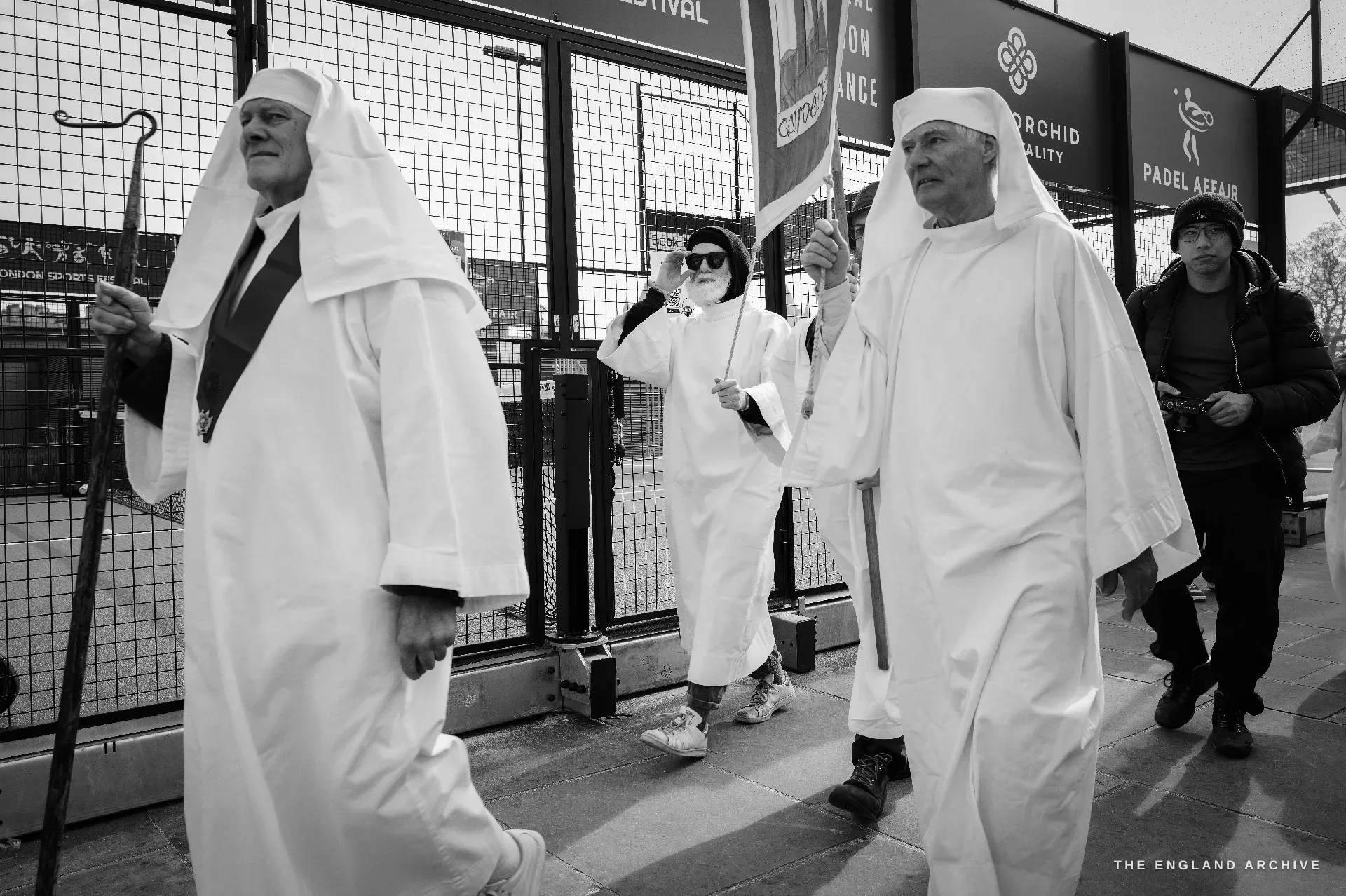
A senior Druid in striped scarf and sunglasses moves through the circle carrying a tall wooden staff with a hooked top. The staff has the worn handhold of something used many times. It is not a prop.
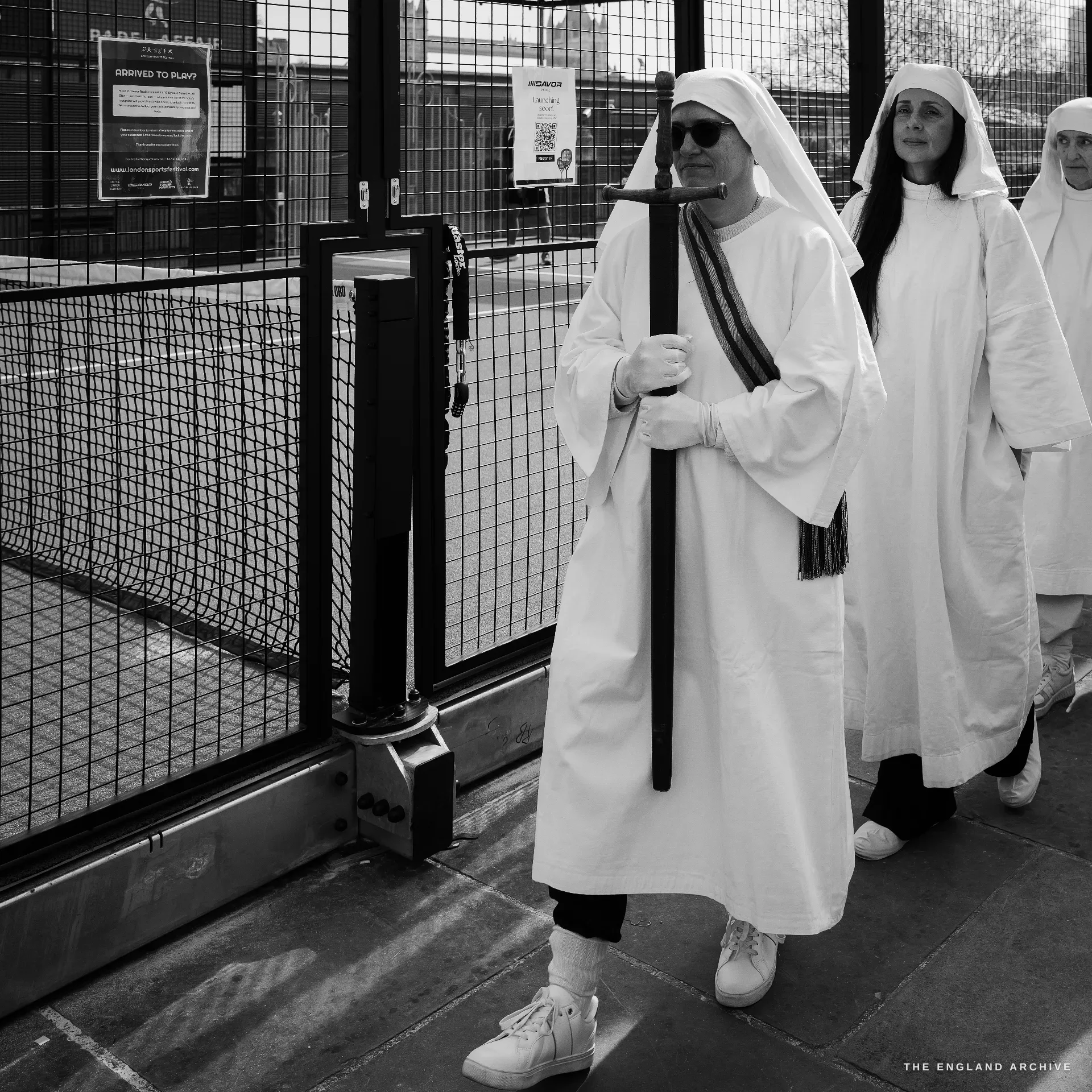
Two senior members of the Order walk together past the metal mesh of a padel court. They have done this for decades. The padel court has been there for two summers.
Inside the circle the words are spoken aloud. The elements are invoked. Ceridwen, the earth mother of Welsh mythology, is called upon. Token seeds are brought forward and symbolically sown around the perimeter - a gesture toward fertility, toward renewal, toward the turning of the dark half of the year into the light. There is no amplification. No printed programme for spectators. The ceremony lasts about forty minutes; afterwards, the circle simply opens, and the day continues.
The Order holds three public ceremonies each year, each tied to an astronomical event and a specific London landscape: the Spring Equinox at Tower Hill, the Summer Solstice at Stonehenge, and the Autumn Equinox at Primrose Hill. The locations are not interchangeable. Each site carries its own mythology and its own relationship to the ceremony performed there.
The Crowd Around the Circle
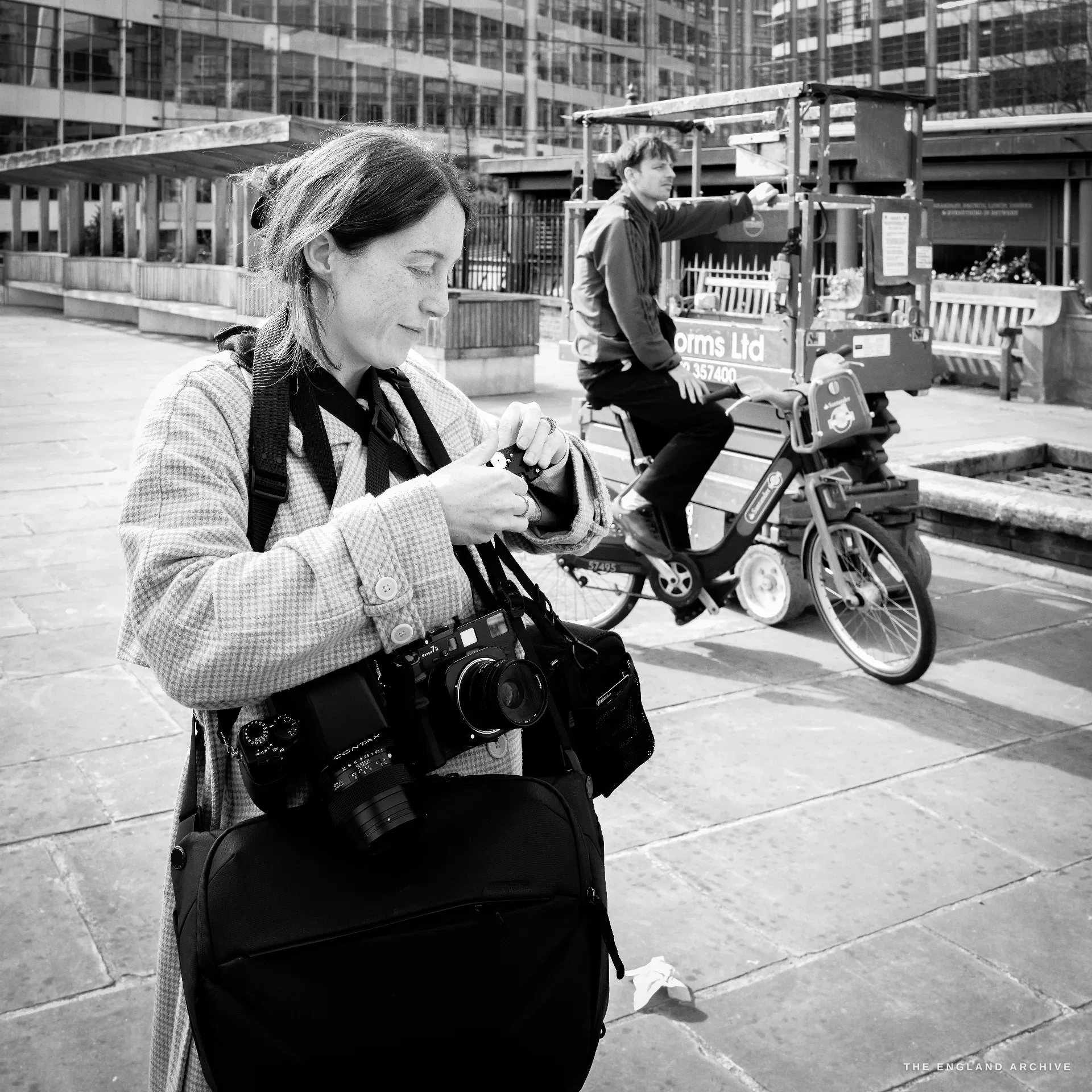
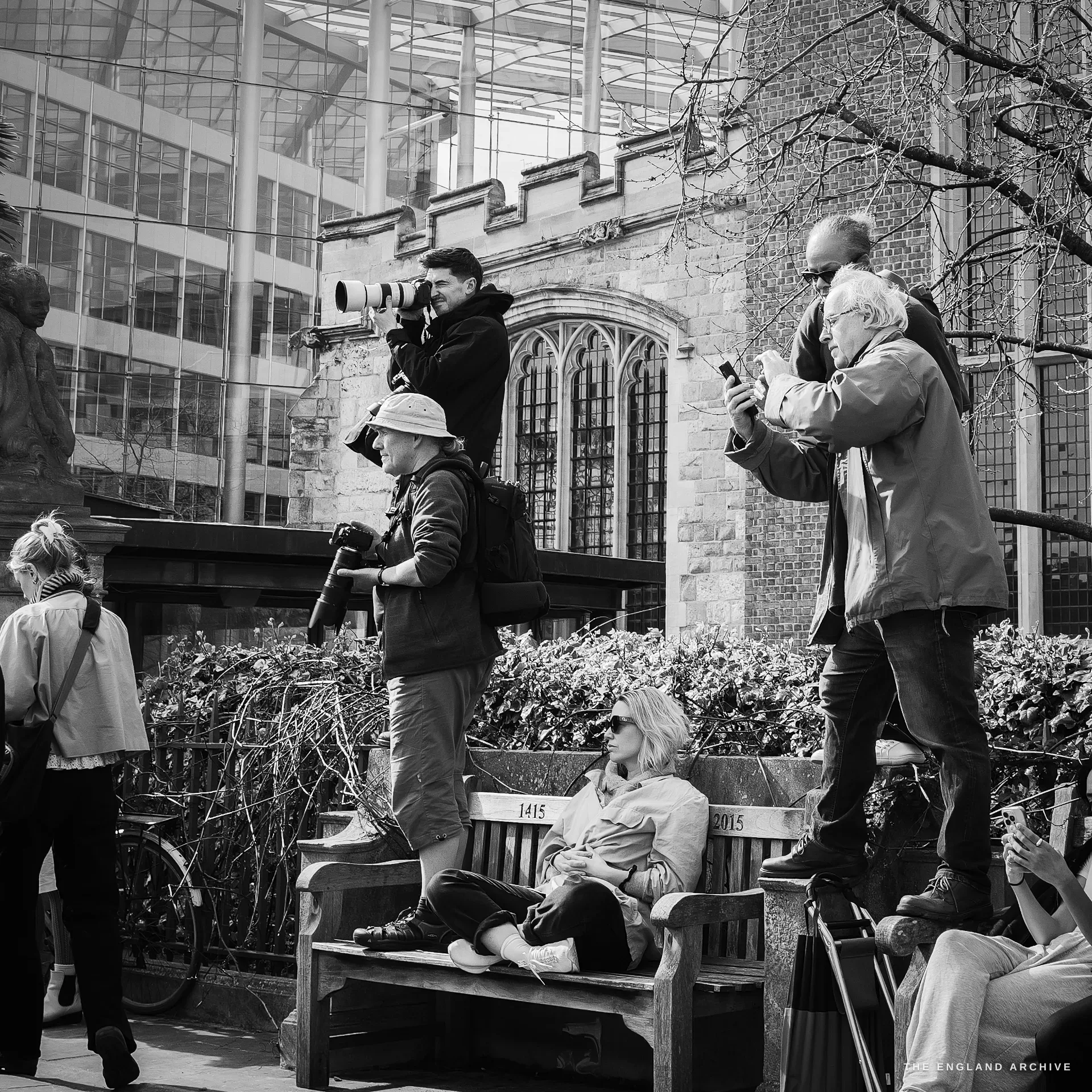
The Druid Order’s spring rite draws a small press of its own each year. Documentary photographers position themselves on the low park benches and stand on them for height. Long telephoto lenses point in from across the road. A woman with two film cameras around her neck adjusts one of them in the open square. A man crouches in the empty street to get the procession in low profile.
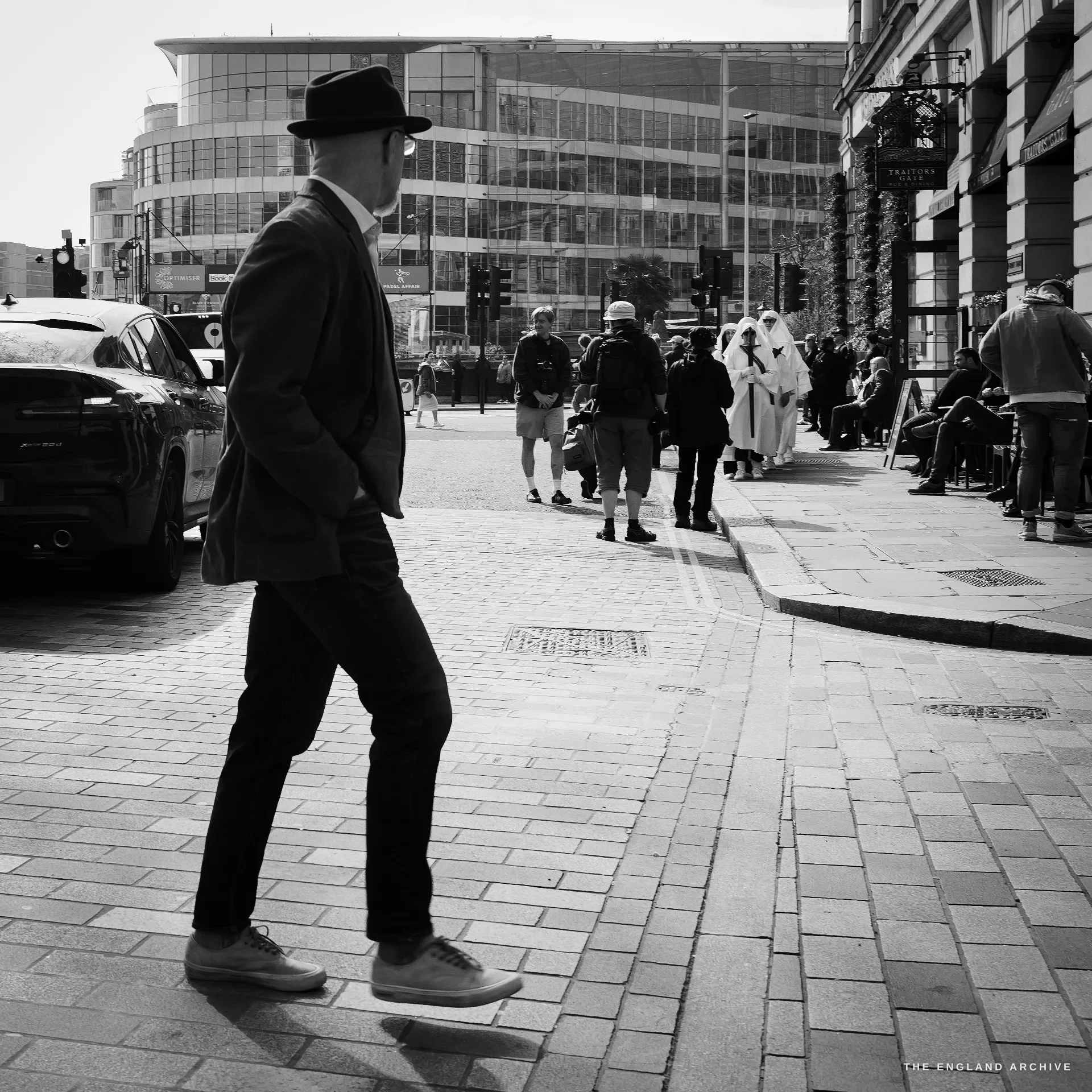
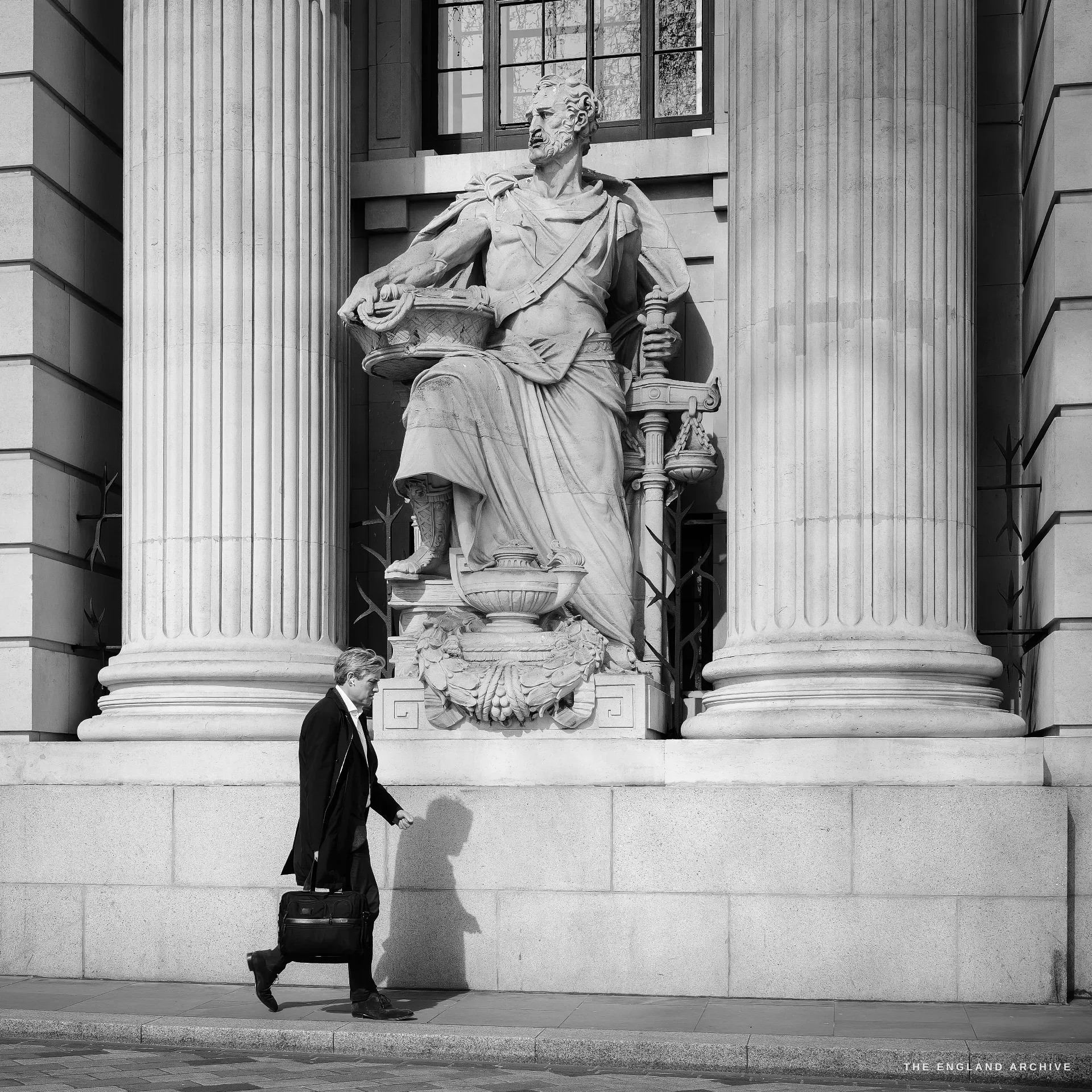
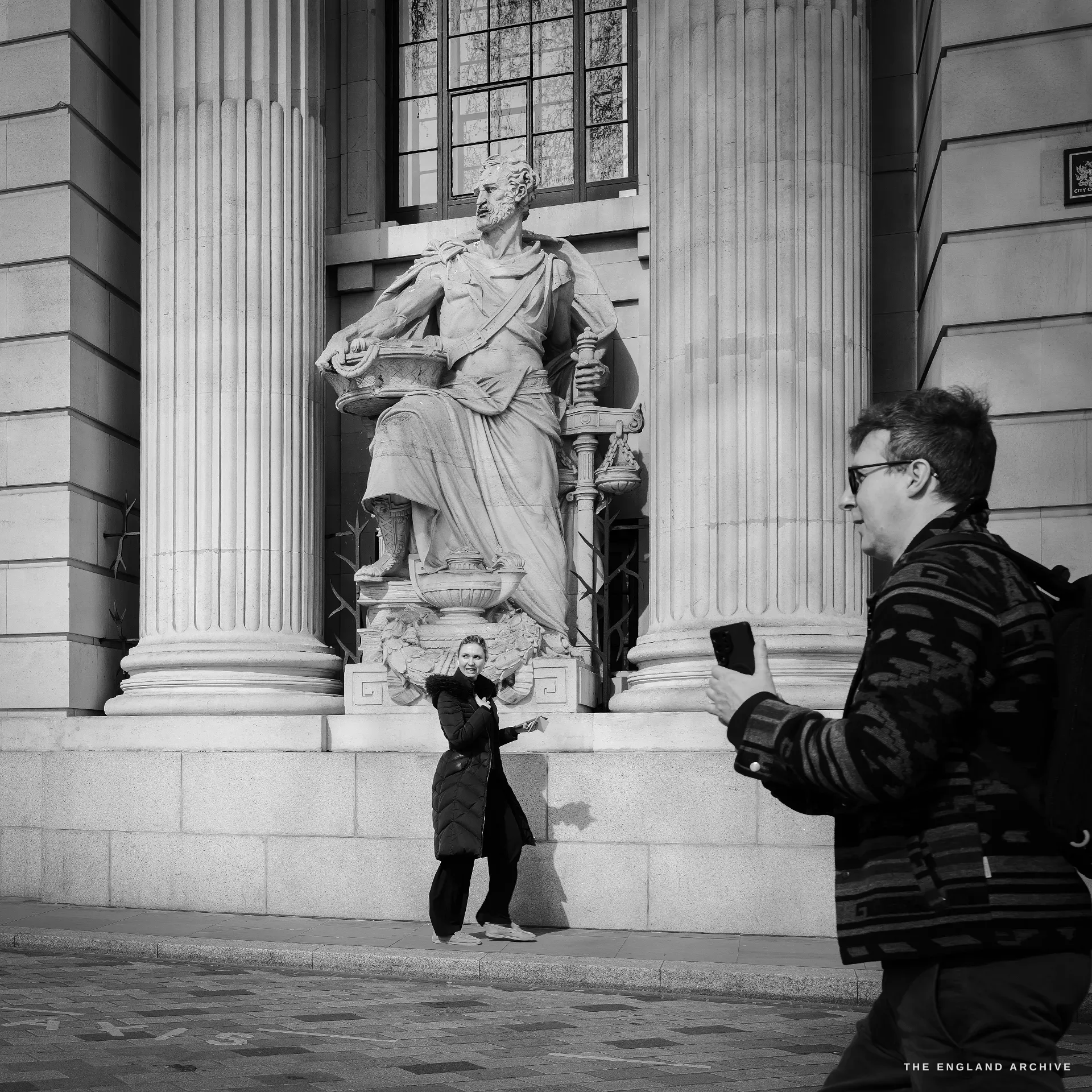
The general public stops, looks, and largely keeps moving. A man in a fedora crosses the road. A businessman cuts through the colonnade of the Port of London Authority building. Tourists at the foot of the Port of London statue raise phones for a selfie. The City does not pause for the Order. The Order does not appear to mind.
Three Londons in One Frame
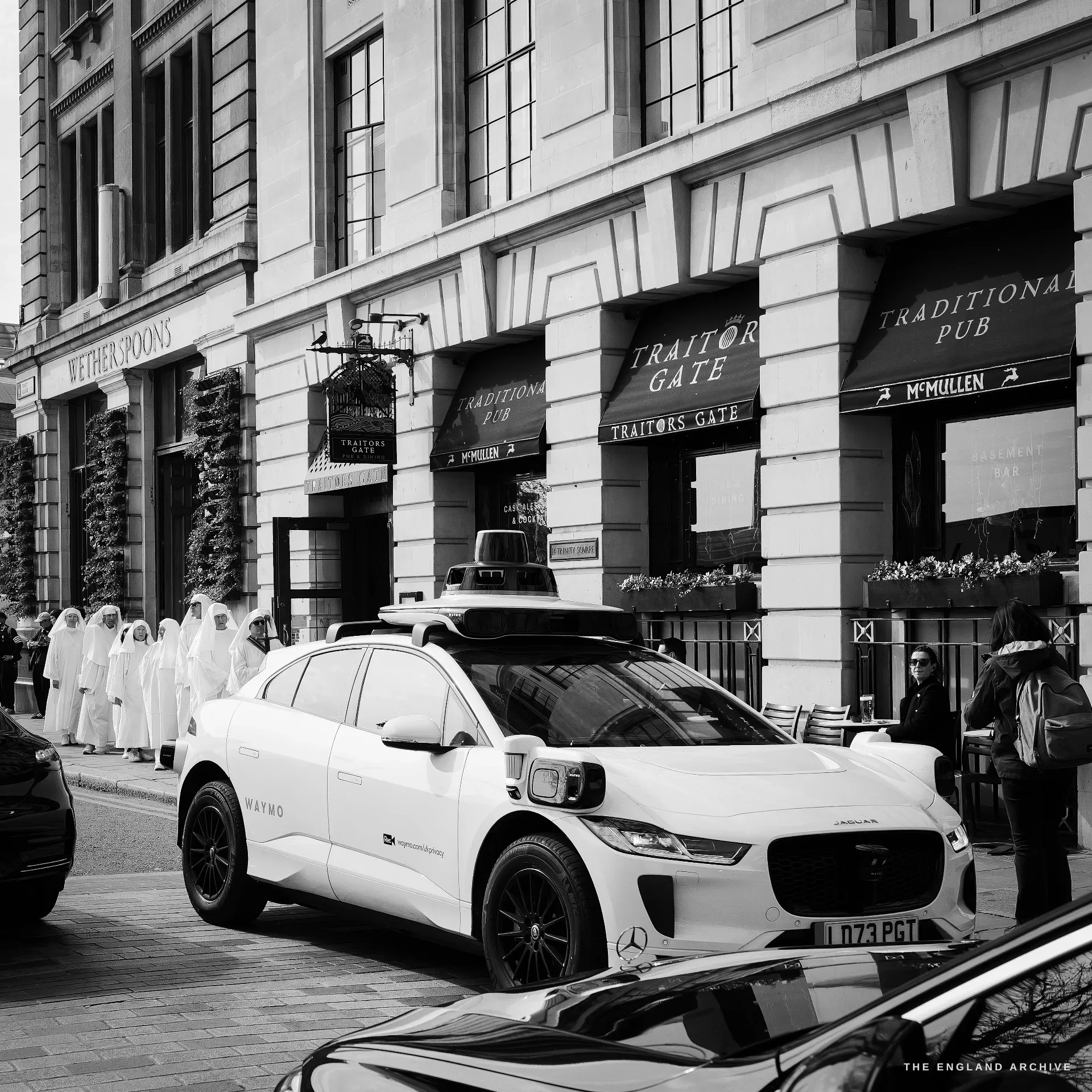
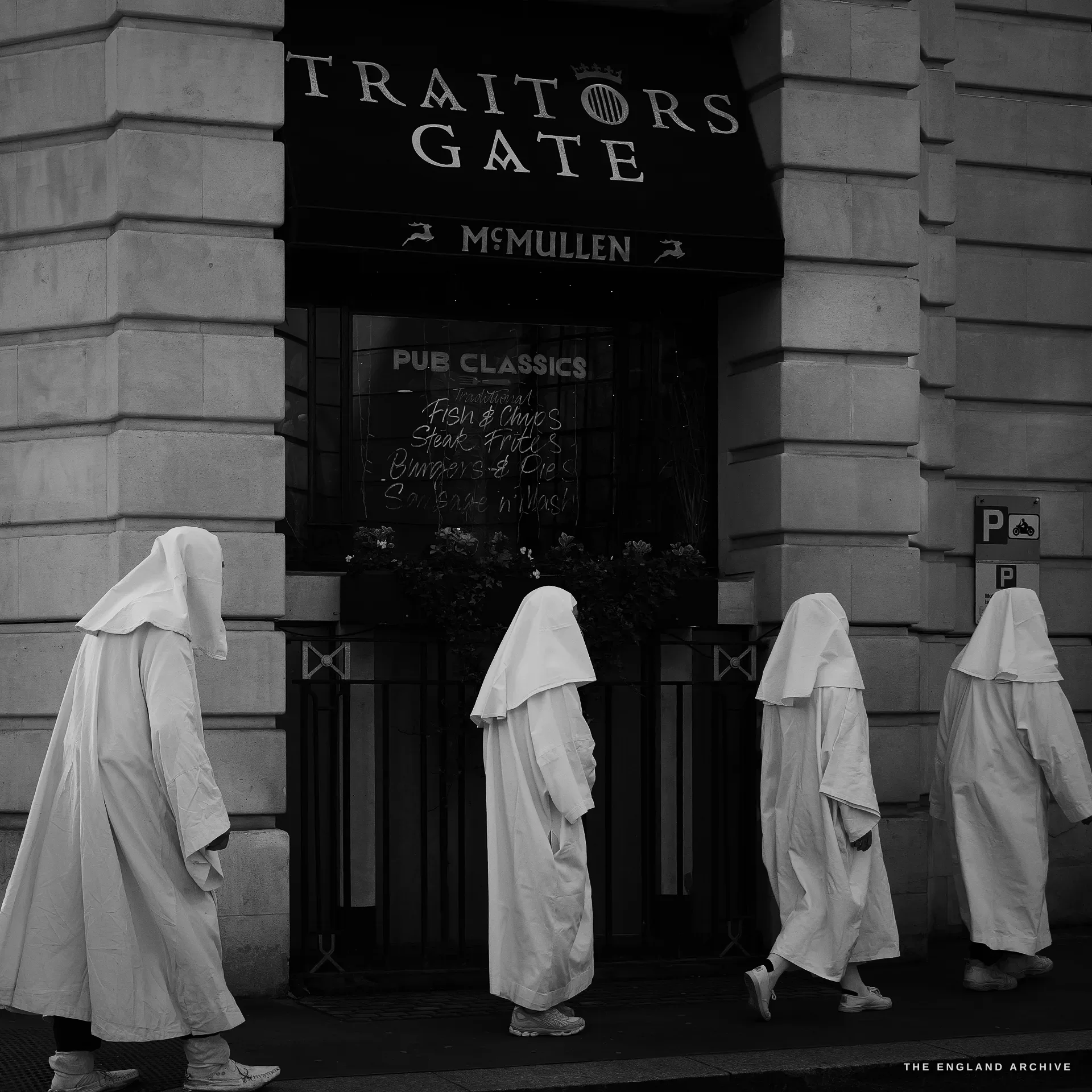
Halfway down a side street the procession passes the Traitors Gate pub, named for the water-gate of the Tower of London where prisoners were brought through. A Waymo self-driving Jaguar I-PACE is parked at the kerb in front of it, the white roof sensor turning. To the left, a Wetherspoons. To the right, the McMullen-owned Traitors Gate. Inside, the chalkboard offers fish and chips, steak frites, burger and fries.
The Druid Order, white-robed, walks past all three.
The Final Approach
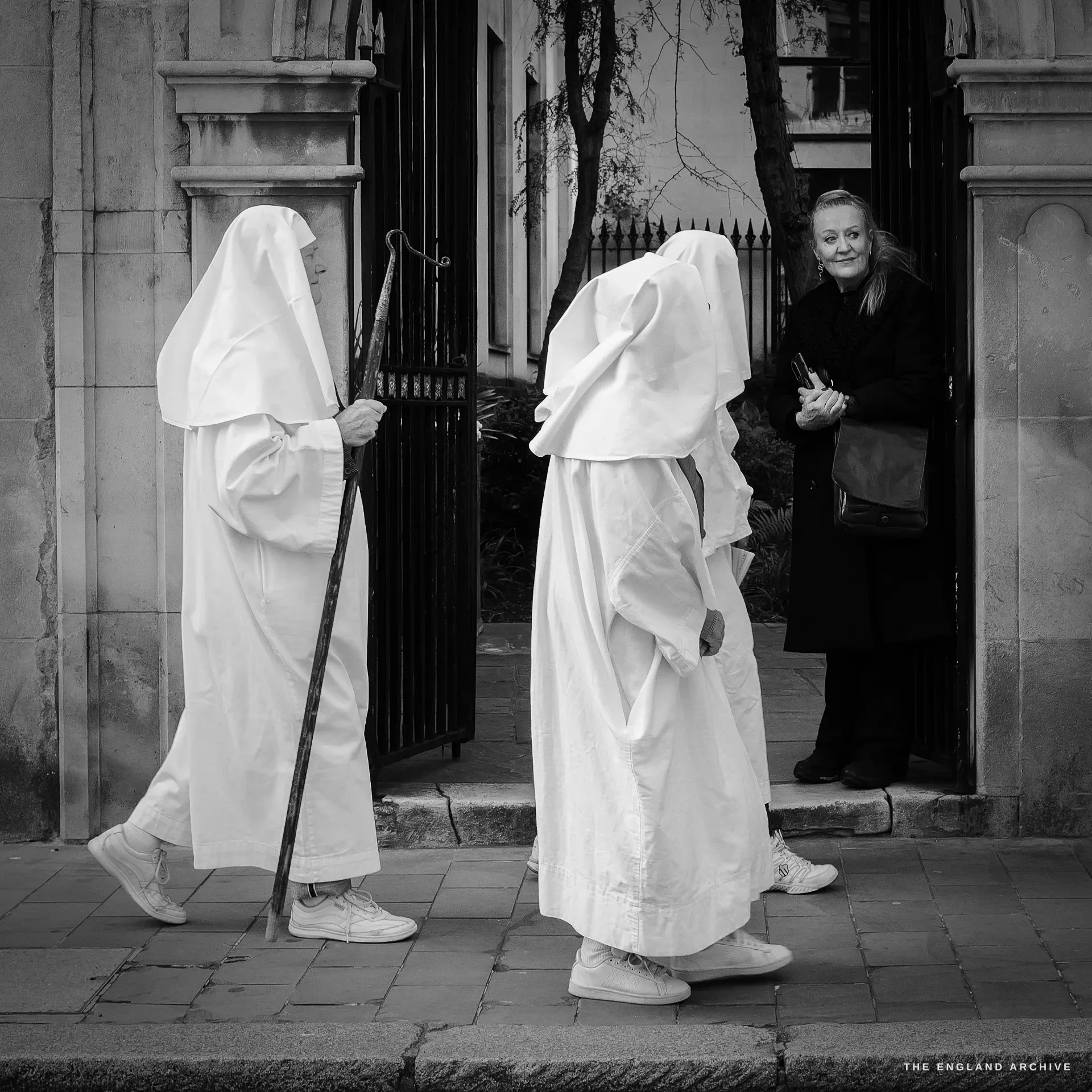
The line reforms for the closing approach. The banner at the centre. Floral crowns at the head. The basket of flowers carried in the front. The pamphlet of the rite carried in the rear. Through a black wrought-iron gate, the staff goes first.
Inside the Pub Afterwards
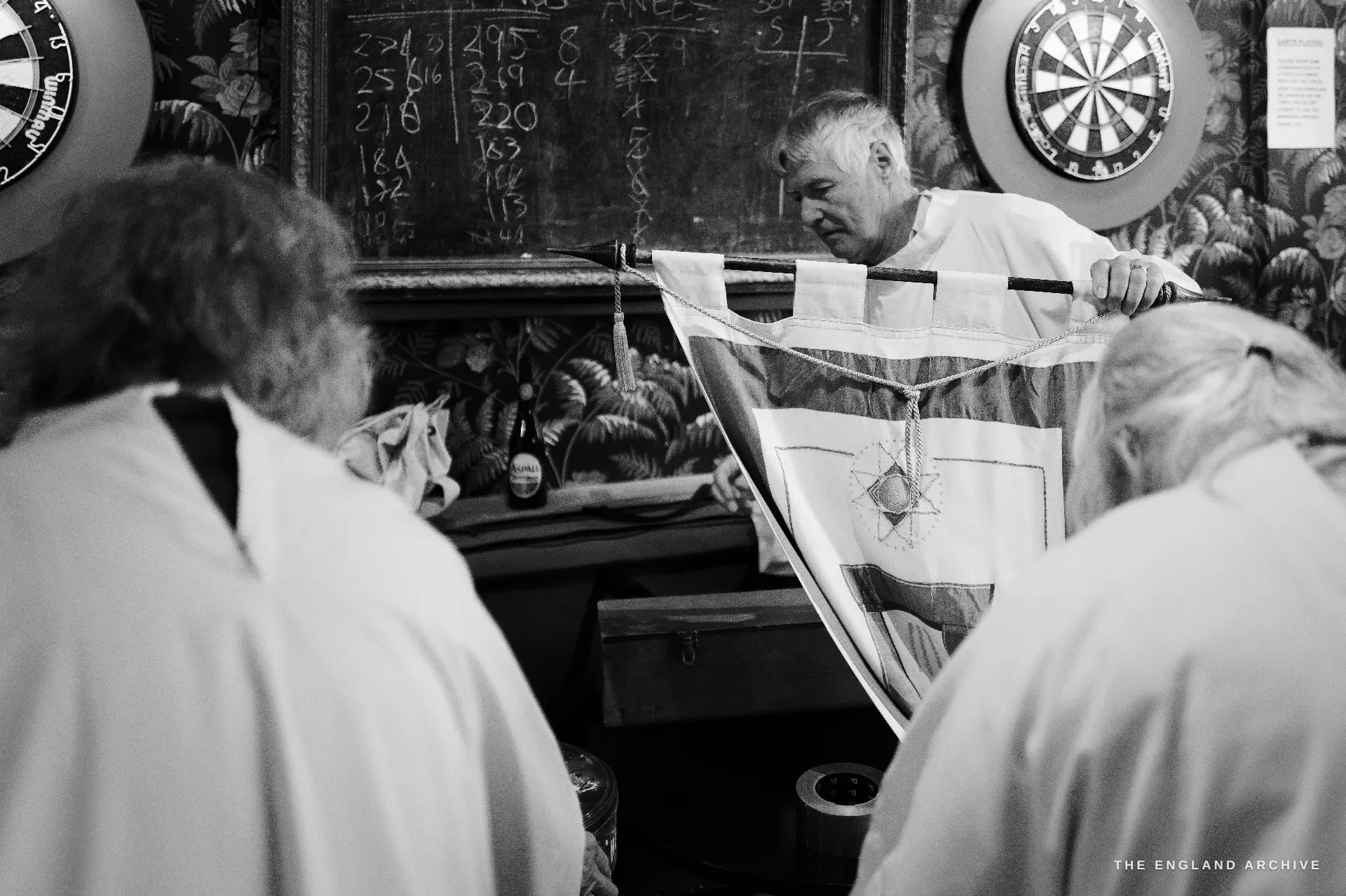
An hour later, the same fifteen figures are inside a London pub under the warm light of fairy bulbs and dart-board scoreboards. The Druid in robe and head-veil who carried the sword is laughing about something the publican said. Another senior member is holding up the Order’s embroidered ceremonial cloth - a hexagram and a cross over a tower - to show a fellow member who has not seen it before. People who were, an hour ago, performing a ritual that pre-dates Christianity, are now ordering pints and talking about the traffic.
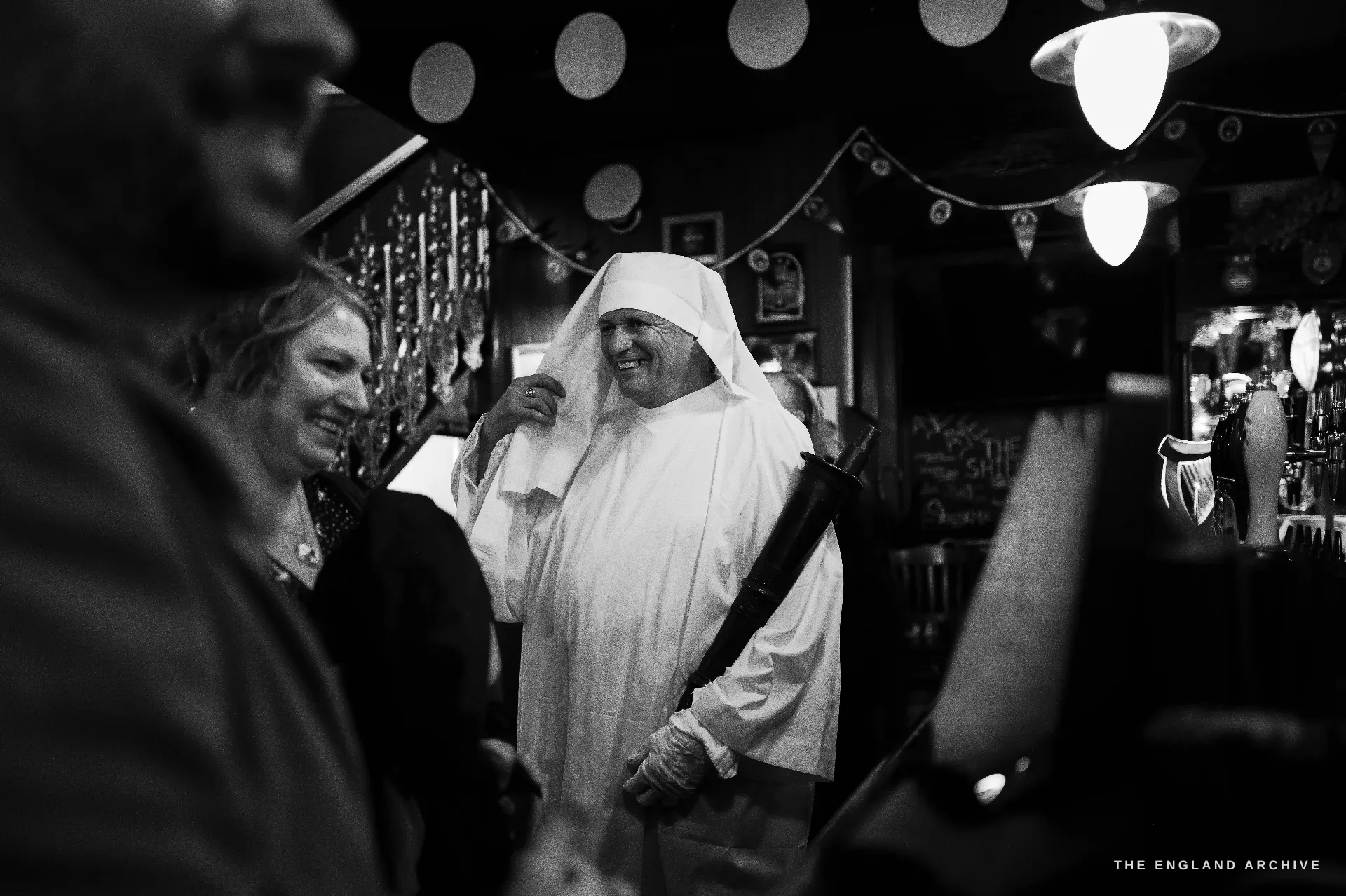
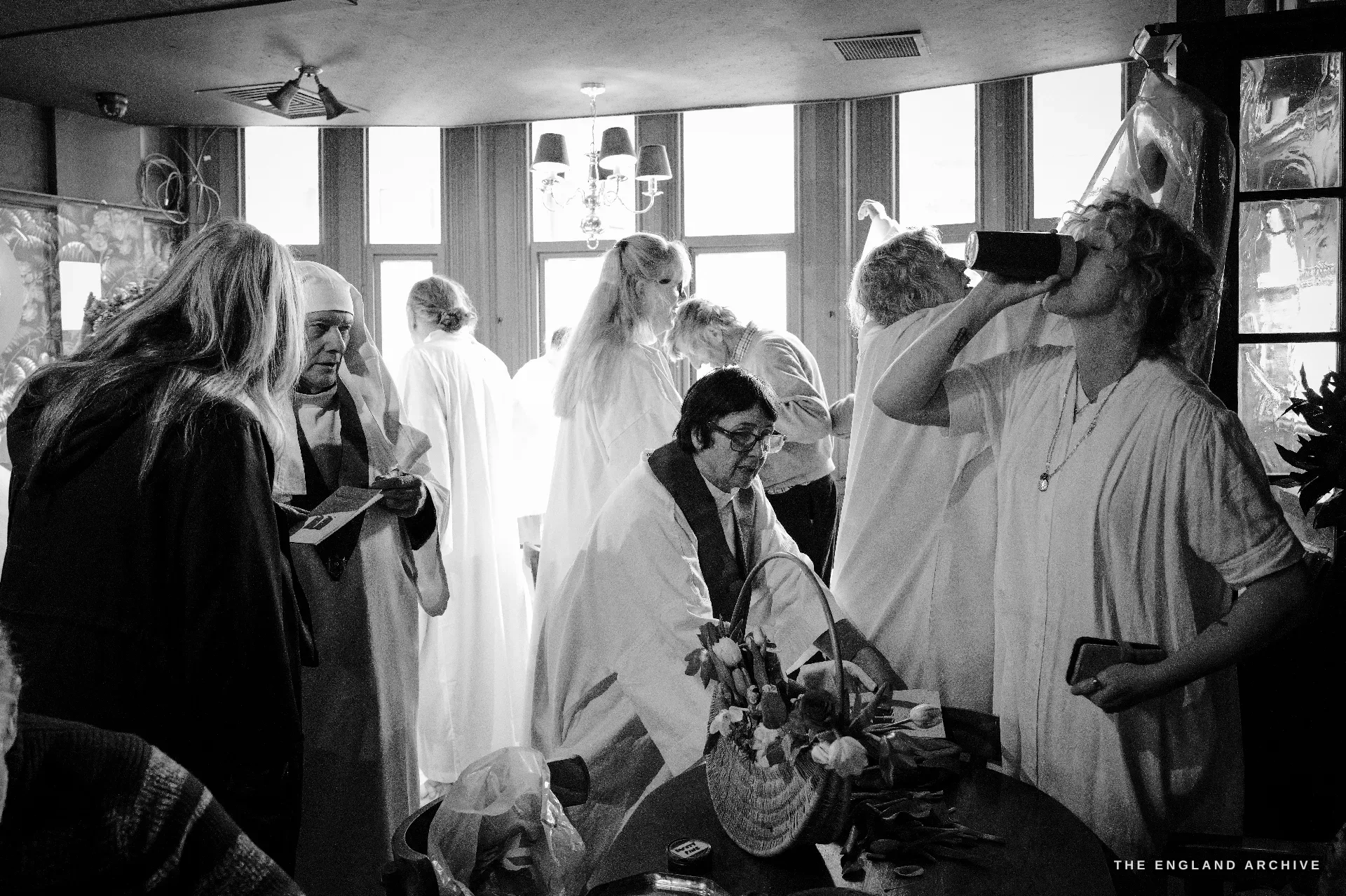
This is not a contradiction. This is how a living tradition actually works: the ceremony is real, the commitment is genuine, and the people who carry it are also people who have jobs and bus passes and opinions about the weather. The pub afterwards is as much a part of the event as the circle on the hill, because it shows you who these people are when the ceremony is not making them into something else.
The pub afterwards is as much a part of the event as the circle on the hill. It shows you who these people are when the ceremony is not making them into something else.
Why This Is a Carriers Subject
The Druid Order’s Spring Equinox ceremony fits the Carriers category precisely. It is date-locked: the equinox falls when it falls, and the ceremony happens on that day or not at all. It depends on the annual commitment of specific people: the Chief Druid who leads it, the standard bearers who carry the banners, the members who put on the robes and walk through the City in silence. If those people stopped showing up, the ceremony would end. Not next decade. Next March.
The ceremony is also publicly accessible, which makes it an important early subject for the archive. Unlike the Padstow Obby Oss or the inner workings of the Lewes bonfire societies, the Spring Equinox at Tower Hill is open to anyone who shows up at midday on the right day. The Order welcomes observers. This openness made it possible to document the event on a first visit, which is rare for a Carriers subject and valuable for establishing the archive’s visual language early in the project.
But the openness should not be mistaken for casualness. These are people who have made a commitment to be here, in these robes, on this hill, at this moment, year after year. That commitment is the tradition. The ceremony is the visible expression of it. The archive’s interest is in both - but especially in the people underneath the robes, the ones who will climb Tower Hill again next March, and the March after that, because they are the ones who carry it.
Field Notes
Access: Fully public. No accreditation required. Arrived 30 minutes early to position. The Order was welcoming and several members spoke briefly after the ceremony.
Light: Midday, March. Overcast skies provided even, diffused light - good for the white robes, which would have blown out in direct sun.
Key moments: The silent procession along Byward Street. The formation of the circle. The seed scattering. The transition to The Ship - the disrobing is the most human and the most telling sequence.
Follow-up: Request an introduction to the Chief Druid for a portrait sitting and longer conversation about the Order’s history and succession. The Autumn Equinox at Primrose Hill (September 2026) is the next ceremony to document.