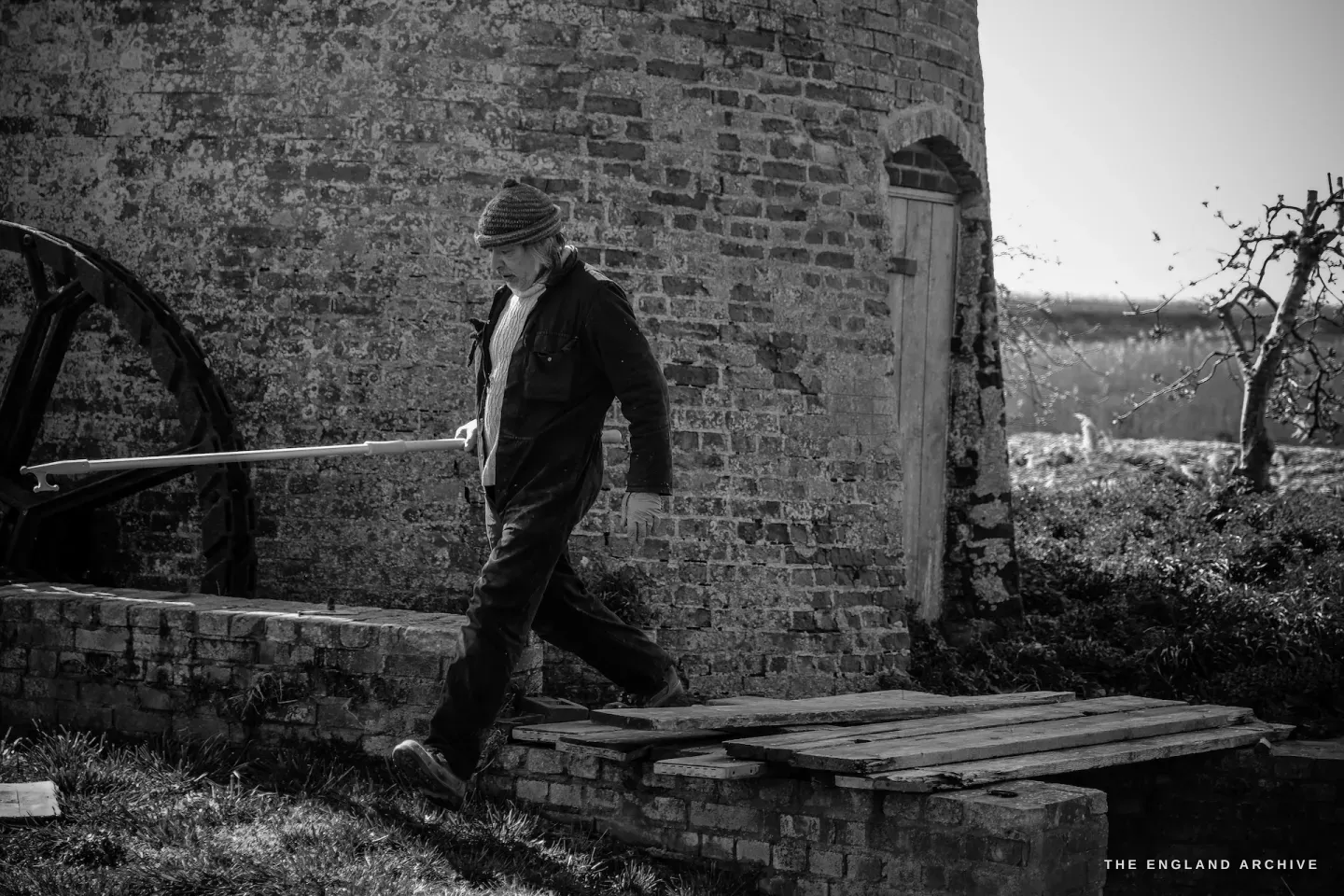
The road onto Haddiscoe Island is unmade and goes past two tall pylons before it bends right towards the bungalow. For maybe a mile you cannot see another building, only grazing land and sky, and then the mill comes into view on the left, standing against the kind of flat Norfolk light that makes everything look slightly older than it is. Bhavani and I parked in the layby and waited for Paul to arrive, because he needed to get his van in first. The van came, Paul came, and ten minutes later the archive had its first subject.
Paul Kemp is a working millwright. He has maintained and restored historic windmills across Norfolk and Suffolk for decades. The mill at Haddiscoe he still visits regularly, but the one that matters to this dispatch is Toft Monks, which we drove to next, and which has been fully refurbished over the last two years by a team of specialist craftspeople - Paul leading on the gearing and metalwork and getting the mill running, alongside fellow millwrights who produced the new timber elements, sails, and structural components. He mentioned his part in passing, without ceremony, the way another person might mention that a job took a long afternoon. Two years, he said, as if the measurement of time is simply what a serious piece of work requires.
I was shooting the whole time, alternating between the Leica and the Fujifilm, trying to hold both the man and the machine in the same frame, trying not to let the photography overtake the listening. It is a difficult balance on the first real day of a project like this. You want to keep the camera moving and you want to keep your attention on what is being said and you want both of those things to happen in the same hour. Towards the end of the session I put the small cameras down and brought out the Bronica. The pace changed. Fewer frames. More stillness. The square format demands that you slow down and I was glad of it by then, because the morning had been fast and full and the Bronica made me stop and look properly at what was in front of me.
What was in front of me was a man in his working life, doing work that almost nobody else in England can do, in a place that would fall into silence without the people who understand it. The mill at Toft Monks runs because craftspeople like Paul Kemp exist. That is not a small thing. He knows every timber in it, every joint, every tendency in different winds. That knowledge lives nowhere except in him and in the handful of people like him scattered across the county.
Then we drove to Richard.
Richard Seago I had contacted on Paul's recommendation, expecting a retired millwright who would talk to me about the old days. What we found, after a little difficulty locating the place, was a huge plot of farmland with a house at one end and, at the centre, a post mill I will not forget. White construction on top. Brick circular base below. And this: the sails of the mill sit on a wheeled track that runs in a full circle around the building, so the whole cap turns to face the wind on a groove I have never seen anywhere else. I stood in that field for a long time before I raised the camera.
Richard is not someone the original five categories of the archive could account for. He is not a Maker in the craft-for-customers sense - he built the post mill for himself, on his own land, at his own expense, over thirty years. He is not a Keeper of a public building. He is something the framework had not anticipated: a private person who decided, alone and without mandate, that certain things must not disappear, and who acted on that conviction with his own hands. On the drive home I realised the archive needed a sixth category. I am calling them Gatherers. Richard Seago is the reason that word exists.
One day, two millwrights, one of them still on the ladder and one of them in the garden with a mill nobody else has. The archive needs both of them. It probably needs a second visit to Richard before it needs anything else this year.
The archive has started. This is the first dispatch from the field and it will not be the last.
Update, 18 April: The following Saturday we drove to Long Melford and met Julie Thomson and Melonie Clubb of the Long Melford Historical and Archaeological Society. That visit opened the Rememberers category - the third strand activated in eight days. Full journal entry here.
Paul Kemp is a working millwright based in East Anglia. The refurbishment of Toft Monks Mill, led by Paul alongside a team of specialist craftspeople, is the kind of work the Makers strand exists to document.
Richard Seago is a retired millwright with an extraordinary post mill on his own land at South Walsham. His visit created the Gatherers category - the sixth strand of the archive.
Julie Thomson and Melonie Clubb are members of the Long Melford Historical and Archaeological Society. Their visit opened the Rememberers category.